

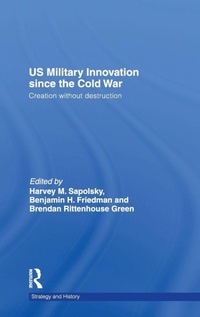
US Military Innovation since the Cold War
Creation Without Destruction
1st Edition
Published on 23. April 2009
Book
Hardback
224 pages
978-0-415-77791-9 (ISBN)
Description
This book explains how the US military reacted to the 'Revolution in Military Affairs' (RMA), and failed to innovate its organization or doctrine to match the technological breakthroughs it brought about.
Many called for the transformation of the US military in the years after the end of the Cold War, seeking the changes in organization and doctrine that would complete the RMA innovation and a commitment to counter-insurgency, peace keeping and nation building missions. This volume describes the origins, uses, and limits of the RMA technologies, examines how each of the five US armed services (categorising the Special Operations as a separate service) made their adjustments both to the technologies and the use of force, and how the role of the civilian officials and the defense industry altered in this process of change and avoidance of change.
The book examines the internal politics of the services as well as civil/military relations to identify the external pressures on the services for significant change in their doctrine and weapons. Many have noted the failure of the services to innovate in what can be called the 'Second Inter-war Period' (the years after the Cold War). This book offers explanations for this failure and arguments about the possible range and desirability of military innovation in the post-Cold war era.
This book will be of great interest to students of strategic studies, US defence politics, military studies, and US politics.
Harvey M. Sapolsky is Professor of Public Policy and Organization in the Department of Political Science at MIT and former Director of the Security Studies Program. Benjamin H. Friedman is a Research Fellow in Defense and Homeland Security Studies at the Cato Institute and a Ph.D. Candidate in Political Science at MIT. Brendan Green is a Ph.D. Candidate in Political Science at MIT and an affiliate of the Security Studies Program.
Many called for the transformation of the US military in the years after the end of the Cold War, seeking the changes in organization and doctrine that would complete the RMA innovation and a commitment to counter-insurgency, peace keeping and nation building missions. This volume describes the origins, uses, and limits of the RMA technologies, examines how each of the five US armed services (categorising the Special Operations as a separate service) made their adjustments both to the technologies and the use of force, and how the role of the civilian officials and the defense industry altered in this process of change and avoidance of change.
The book examines the internal politics of the services as well as civil/military relations to identify the external pressures on the services for significant change in their doctrine and weapons. Many have noted the failure of the services to innovate in what can be called the 'Second Inter-war Period' (the years after the Cold War). This book offers explanations for this failure and arguments about the possible range and desirability of military innovation in the post-Cold war era.
This book will be of great interest to students of strategic studies, US defence politics, military studies, and US politics.
Harvey M. Sapolsky is Professor of Public Policy and Organization in the Department of Political Science at MIT and former Director of the Security Studies Program. Benjamin H. Friedman is a Research Fellow in Defense and Homeland Security Studies at the Cato Institute and a Ph.D. Candidate in Political Science at MIT. Brendan Green is a Ph.D. Candidate in Political Science at MIT and an affiliate of the Security Studies Program.
More details
Series
Language
English
Place of publication
London
United Kingdom
Publishing group
Taylor & Francis Ltd
Target group
College/higher education
Professional and scholarly
Product notice
Paper over boards
Dimensions
Height: 240 mm
Width: 161 mm
Thickness: 17 mm
Weight
505 gr
ISBN-13
978-0-415-77791-9 (9780415777919)
Copyright in bibliographic data and cover images is held by Nielsen Book Services Limited or by the publishers or by their respective licensors: all rights reserved.
Schweitzer Classification
Other editions
Additional editions
Harvey Sapolsky | Benjamin Friedman | Brendan Green
US Military Innovation since the Cold War
Creation Without Destruction
Book
03/2012
1st Edition
Routledge
€78.80
Shipment within 15-20 days
Harvey Sapolsky | Benjamin Friedman | Brendan Green
US Military Innovation since the Cold War
Creation Without Destruction
E-Book
04/2009
Routledge
€72.49
Available for download
Harvey Sapolsky | Benjamin Friedman | Brendan Green
US Military Innovation since the Cold War
Creation Without Destruction
E-Book
04/2009
1st Edition
Routledge
€72.49
Available for download
Persons
Harvey M. Sapolsky is Professor of Public Policy and Organization in the Department of Political Science at MIT and former Director of the Security Studies Program. Benjamin H. Friedman is a Research Fellow in Defense and Homeland Security Studies at the Cato Institute and a PhD Candidate in Political Science at MIT. Brendan Rittenhouse Green is a PhD Candidate in Political Science at MIT and an affiliate of the Security Studies Program.
Content
1. The Missing Transformation Harvey M. Sapolsky, Benjamin H. Friedman, and Brendan Rittenhouse Green 2. The Technology of The Revolution in Military Affairs David Burbach, Brendan Rittenhouse Green, and Benjamin H. Friedman 3. From Conservation to Revolutionary Intoxication: The US Army and the Second Interwar Period Colin Jackson 4. The Navy After the Cold War: Progress Without Revolution Benjamin H. Friedman 5. Evolution in the Post-Cold War Air Force: Technology, Doctrine and Bureaucratic Politics Sanford L. Weiner 6. The Marine Corps: Sticking to its Guns Austin Long 7. The Fifth Service: The Rise of Special Operations Command Austin Long and Colin Jackson 8. Defense Strategy in the 1990s: Old Wine, New Bottles Robert R. Tomes 9. The RMA and the Defense Industry Eugene Gholz 10. The RMA and the Second Interwar Period Harvey M. Sapolsky, Benjamin H. Friedman, and Brendan Rittenhouse Green