

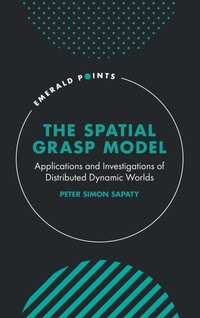
The Spatial Grasp Model
Applications and Investigations of Distributed Dynamic Worlds
Published on 30. January 2023
Book
Hardback
184 pages
978-1-80455-575-0 (ISBN)
Description
Born half a century ago, predating the internet and named WAVE in its infantry, the Spatial Grasp Model has been tested on numerous applications: graph and network theory, collective robotics, crisis management, security and defense, social systems, and space-based systems. The Spatial Grasp Model confirms the potential applicability of the developed paradigm, language, and technology for solving much broader classes of problems, especially those related to large and unknown worlds.
Presenting the main ideas of the Spatial Grasp paradigm and details of its key Spatial Grasp Language (SGL) - including its philosophy, methodology, syntax, semantics, and interpretation in distributed systems - Sapaty explores extended technological applications of the approach. Allowing us to evaluate large, distributed phenomena by their physical or virtual coverage, The Spatial Grasp Model suggests uses beyond the theoretical, including the examination of hurricanes and forest fires. Investigating group behaviour of ocean animals, discovery of unknown terrain features, and path-findings in large transport networks truly demonstrates the real-world application of SGL.
Applicable for high-level formulation of key problems and their solutions in the place of natural languages, The Spatial Grasp Model is crucial reading for researchers across multiple fields faced with developing global.
Presenting the main ideas of the Spatial Grasp paradigm and details of its key Spatial Grasp Language (SGL) - including its philosophy, methodology, syntax, semantics, and interpretation in distributed systems - Sapaty explores extended technological applications of the approach. Allowing us to evaluate large, distributed phenomena by their physical or virtual coverage, The Spatial Grasp Model suggests uses beyond the theoretical, including the examination of hurricanes and forest fires. Investigating group behaviour of ocean animals, discovery of unknown terrain features, and path-findings in large transport networks truly demonstrates the real-world application of SGL.
Applicable for high-level formulation of key problems and their solutions in the place of natural languages, The Spatial Grasp Model is crucial reading for researchers across multiple fields faced with developing global.
More details
Series
Language
English
Place of publication
Bingley
United Kingdom
Target group
Professional and scholarly
Dimensions
Height: 235 mm
Width: 157 mm
Thickness: 15 mm
Weight
426 gr
ISBN-13
978-1-80455-575-0 (9781804555750)
Copyright in bibliographic data and cover images is held by Nielsen Book Services Limited or by the publishers or by their respective licensors: all rights reserved.
Schweitzer Classification
Other editions
Additional editions
Peter Simon Sapaty
The Spatial Grasp Model
Applications and Investigations of Distributed Dynamic Worlds
E-Book
01/2023
1st Edition
Emerald Publishing Limited
€55.49
Available for download
Person
Peter Simon Sapaty is Chief Research Scientist at the Ukrainian Academy of Sciences, has worked with networked systems for five decades. Outside of Ukraine, he worked in the former Czechoslovakia (now Slovak Republic), Germany, the UK, Canada, and Japan as a group leader, Alexander von Humboldt researcher, and invited and visiting professor. He invented a distributed control technology that resulted in a European patent.
Content
Chapter 1. Introduction
Chapter 2. Investigating Terrestrial and Celestial Worlds
Chapter 3. Spatial Grasp Model and Technology Basics
Chapter 4. Spatial Grasp Language Basic Organization
Chapter 5. Mechanisms of SGL Distributed Implementation
Chapter 6. Distributed Worlds Vision and Comprehension in SGL
Chapter 7. Investigating Unknown Worlds in SGL
Chapter 8. SGL against Other Languages
Chapter 9. Relation of SGL to Higher Psychological and Mental Concepts
Chapter 10. Conclusions
Chapter 2. Investigating Terrestrial and Celestial Worlds
Chapter 3. Spatial Grasp Model and Technology Basics
Chapter 4. Spatial Grasp Language Basic Organization
Chapter 5. Mechanisms of SGL Distributed Implementation
Chapter 6. Distributed Worlds Vision and Comprehension in SGL
Chapter 7. Investigating Unknown Worlds in SGL
Chapter 8. SGL against Other Languages
Chapter 9. Relation of SGL to Higher Psychological and Mental Concepts
Chapter 10. Conclusions