

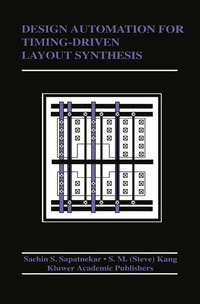
Design Automation for Timing-Driven Layout Synthesis
Published on 31. October 1992
Book
Hardback
XXI, 269 pages
978-0-7923-9281-1 (ISBN)
Description
Moore's law [Noy77], which predicted that the number of devices in tegrated on a chip would be doubled every two years, was accurate for a number of years. Only recently has the level of integration be gun to slow down somewhat due to the physical limits of integration technology. Advances in silicon technology have allowed Ie design ers to integrate more than a few million transistors on a chip; even a whole system of moderate complexity can now be implemented on a single chip. To keep pace with the increasing complexity in very large scale integrated (VLSI) circuits, the productivity of chip designers would have to increase at the same rate as the level of integration. Without such an increase in productivity, the design of complex systems might not be achievable within a reasonable time-frame. The rapidly increasing complexity of VLSI circuits has made de- 1 2 INTRODUCTION sign automation an absolute necessity, since the required increase in productivity can only be accomplished with the use of sophisticated design tools. Such tools also enable designers to perform trade-off analyses of different logic implementations and to make well-informed design decisions.
More details
Series
Edition
1993 ed.
Language
English
Place of publication
New York
United States
Target group
Professional and scholarly
Research
Product notice
sewn/stitched
Cloth over boards
Illustrations
XXI, 269 p.
Dimensions
Height: 241 mm
Width: 160 mm
Thickness: 21 mm
Weight
612 gr
ISBN-13
978-0-7923-9281-1 (9780792392811)
DOI
10.1007/978-1-4615-3178-4
Schweitzer Classification
Other editions
Additional editions
S. Sapatnekar | Sung-Mo (Steve) Kang
Design Automation for Timing-Driven Layout Synthesis
E-Book
12/2012
Springer
€149.79
Available for download
S. Sapatnekar | Sung-Mo (Steve) Kang
Design Automation for Timing-Driven Layout Synthesis
Book
10/2012
Springer
€160.49
Shipment within 7-9 days
Content
1 Introduction.- 1.1 The Process of IC Design.- 1.2 Layout Styles.- 1.3 Timing-driven Layout.- 1.4 Outline of the Book.- 2 Delay Estimation.- 2.1 Introduction.- 2.2 Micromodeling - The RC Model.- 2.3 Macromodeling.- 2.4 Worst-case Delay Estimation.- 2.5 Delay Calculation at the Circuit Level.- 2.6 Posynomial Delay Modeling.- 2.7 A Case Study: iCONTRAST's Timing Analyzer.- 2.8 Summary.- 3 Transistor Sizing Algorithms: Existing Approaches.- 3.1 Introduction.- 3.2 The TILOS Algorithm.- 3.3 The Method of Feasible Directions (MFD) Algorithm.- 3.4 Lagrangian Multiplier Approaches.- 3.5 Two-step Optimization.- 3.6 Other Approaches.- 3.7 Summary of Previous Approaches.- 4 A Convex Programming Approach to Transistor Sizing.- 4.1 Introduction.- 4.2 The Convex Programming Algorithm.- 4.3 Experimental Results.- 4.4 Summary.- 5 Global Routing Using Zero-one Integer Linear Programming.- 5.1 Introduction.- 5.2 Extracting Global Routing Information.- 5.3 Global Routing Phases.- 5.4 Global Routing on Medium-sized Arrays.- 5.5 Application to Custom Logic Layout.- 5.6 Handling Very Large Circuits.- 5.7 Runtime Complexity.- 5.8 Conclusion.- 6 Timing-driven CMOS Layout Synthesis.- 6.1 Introduction.- 6.2 A Methodology for Designing CMOS Standard Cells.- 6.3 The Metal-Metal Matrix (M3) Layout Style for Two level Technologies.- 6.4 iCGEN: A CMOS Layout Synthesis System for Three-level Metal Technology.