

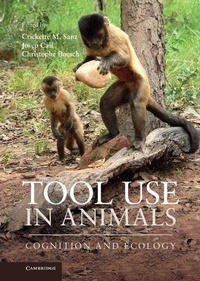
Tool Use in Animals
Cognition and Ecology
Published on 7. March 2013
Book
Hardback
324 pages
978-1-107-01119-9 (ISBN)
Description
The last decade has witnessed remarkable discoveries and advances in our understanding of the tool using behaviour of animals. Wild populations of capuchin monkeys have been observed to crack open nuts with stone tools, similar to the skills of chimpanzees and humans. Corvids have been observed to use and make tools that rival in complexity the behaviours exhibited by the great apes. Excavations of the nut cracking sites of chimpanzees have been dated to around 4-5 thousand years ago. Tool Use in Animals collates these and many more contributions by leading scholars in psychology, biology and anthropology, along with supplementary online materials, into a comprehensive assessment of the cognitive abilities and environmental forces shaping these behaviours in taxa as distantly related as primates and corvids.
Reviews / Votes
'Tool Use in Animals: Cognition and Ecology may well be the new benchmark text for animal cognition. This book is clear, well-written, suitably broad in its approach, and delivers information that covers a review of the field in addition to new data. Its appeal will encompass readers from various connected academic disciplines, and [it] is an appropriate text for professionals and for students. This is an important and timely offering, and a happy addition to my library.' Kerrie Lewis Graham, American Journal of Physical Anthropology 'During the half century since Jane Goodall first observed a chimpanzee fashioning and using a tool, there has been great interest and attention to defining, describing, and interpreting tool use among many animal phyla. Whereas some books have catalogued tool use, this volume investigates four behavioral domains - phylogenetic, functional, ontogenetic, and mechanistic ... Readers will gain perspective on the interaction of evolutionary and environmental factors shaping tool use behaviour, yet wonder why more animals do not use tools or make better use of them ... Highly recommended. Lower-division undergraduates and above; general readers.' J. Burger, ChoiceMore details
Language
English
Place of publication
Cambridge
United Kingdom
Target group
Professional and scholarly
Illustrations
7 Tables, black and white; 31 Halftones, unspecified; 21 Line drawings, unspecified
Dimensions
Height: 250 mm
Width: 175 mm
Thickness: 22 mm
Weight
740 gr
ISBN-13
978-1-107-01119-9 (9781107011199)
Copyright in bibliographic data and cover images is held by Nielsen Book Services Limited or by the publishers or by their respective licensors: all rights reserved.
Schweitzer Classification
Other editions
Additional editions
Book
03/2014
Cambridge University Press
€62.60
Shipment within 15-20 days
E-Book
03/2013
Cambridge University Press
€35.49
Available for download
E-Book
03/2013
Cambridge University Press
€41.49
Available for download

Book
Cambridge University Press
Unfortunately, price unknown
The article will not be published
Persons
Crickette Sanz is an Assistant Professor in Anthropology at Washington University, St Louis, where she teaches courses on primate behaviour and human evolution. She is one of the principal investigators of the Goualougo Triangle Ape Project, which focuses on studying and conserving sympatric central chimpanzee and western lowland gorilla populations. Josep Call is a comparative psychologist specialising in primate cognition at the Max Planck Institute for Evolutionary Anthropology. He is also the co-founder of the Wolfgang Kohler primate research centre and has an extensive back catalogue of works including 3 books and nearly 200 peer-reviewed articles. Christophe Boesch is Director of the Max Planck Institute of Evolutionary Anthropology's primatology department. His work covers many areas of chimpanzee biology which he has used to further understanding of the evolution of cognitive and cultural abilities in humans. He is also the founder and president of the Wild Chimpanzee Foundation.
Content
List of contributors; Part I. Cognition of Tool Use: 1. Three ingredients for becoming a creative tool-user J. Call; 2. Ecology and cognition of tool use in chimpanzees C. Boesch; 3. Chimpanzees plan their tool use R. W. Byrne, C. M. Sanz and D. B. Morgan; Part II. Comparative Cognition: 4. Insight, imagination and invention: tool understanding in a non-tool-using corvid N. Emery; 5. Why is tool use rare in animals? G. Hunt, R. Gray and A. Taylor; 6. Understanding differences in the way human and non-human primates represent tools: the role of teleological-intentional information A. M. Ruiz and L. R. Santos; 7. Why do woodpecker finches use tools? S. Tebbich and I. Teschke; Part III. Ecology and Culture: 8. The social context of chimpanzee tool use C. M. Sanz and D. B. Morgan; 9. Orangutan tool use and the evolution of technology E. J. M. Meulman and C. P. van Schaik; 10. The EthoCebus project: stone tool use by wild capuchin monkeys E. Visalberghi and D. Fragaszy; Part IV. Archaeological Perspectives: 11. From pounding to knapping: how chimpanzees can help us model hominin lithics S. Carvalho, T. Matsuzawa and W. C. McGrew; 12. Early hominin social learning strategies underlying the use and production of bone and stone tools M. Caruana, F. d'Errico and L. Backwell; 13. Perspectives on stone tools and cognition in the early paleolithic record S. P. McPherron; Index.