

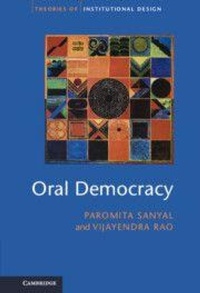
Oral Democracy
Deliberation in Indian Village Assemblies
Published on 20. December 2018
Book
Hardback
224 pages
978-1-107-01974-4 (ISBN)
Description
Oral Democracy studies citizens' voices in civic and political deliberations in India's gram sabhas (village assemblies), the largest deliberative institution in human history. It analyses nearly three hundred transcripts of gram sabhas, sampled within the framework of a natural experiment, allowing the authors to study how state policy affects the quality of discourse, citizens' discursive performances and state enactments embodied by elected leaders and public officials. By drawing out the varieties of speech apparent in citizen and state interactions, their analysis shows that citizens' oral participation in development and governance can be improved by strengthening deliberative spaces through policy. Even in conditions of high inequality and illiteracy, gram sabhas can create discursive equality by developing the 'oral competence' of citizens and establishing a space in which they can articulate their interests. The authors develop the concept of 'oral democracy' to aid the understanding of deliberative systems in non-Western and developing countries. This title is also available as Open Access.
Reviews / Votes
'Using a detailed analysis of gram sabha deliberations in over two hundred villages bordering four states, this book provides a rich picture of participatory grassroots democracy in South India. Instead of the usual preoccupation with quantitative indicators of service delivery outcomes, Rao and Sanyal focus on development of civic capacity, engagement between civil society and state officials, and political legitimacy of the state, and how these vary with historical inequality, literacy and state policy.' Dilip Mookherjee, Director of the Institute for Economic Development, Boston University 'This valuable book documents the diverse voices from the ground that form the body and soul of everyday democracy in action. It serves as a crucial reminder to urban readers that the the real crucible of Indian democracy is not the quinquennial Election Day, but the messy, contested terrain of gram sabhas, where citizens ask questions, demand answers, and help make decision-making responsive and reflexive.' Ashwini Deshpande, Delhi School of Economics 'In Oral Democracy, Sanyal and Rao engage in a detailed comparative analysis to illuminate how local state capacity and literacy influence the extent to which an institutionalized system of public collective deliberation (gram sabhas) contributes to the transformation of the practice of citizenship in contemporary India. This rigorous analysis produces a pathbreaking contribution to our understanding of political culture outside the West. Their book should be widely read by social scientists who wish to better understand the broad institutional context in which the poor defend their dignity in an extraordinarily unequal society.' Michele Lamont, Director of the Weatherhead Center for International Affairs, Harvard University and author of The Dignity of Working menMore details
Series
Language
English
Place of publication
Cambridge
United Kingdom
Target group
Professional and scholarly
Product notice
sewn/stitched
Cloth over boards
Illustrations
Worked examples or Exercises
Dimensions
Height: 234 mm
Width: 162 mm
Thickness: 18 mm
Weight
454 gr
ISBN-13
978-1-107-01974-4 (9781107019744)
Copyright in bibliographic data and cover images is held by Nielsen Book Services Limited or by the publishers or by their respective licensors: all rights reserved.
Schweitzer Classification
Other editions
Additional editions
E-Book
01/2019
Cambridge University Press
€88.99
Available for download
E-Book
12/2018
Cambridge University Press
€73.99
Available for download
Persons
Paromita Sanyal is an Associate Professor in the Department of Sociology at Florida State University. She has written Credit to Capabilities: A Sociological Study of Microcredit Groups in India (Cambridge, 2014), which won an Outstanding Book Award from the American Sociological Association. Her work has also been published in leading sociology journals, including the American Sociological Review. Vijayendra Rao is Lead Economist in the Development Economics Research Group at The World Bank. He co-edited Culture and Public Action (2004), and co-authored Localizing Development: Does Participation Work? (2012). He has published in the leading journals in economics and development studies, and he is a member of the Successful Societies Program at the Canadian Institute for Advanced Research.
Content
1. Introduction; 2. Discursive political culture; 3. Political construction, state enactments, and citizen performances; 4. The role of literacy in deliberative democracy; 5. Conclusion: oral democracy.