

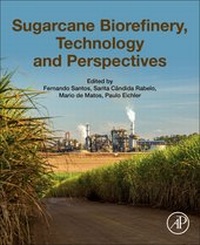
Sugarcane Biorefinery, Technology and Perspectives
Published on 22. November 2019
Book
Paperback/Softback
304 pages
978-0-12-814236-3 (ISBN)
Description
Sugarcane Biorefinery, Technology and Perspectives provides the reader with a current view of the global scenario of sugarcane biorefinery, launching a new expectation on this important crop from a chemical, energy and sustainability point-of-view. The book explores the existing biorefinery platforms that can be used to convert sugarcane to new high value added products. It also addresses one of today's most controversial issues involving energy cane, in addition to the dilemma "sugar cane vs. food vs. the environment", adding even more value in a culture that is already a symbol of case study around the world.
Focusing on the chemical composition of sugarcane, and the production and processes that optimize it for either agricultural or energy use, the book is designed to provide practical insights for current application and inspire the further exploration of options for balancing food and fuel demands.
Focusing on the chemical composition of sugarcane, and the production and processes that optimize it for either agricultural or energy use, the book is designed to provide practical insights for current application and inspire the further exploration of options for balancing food and fuel demands.
More details
Language
English
Place of publication
San Diego
United States
Publishing group
Elsevier Science Publishing Co Inc
Target group
Professional and scholarly
Researchers, undergraduate and graduate students, professionals from the sugarcane and chemical industry, as well as people interested in the subject of sugarcane biorefinery.
Dimensions
Height: 229 mm
Width: 152 mm
Weight
570 gr
ISBN-13
978-0-12-814236-3 (9780128142363)
Copyright in bibliographic data and cover images is held by Nielsen Book Services Limited or by the publishers or by their respective licensors: all rights reserved.
Schweitzer Classification
Other editions
Additional editions
Fernando Santos | Sarita Rabelo | Mario de Matos
Sugarcane Biorefinery, Technology and Perspectives
E-Book
11/2019
Academic Press
€131.00
Available for download
Persons
Prof. Dr. Fernando Santos - Post-doctorate in Bioenergy by the Faculty of Sciences and Technology of the New University of Lisbon; Post-doctorate in Forestry Engineering by the Federal University of Vicosa; PhD in Agricultural Biochemistry, Federal University of Vicosa; Master in Phytotechnology, Federal University of Vicosa; Agricultural Engineer from the State University of Montes Claros. Adjunct Professor of the State University of Rio Grande do Sul. Coordinator of the Research Group CESBIO - Center for Studies in Biorefinery. Advisor and co-advisor of undergraduate and graduate students. Integrates the Editorial Board of the Brazilian Journal of Biomass and Energy, Editorial Board of the Journal of Technological Studies in Engineering. Chief Editor of BSS Magazine - Biorefinery Sustainable Solutions. Founder of companies BSS - Biorefinery Sustainable Solutions and 3S - Solar Sustainable Solutions. Editor of several books published on biomass and biorefinery. Many publications in scientific journals and periodicals, some of them being awarded prizes. Ad hoc reviewer of journals and scientific projects. Has experience in the area of engineering, agricultural production system, biomass, agricultural biochemistry, biorefinery and elaboration and management of projects for fundraising. Sarita Candida Rabelo is an assistant professor at the College of Agricultural Sciences at Sao Paulo State University (UNESP), Botucatu Campus, Brazil. She holds a M.Sc. (2007) and PhD (2010) in Chemical Engineering from the University of Campinas (UNICAMP), Brazil, with a sandwich PhD period at National Institute of Agronomic Research (INRA), France. She conducted her postdoctoral research at Lund University, Sweden. She was a researcher (2010-2018) and coordinator of the Process Division (2016-2018) at the Brazilian Bioethanol Science and Technology Laboratory (CTBE/CNPEM), Brazil. Her research focuses on the studies of lignocellulosic biomass processing to production of biofuels and high value-added renewable chemicals. Mario de Matos has over 40 years of experience as an agriculturist involved in low- and high-input agricultural development systems worldwide. He has researched in over 40 countries with specialists of private consulting firms such as Africa Global Schaffer and with public international institutions including USAID, EU, and IFDC. His experience includes the sugar industry by-products, crop processing added value, agroforestry development, and Out Growers Cooperatives and Associations developments in a multitude of social, technical, and cultural environments. Dr. de Matos received his bachelor's degree in agricultural sciences in 1975 from Escola Superior Agraria, at Vila Pery, Mozambique and is a member of the American Society of Sugar Cane Technologists - Louisiana Division, Australian Institute of Agricultural Sciences, South African Sugar Technologists Association, Associacao Portuguesa de Ciencias Agrarias, Sociedade de Geografia de Lisboa, and Soils Sciences Society of Nigeria. He was awarded the Portuguese Diaspora Diploma in 2009 Paolo Eichler is a consultant for biorefinery, bioenergy, and residue treatment projects and is completing a PhD in materials engineering and technology at Pontifical Catholic University of Rio Grande do Sul. He has participated in several interchange programs including researching at the Centre for Plant and Water Science at Central Queensland University and the Science Without Borders program at the University of Hull. He is a member of the Center for Studies in Biorefinery (CESBIO) and an ad hoc reviewer of journals and scientific projects.
Editor
Universidade Estadual do Rio Grande Do Sul, Porto Alegre, RS, Brazil
College of Agricultural Sciences, Sao Paulo State University (UNESP), Botucatu Campus, Botucatu, SP, Brazil
Senior Associate, Schaffer / Africaglobal
Pontifical Catholic University of Rio Grande do Sul, Porto Alegre, RS, Brazil
Content
1. Sugarcane World Scenario
2. Byproducts of the Sugarcane Industry
3. Sugarcane Straw: Recovery and Logistics
4. Sugarcane: Food Production, Energy and Environment
5. Sustainability of Sugarcane for Energy Purposes
6. Energy Cane Breeding
7. Energy from Sugarcane
8. Chemical and Energy Potential of Sugarcane
9. Sugarcane for Renewable Chemistry
10. Use of Sugarcane Vinasse to Biogas, Bioenergy and Biofertilizer Production
11. Production of Second-Generation Ethanol from Sugarcane
12. Biopolymers of Sugarcane
13. Bioelectricity of Sugarcane: A Case Study from Brazil and Perspectives
2. Byproducts of the Sugarcane Industry
3. Sugarcane Straw: Recovery and Logistics
4. Sugarcane: Food Production, Energy and Environment
5. Sustainability of Sugarcane for Energy Purposes
6. Energy Cane Breeding
7. Energy from Sugarcane
8. Chemical and Energy Potential of Sugarcane
9. Sugarcane for Renewable Chemistry
10. Use of Sugarcane Vinasse to Biogas, Bioenergy and Biofertilizer Production
11. Production of Second-Generation Ethanol from Sugarcane
12. Biopolymers of Sugarcane
13. Bioelectricity of Sugarcane: A Case Study from Brazil and Perspectives