

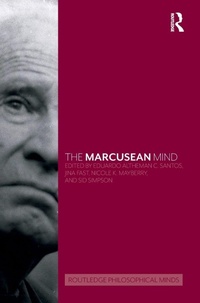
The Marcusean Mind
1st Edition
Published on 29. October 2024
Book
Hardback
556 pages
978-1-032-46299-8 (ISBN)
Description
Herbert Marcuse (1898-1979) was a member of the Frankfurt School, a leading figure of 1960s counterculture, and a fundamental character for the New Left. His ideas and theories, inspired by a rich fusion of Marxian and Freudian thought, exert a strong influence on contemporary thinking about activism, emancipation, and political resistance. He was also a student of Martin Heidegger in the late 1920s and engaged deeply with philosophy throughout his career.
The Marcusean Mind is an outstanding survey and assessment of Marcuse's thought. Beginning with a thorough introduction to Marcuse's life and work, 39 chapters by an international and interdisciplinary team of contributors are organized into five clear parts:
Intellectual Ecosystems of Marcuse
Reason and Sensibilities
Futures and Utopias
Contemporary Movements
Counterrevolutions, Neoliberalism, and Fascism
These sections each contain a short introduction, after which Marcusean ideas are brought to bear on many key contemporary debates and issues across the humanities, social sciences, and science and technology.
Including a Foreword by Craig Calhoun and an Afterword by Douglas Kellner, The Marcusean Mind is a superb resource for anyone interested in Marcuse's thought and its legacy. It is valuable reading for students of contemporary political theory, activism, philosophy, sociology, media and cultural studies, critical legal studies, and race and gender studies.
The Marcusean Mind is an outstanding survey and assessment of Marcuse's thought. Beginning with a thorough introduction to Marcuse's life and work, 39 chapters by an international and interdisciplinary team of contributors are organized into five clear parts:
Intellectual Ecosystems of Marcuse
Reason and Sensibilities
Futures and Utopias
Contemporary Movements
Counterrevolutions, Neoliberalism, and Fascism
These sections each contain a short introduction, after which Marcusean ideas are brought to bear on many key contemporary debates and issues across the humanities, social sciences, and science and technology.
Including a Foreword by Craig Calhoun and an Afterword by Douglas Kellner, The Marcusean Mind is a superb resource for anyone interested in Marcuse's thought and its legacy. It is valuable reading for students of contemporary political theory, activism, philosophy, sociology, media and cultural studies, critical legal studies, and race and gender studies.
More details
Series
Language
English
Place of publication
London
United Kingdom
Publishing group
Taylor & Francis Ltd
Target group
College/higher education
Postgraduate and Undergraduate Advanced
Illustrations
1 s/w Abbildung, 1 s/w Zeichnung, 1 s/w Tabelle
1 Tables, black and white; 1 Line drawings, black and white; 1 Illustrations, black and white
Dimensions
Height: 250 mm
Width: 175 mm
Thickness: 37 mm
Weight
1203 gr
ISBN-13
978-1-032-46299-8 (9781032462998)
Copyright in bibliographic data and cover images is held by Nielsen Book Services Limited or by the publishers or by their respective licensors: all rights reserved.
Schweitzer Classification
Other editions
Additional editions
Eduardo Altheman C. Santos | Jina Fast | Nicole K. Mayberry
The Marcusean Mind
Book
approx. 07/2026
1st Edition
Routledge
€63.50
Not yet published
Eduardo Altheman C. Santos | Jina Fast | Nicole K. Mayberry
The Marcusean Mind
E-Book
10/2024
1st Edition
Routledge
€68.49
Available for download
Eduardo Altheman C. Santos | Jina Fast | Nicole K. Mayberry
The Marcusean Mind
E-Book
10/2024
1st Edition
Routledge
€68.49
Available for download
Persons
Eduardo Altheman C. Santos is a post-doctoral fellow in sociology at the University of Sao Paulo, Brazil.
Jina Fast is the SHIFT Professor of Applied Ethics and the Common Good at Hampshire College in Amherst, USA.
Nicole K. Mayberry is Assistant Research Professor in the School of Public Affairs at Arizona State University, USA.
Sid Simpson is Assistant Professor of Politics at The University of the South in Sewanee, USA.
Jina Fast is the SHIFT Professor of Applied Ethics and the Common Good at Hampshire College in Amherst, USA.
Nicole K. Mayberry is Assistant Research Professor in the School of Public Affairs at Arizona State University, USA.
Sid Simpson is Assistant Professor of Politics at The University of the South in Sewanee, USA.
Content
Foreword Craig Calhoun Introduction Eduardo Altheman C. Santos, Jina Fast, Nicole K. Mayberry, and Sid Simpson Part 1: Intellectual Ecosystems of Marcuse Introduction to Part 1: Critical Constellations: Herbert Marcuse and his Intellectual Ecosystem Sid Simpson 1. What is Immanent Critique? Marcuse's Critical Theory of Society Jeta Mulaj 2. Leo Loewenthal - Herbert Marcuse: Friendship and Critical Thought as Concrete Utopia Peter-Erwin Jansen and Inka Engel (Translated from German to English by Eduardo Altheman C. Santos) 3. Angela Y. Davis: From Icon to Critical Theorist Rashad Shabazz 4. Marcuse, the American Robert Kirsch 5. Marcuse's Critique of Technology Today Andrew Feenberg 6. Herbert Marcuse and the Post-Colonial: Missed Connections with Frantz Fanon, Sylvia Wynter, and Aime Cesaire Sid Simpson 7. Reflecting on Lelia Gonzalez and Herbert Marcuse Stefan Klein 8. Marcuse, Feminism, and Intersectionality Jina Fast Part 2: Reason and Sensibilities Introduction to Part 2: A Revolution of Reason Nicole K. Mayberry and Sid Simpson 9. Marcusean Readings of Immanuel Kant's Philosophy Juliano Bonamigo Ferreira de Souza 10. Surplus-Aggression and Happy Consciousness: Marcuse and Hegel on the Second Nature of Advanced Industrial Society Wes Furlotte 11. Dialectics of Domination and Eros: Herbert Marcuse and the Critique of Technological Rationality Sid Simpson 12. Marcuse's Emancipatory Model and His Critics Maria Clara Togeiro 13. Herbert Marcuse and the West German Student Movement Meike Gerber, Emanuel Kapfinger, and Julian Volz 14. Herbert Marcuse and the Aesthetic Dimension of Popular Music Cristina Parapar 15. Capitalism and Aesthetic Socialism at the Time of Climate Breakdown Luca Mandara Part 3: Futures and Utopias Introduction to Part 3: What Can the Future Be? Jina Fast 16. Marcuse and Utopian Possibilities Emre Cetin Guerer 17. Built for Reason or Rationality? Marcuse and Artificial Intelligence Margath Walker 18. Exploring Marcusean Feminist Utopian Possibilities: The Gendered Impact of Technological Rationality Nuzhat Khurshid 19. Ursula Le Guin's Always Coming Home as Marcusean Art Javier Sethness 20. Marcuse's Catastrophe of Liberation for the Anthropocene Jonathon Catlin 21. Marcuse and Temptations of a Post-Work Imaginary Kenneth Roesen and Alexander Kurunczi Part 4: Contemporary Movements Introduction to Part 4: Contemporary Movements: Ruptures in the Establishment Nicole K. Mayberry and Jina Fast 22. Spatializing One Dimensionality and Roe V. Wade Nicole K. Mayberry 23. Beyond the Performance Principle: Marcuse and the Modern Work Ethic Caroline Nielson and Christophe Premat 24. Marcuse's Refusal of Capitalism Sergio Bedoya-Cortes and German Aristizabal Jara 25. Extinction Rebellion: A Great Refusal for the Anthropocene Rory Varrato 26. Marcuse and Fromm Maor Levitin 27. Law and Order: Rethinking Marcuse's Legacy for Abolitionist Politics Lucien Ferguson 28. Reforms and Revolution: Implications of Germany's Last Generation Rene Buennagel 29. Progress for Whom? Herbert Marcuse and Popular Feminism in Brazil Isabel Loureiro Part 5: Counterrevolutions, Neo-Liberalism, and Fascism Introduction to Part 5: An Era of Counterrevolutions Eduardo Altheman C. Santos 30. Global Counterrevolution as Uneven Fascist Development Tyler James Olsen and Robinson Torres-Salinas 31. Fascism Now and Then - Herbert Marcuse's Legacies for the Critique of Far-Right Authoritarianism Eduardo Altheman C. Santos 32. Herbert Marcuse and the Dialectics of Liberation in the Age of Trump John Abromeit 33. Repressive Tolerance Jina Fast 34. Revisiting Marcuse on Repressive Tolerance: A Twenty-First Century Retrospective David Ingram 35. What Marcuse Strikes Back Against - and For Terry Maley 36. False Needs and Artificial Intelligence Matthew Lucky 37. Herbert Marcuse and America's Cultural Revolution Craig Calhoun 38. 21st Century One-dimensionality: Big Tech-nological Rationality, Digital Culture Industry, and Platform Postmodernity Bruna Della Torre 39. From Advanced Industrial Society to Neoliberalism: The Dialectics of Integration and Disintegration Eduardo Altheman C. Santos Afterword: The Global Marcuse Douglas Kellner. Index