

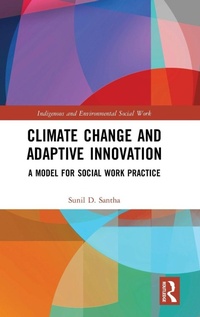
Climate Change and Adaptive Innovation
A Model for Social Work Practice
1st Edition
Published on 15. April 2020
Book
Hardback
188 pages
978-0-367-19555-7 (ISBN)
Description
The world is witnessing climate change. As responsible citizens of planet earth, we can actively participate in the co-creation of actionable knowledge and solutions. There may not be a single and linear pathway to adaptation anymore. This book explores multiple and iterative pathways of adapting to climate change and its impacts.
Climate Change and Adaptive Innovation introduces an adaptive innovation model that has its premise on core values of justice, care and solidarity. Navigating collectively through shared conversations and dialogic processes, this model showcases how we could embark on an enduring journey where diverse actors could collaboratively make informed choices and take necessary actions to enhance the safety and security of their lived environment. Rooted in action research, it is envisaged that this model could enable us to facilitate the designing and implementation of people-centred ethical adaptation projects.
This book will be of interest to social workers, social scientists and development practitioners who are engaged in the field of climate justice, adaptation, social innovation and sustainable livelihoods. Social work educators and students will certainly draw inspiration from the stories that are shared in this book. It will further motivate many transdisciplinary professionals to engage with action research as a method of innovation, reflection and practice
Climate Change and Adaptive Innovation introduces an adaptive innovation model that has its premise on core values of justice, care and solidarity. Navigating collectively through shared conversations and dialogic processes, this model showcases how we could embark on an enduring journey where diverse actors could collaboratively make informed choices and take necessary actions to enhance the safety and security of their lived environment. Rooted in action research, it is envisaged that this model could enable us to facilitate the designing and implementation of people-centred ethical adaptation projects.
This book will be of interest to social workers, social scientists and development practitioners who are engaged in the field of climate justice, adaptation, social innovation and sustainable livelihoods. Social work educators and students will certainly draw inspiration from the stories that are shared in this book. It will further motivate many transdisciplinary professionals to engage with action research as a method of innovation, reflection and practice
More details
Series
Language
English
Place of publication
London
United Kingdom
Publishing group
Taylor & Francis Ltd
Target group
College/higher education
Illustrations
6 s/w Abbildungen, 6 s/w Zeichnungen
6 Line drawings, black and white; 6 Illustrations, black and white
Dimensions
Height: 240 mm
Width: 161 mm
Thickness: 16 mm
Weight
473 gr
ISBN-13
978-0-367-19555-7 (9780367195557)
Copyright in bibliographic data and cover images is held by Nielsen Book Services Limited or by the publishers or by their respective licensors: all rights reserved.
Schweitzer Classification
Other editions
Additional editions
Book
06/2022
1st Edition
Routledge
€63.00
Shipment within 10-20 days
E-Book
03/2020
1st Edition
Routledge
€55.49
Available for download
E-Book
03/2020
1st Edition
Routledge
€55.49
Available for download
Person
Sunil D. Santha is presently working at the Centre for Livelihoods and Social Innovation, School of Social Work, TISS, India. He has associated with natural resource dependent communities for several years. As an expert in Environmental Social Work, supplemented by his interests in Sociology of Knowledge and Systems Thinking, he has keen interests in the field of environmental risks, climate justice and sustainable development. He believes in action research and reflective practice as creative pathways to design participatory models of social innovation and emergent livelihoods.
Content
List of figures. Stories from the Field. Acknowledgements. List of abbreviations. 1. Introduction. 2. Locating Climate Change Adaptation. 3. The Landscape of Adaptive Innovation. 4. Ethical Adaptation to Climate Change. 5. Adaptive Innovation Phases. 6. Methods of Inquiry and Practice. 7. Actor Interface Analysis and Reflective Practice. 8. Concluding Reflections. Glossary. Index.