

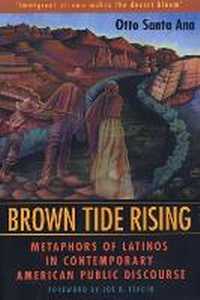
Brown Tide Rising
Metaphors of Latinos in Contemporary American Public Discourse
Published on 1. July 2002
Book
Paperback/Softback
424 pages
978-0-292-77767-5 (ISBN)
Description
2002 - Best Book on Ethnic and Racial Political Ideology and/or Political Theory - Organized Section on Race, Ethnicity, and Politics of the American Political Science Association
"...awash under a brown tide...the relentless flow of immigrants..like waves on a beach, these human flows are remaking the face of America...." Since 1993, metaphorical language such as this has permeated mainstream media reporting on the United States' growing Latino population. In this groundbreaking book, Otto Santa Ana argues that far from being mere figures of speech, such metaphors produce and sustain negative public perceptions of the Latino community and its place in American society, precluding the view that Latinos are vested with the same rights and privileges as other citizens.
Applying the insights of cognitive metaphor theory to an extensive natural language data set drawn from hundreds of articles in the Los Angeles Times and other media, Santa Ana reveals how metaphorical language portrays Latinos as invaders, outsiders, burdens, parasites, diseases, animals, and weeds. He convincingly demonstrates that three anti-Latino referenda passed in California because of such imagery, particularly the infamous anti-immigrant measure, Proposition 187. Santa Ana illustrates how Proposition 209 organizers broadcast compelling new metaphors about racism to persuade an electorate that had previously supported affirmative action to ban it. He also shows how Proposition 227 supporters used antiquated metaphors for learning, school, and language to blame Latino children's speech-rather than gross structural inequity-for their schools' failure to educate them. Santa Ana concludes by calling for the creation of insurgent metaphors to contest oppressive U.S. public discourse about minority communities.
"...awash under a brown tide...the relentless flow of immigrants..like waves on a beach, these human flows are remaking the face of America...." Since 1993, metaphorical language such as this has permeated mainstream media reporting on the United States' growing Latino population. In this groundbreaking book, Otto Santa Ana argues that far from being mere figures of speech, such metaphors produce and sustain negative public perceptions of the Latino community and its place in American society, precluding the view that Latinos are vested with the same rights and privileges as other citizens.
Applying the insights of cognitive metaphor theory to an extensive natural language data set drawn from hundreds of articles in the Los Angeles Times and other media, Santa Ana reveals how metaphorical language portrays Latinos as invaders, outsiders, burdens, parasites, diseases, animals, and weeds. He convincingly demonstrates that three anti-Latino referenda passed in California because of such imagery, particularly the infamous anti-immigrant measure, Proposition 187. Santa Ana illustrates how Proposition 209 organizers broadcast compelling new metaphors about racism to persuade an electorate that had previously supported affirmative action to ban it. He also shows how Proposition 227 supporters used antiquated metaphors for learning, school, and language to blame Latino children's speech-rather than gross structural inequity-for their schools' failure to educate them. Santa Ana concludes by calling for the creation of insurgent metaphors to contest oppressive U.S. public discourse about minority communities.
Reviews / Votes
"This is a highly significant contribution to scholarship in several fields - sociology, sociolinguistics, cultural studies, political studies, ethnic studies... The combination of lucid and rational theory, rich data set, and carefully reasoned analysis results in an unusually powerful book." Ronald Schmidt Sr., author of Language Policy and Identity Politics in the United StatesMore details
Language
English
Place of publication
Austin, TX
United States
Target group
Professional and scholarly
Product notice
Paperback (trade)
Dimensions
Height: 229 mm
Width: 152 mm
Thickness: 30 mm
Weight
594 gr
ISBN-13
978-0-292-77767-5 (9780292777675)
Copyright in bibliographic data and cover images is held by Nielsen Book Services Limited or by the publishers or by their respective licensors: all rights reserved.
Schweitzer Classification
Person
Otto Santa Ana is a founder and professor of the Cesar Chavez Center for Chicana and Chicano Studies at UCLA.
Content
Foreword by Joe R. Feagin
Preface
Acknowledgments
Chapter One: Why Study the Public Discourse Metaphors Depicting Latinos?
Part I: Theory and Method
Chapter Two: How Metaphor Shapes Public Opinion
Part II: Analyses
Chapter Three: Proposition 187: Misrepresenting Immigrants and Immigration
Chapter Four: Proposition 209: Competing Metaphors to Construct Racism and Affirmative Action
Chapter Five: Student as Means, Not End: Contemporary American Discourse on Education
Chapter Six: American Discourse on Nation and Language: The "English for the Children" Referendum
Part III: Conclusions
Chapter Seven: Disease or Intruder: Metaphors Constructing the Place of Latinos in the United States
Chapter Eight: Insurgent Metaphors: Contesting the Conventional Representations of Latinos
Appendix: Tallies of Political Metaphors
Notes
References
Index
Preface
Acknowledgments
Chapter One: Why Study the Public Discourse Metaphors Depicting Latinos?
Part I: Theory and Method
Chapter Two: How Metaphor Shapes Public Opinion
Part II: Analyses
Chapter Three: Proposition 187: Misrepresenting Immigrants and Immigration
Chapter Four: Proposition 209: Competing Metaphors to Construct Racism and Affirmative Action
Chapter Five: Student as Means, Not End: Contemporary American Discourse on Education
Chapter Six: American Discourse on Nation and Language: The "English for the Children" Referendum
Part III: Conclusions
Chapter Seven: Disease or Intruder: Metaphors Constructing the Place of Latinos in the United States
Chapter Eight: Insurgent Metaphors: Contesting the Conventional Representations of Latinos
Appendix: Tallies of Political Metaphors
Notes
References
Index