

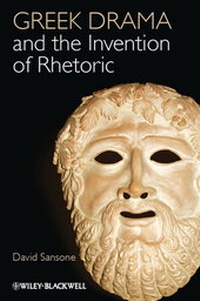
Greek Drama and the Invention of Rhetoric
Published on 3. August 2012
Book
Hardback
272 pages
978-1-118-35708-8 (ISBN)
Description
* Asserts a novel and controversial theory on the origins of rhetoric that differs radically from the standard view
* Argues that it was the theatre of Ancient Greece, first appearing around 500 BC, that prompted
* the development of formalized rhetoric, which evolved soon thereafter
* Provides a cogent reworking of existing evidence
* Reveals the bias and inconsistency of Aristotle
Reviews / Votes
"Every reader, both novice and expert, will learn a great deal from this insightful and refreshing study." (Vorlagen und Nachrichten, 1 November 2014) "The book is lively and readable, and should be read by everyone interested either in tragedy or in the origins of rhetoric." (Bryn Mawr Classical Review, 16 June 2013) "Sansone considers a wide range of text and offers a valuable discussion of how many features of formal rhetoric may be traced back to drama and earlier literary genres." (Anglo-Hellenic Review, 1 March 2013) "The book is elegantly and often wittily written, with a wide range of cultural reference, and can strongly be recommended to anyone interested in the drama of any period." (Rogueclassicism, 26 February 2013)More details
Product info
gebunden
Edition
1. Auflage
Language
English
Place of publication
Hoboken
United Kingdom
Publishing group
John Wiley and Sons Ltd
Target group
College/higher education
Dimensions
Height: 23.2 cm
Width: 16 cm
Thickness: 1.8 cm
Weight
508 gr
ISBN-13
978-1-118-35708-8 (9781118357088)
Schweitzer Classification
Other editions
Additional editions
David Sansone
Greek Drama and the Invention of Rhetoric
E-Book
11/2012
Wiley-Blackwell
€100.99
Available for download
David Sansone
Greek Drama and the Invention of Rhetoric
E-Book
07/2012
Wiley-Blackwell
€100.99
Available for download
Person
David Sansone is Professor Emeritus of Classics at the University of Illinois. A former editor of the journal Illinois Classical Studies, he has also served on the editorial boards of Classical Philology and Bryn Mawr Classical Review, and been a member of the Board of Directors of the American Philological Association. He is the author of Greek Athletics and the Genesis of Sport (1988), Plutarch: Lives of Aristeides and Cato (1989) and Ancient Greek Civilization (Wiley-Blackwell, 2009).
Content
Preface
Part One: What Drama Does and How It Does It
1. Setting the Stage
2. Seeing is Believing
3. The Muse Takes a Holiday
4. "It's counterpoint," he countered, and pointed.
5. Illusion and Collusion
6. Reaction Time
Part Two: The Second Stage: The Invention of Rhetoric
7. Paradigm Shift Happens
8. Perhaps You Will Object
9. Putting the Accuser on Trial
Works Cited