

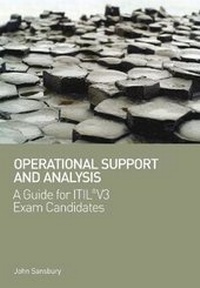
Operational Support and Analysis
A Guide for ITIL (R) V3 Exam Candidates
Published on 4. January 2011
Book
Paperback/Softback
160 pages
978-1-906124-59-5 (ISBN)
Description
This user-friendly book aims to assist candidates pass the ITIL (R) OSA Intermediate examination. It not only references the source material from the core ITIL texts but also gives practical guidance based on real life. Exam candidates no longer have to rely just on their memory and revision, but are able to draw on their understanding of the material and thereby significantly increase their chance of success in both the examination and the adoption of the principles in their professional life. An ITIL (R) Licensed Product.
Reviews / Votes
John has produced a well-balanced publication which provides comprehensive syllabus coverage of the ITIL (R) V3 Intermediate examination in Operational Support and Analysis, whilst also adding significant value around describing 'real world' good practice in this area. Thus he has created an excellent aid to preparation for those seeking success in the examination together with a superb reference manual, to complement the existing ITIL guidance, for those already practising 'in the field'. -- P H P Montanaro FBCS CITP FISMMore details
Language
English
Place of publication
Swindon
United Kingdom
Publishing group
BCS Learning & Development Limited
Target group
Professional and scholarly
Dimensions
Height: 246 mm
Width: 172 mm
Thickness: 12 mm
Weight
295 gr
ISBN-13
978-1-906124-59-5 (9781906124595)
Copyright in bibliographic data and cover images is held by Nielsen Book Services Limited or by the publishers or by their respective licensors: all rights reserved.
Schweitzer Classification
Other editions
New editions
Book
04/2014
2nd Edition
BCS, The Chartered Institute for IT
€57.13
Article is exhausted; no reprint
Person
John Sansbury is a Senior ITIL Examiner, a Fellow of the BCS and the Institute of Service Management. He has shunned the technical aspects of IT, largely because he finds them boring. Instead, he has excelled at helping organisations deliver business value from IT. As a practitioner, John learnt his trade with Philips and London Electricity.
Content
INTRODUCTION
SECTION 1: INTRODUCTION
1 The concept of service management as a practice
2 The concept of service, its value proposition and composition
3 The functions and proceses across the lifecycle
4 The role of processes in the service lifecycle
5 How service management creates business value
6 How operational support and analysis supports the service lifecycle
SECTION 2: THE OSA PROCESSES AND FUNCTIONS
7 Event management
8 Incident management
9 Request fulfilment
10 Problem management
11 Access management
12 The service desk
13 The OSA functions
14 Technology and implementation considerations
15 Common service activities
SECTION 3: PASSING THE OSA EXAMINATION
16 What you are expected to know
17 Making the most of the training
18 The format of the examination
APPENDICES
A1 Operational support and analysis syllabus
A2 Sample questions
A3 The generic use of metrics to check and improve efficiency and effectiveness
A4 Generic challenges, critical success factors and risks
SECTION 1: INTRODUCTION
1 The concept of service management as a practice
2 The concept of service, its value proposition and composition
3 The functions and proceses across the lifecycle
4 The role of processes in the service lifecycle
5 How service management creates business value
6 How operational support and analysis supports the service lifecycle
SECTION 2: THE OSA PROCESSES AND FUNCTIONS
7 Event management
8 Incident management
9 Request fulfilment
10 Problem management
11 Access management
12 The service desk
13 The OSA functions
14 Technology and implementation considerations
15 Common service activities
SECTION 3: PASSING THE OSA EXAMINATION
16 What you are expected to know
17 Making the most of the training
18 The format of the examination
APPENDICES
A1 Operational support and analysis syllabus
A2 Sample questions
A3 The generic use of metrics to check and improve efficiency and effectiveness
A4 Generic challenges, critical success factors and risks