

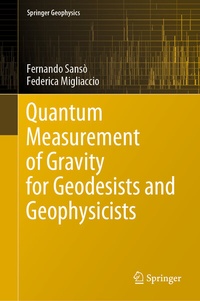
Quantum Measurement of Gravity for Geodesists and Geophysicists
Published on 10. March 2020
Book
Hardback
VIII, 133 pages
978-3-030-42837-2 (ISBN)
Description
During the last thirty years a great advancement in low energy physics, particularly interactions of atoms with the electromagnetic field, has been achieved and the development of electronics and laser techniques has allowed to implement a fine manipulation of atoms with photons. A wealth of important applications has sprung out from the ability of manipulating large samples of cold atoms. Among them, the improvement of atomic clocks and the creation of atomic gyroscopes and of atomic gravity meters, which is obviously of great interest for geodesists and geophysicists, particularly for potential applications in satellite geodesy.
This book explains the fundamental concepts necessary to understand atom manipulation by photons, including the principles of quantum mechanics. It is conceived as a road that leads the reader from classical physics (mechanics and electromagnetism, considered as a common scientific background of geodesists and geophysicists), tothe basics of quantum mechanics in order to understand the dynamics of atoms falling in the gravity field, while interacting with suitably resonant laser beams. There are different types of measurements of gravity based on the manipulation of ultra-cold atoms; the book presents the principles of the instruments based on stimulated Raman transition, which can be easily worked out analytically. However, the concepts explained in the text can provide a good starting point to understand also the applications based on the so-called Block oscillations or on the Bose-Einstein condensation.
This book explains the fundamental concepts necessary to understand atom manipulation by photons, including the principles of quantum mechanics. It is conceived as a road that leads the reader from classical physics (mechanics and electromagnetism, considered as a common scientific background of geodesists and geophysicists), tothe basics of quantum mechanics in order to understand the dynamics of atoms falling in the gravity field, while interacting with suitably resonant laser beams. There are different types of measurements of gravity based on the manipulation of ultra-cold atoms; the book presents the principles of the instruments based on stimulated Raman transition, which can be easily worked out analytically. However, the concepts explained in the text can provide a good starting point to understand also the applications based on the so-called Block oscillations or on the Bose-Einstein condensation.
More details
Series
Edition
2020 ed.
Language
English
Place of publication
Cham
Switzerland
Publishing group
Springer International Publishing
Target group
Professional and scholarly
Illustrations
18 s/w Abbildungen
VIII, 133 p. 18 illus.
Dimensions
Height: 241 mm
Width: 160 mm
Thickness: 14 mm
Weight
389 gr
ISBN-13
978-3-030-42837-2 (9783030428372)
DOI
10.1007/978-3-030-42838-9
Schweitzer Classification
Other editions
Additional editions
Fernando Sansò | Federica Migliaccio
Quantum Measurement of Gravity for Geodesists and Geophysicists
Book
03/2021
Springer
€139.09
Shipment within 7-9 days
Fernando Sansò | Federica Migliaccio
Quantum Measurement of Gravity for Geodesists and Geophysicists
E-Book
03/2020
1st Edition
Springer
€128.39
Available for download
Persons
Fernando Sansò is professor emeritus at the Polytechnic University of Milan and a Honorary President of the International Association of Geoscience (IAG). He established the International Geoid Service in 1992 and served as its President until 2011. He is a full member of the Accademia dei Lincei, a fellow of the Royal Astronomical Society (UK), and the president of Geomatics and Research Development (GReD), which he founded in 2012. His research areas include gravity field modelling, boundary value problems, statistics, generalized random fields, and GNSS theory.
Sansò has received numerous accolades, including the Bomford Prize for Geodesy in 1979 and the Feltrinelli Award for Astronomy, Geodesy, Geophysics, and Applications in 1986. He holds honorary doctorates from the University of Copenhagen, the University of Thessaloniki, and the University of Stuttgart. Throughout his career, he has (co)-authored over 500 works.
Alberta Albertella is Associate Professor of Geodesy at Politecnico di Milano. She earned her Ph.D in Geodetic, Surveying, and Photogrammetric Sciences from the Politecnico of Turin, Italy, in 1993. She has conducted extensive research in satellite geodesy, specializing in satellite gradiometry and gravity field determination. She contributed to multiple European and Italian satellite missions,. From 2005 to 2012, she was a research partner in the German project GEOTOP, which focused on ocean circulation using geodetic observations. Her expertise includes statistical and numerical data analysis for physical geodesy, geoid estimation, Bayesian methods, and remote sensing. She has also worked on digital mapping, GIS applications, and contributed to Citizen Science projects.
Content
1 Recalls of classical mechanics.- 2 Recalls of the classical theory of the electromagnetic ?eld.- 3 The crisis of classical physics and the dawn of quantum physics.- 4 The principles of quantum mechanics.- 5 First applications of quantum theory.- 6 The quantum measurement of gravity.