

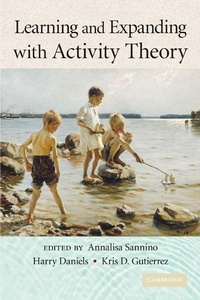
Learning and Expanding with Activity Theory
Published on 17. August 2009
Book
Paperback/Softback
390 pages
978-0-521-75810-9 (ISBN)
Description
This book is a collection about cultural-historical activity theory as it has been developed and applied by Yrjoe Engestroem. The work of Engestroem is both rooted in the legacy of Vygotsky and Leont'ev and focuses on current research concerns that are related to learning and development in work practices. His publications cross various disciplines and develop intermediate theoretical tools to deal with empirical questions. In this volume, Engestroem's work is used as a springboard to reflect on the question of the use, appropriation, and further development of the classic heritage within activity theory. The book is structured as a discussion among senior scholars, including Y. Engestroem himself. The work of the authors pushes on classical activity theory to address pressing issues and critical contradictions in local practices and larger social systems.
Reviews / Votes
"This is a fine collection of papers on activity theory produced by internationally renowned scholars. The book provides a comprehensive overview of one of the most important focal points of activity theory, namely the relationship between theory and practice. It offers valuable insights from many perspectives and discusses the many issues that derive from grappling with this relationship. I would not hesitate to recommend this book to students, colleagues, and practitioners."- Bente Elkjaer, University of Aarhus, Denmark "A superb collection of varied, important research focused on the possibilities for transforming human cognition, institutions, schools, workplaces and communities. This provocative work is grounded within the frameworks for the analysis of how ongoing practice within consequential activity transforms human social life developed by one of our most important contemporary social theorists: Yrjoe Engestroem. It offers a powerful alternative to views of cognition that focus on the individual, to our contemporary ways of theorizing learning and education, and a wonderful place to enter an important dialog on how humans as social creatures transform the social, cognitive and material worlds they inhabit through practice, a dialog that began with the work of Vygotsky, Luria and Leont'ev."
- Charles Goodwin, University of California at Los Angeles "A celebratory yet probing consideration of the work of one the best known cultural-historical activity theorists in the world, Yrjoe Engestroem, this edited volume sets a direction for debates in the field. At the same time, it extends Engestroem's analytic uses of activity theory as reflexive means for changing work practices. The editors skillfully highlight decisive points of theoretical progress and of practical advance."
- Dorothy Holland, University of North Carolina at Chapel Hill "Humanity develops primarily through cultural evolution, the ultra-fast process by which knowledge and tools are accumulated and handed over from generation to generation. One of the most important mechanisms of this process is the constitution and development of activity systems that organize people's actions in relation to shared objects. This book is a homage to Yrjoe Engestroem, the leading theoretician of learning as a vehicle of, and a vehicle for, cultural evolution. It is written by his best and closest intellectual partners. In the world according to Engestroem, people transform themselves by transforming the activity systems which their acts are a part of. You may or may not subscribe to such a deeply materialistic view, but without finding out what happens at one of its hottest frontiers, the field of contemporary research on learning will remain closed to you. This book is actually your key to it."
- Ference Marton, University of Gothenburg, Sweden
More details
Language
English
Place of publication
Cambridge
United Kingdom
Target group
Professional and scholarly
College/higher education
Product notice
Paperback (trade)
Illustrations
3 Tables, unspecified; 8 Halftones, unspecified; 20 Line drawings, unspecified
Dimensions
Height: 229 mm
Width: 152 mm
Thickness: 21 mm
Weight
563 gr
ISBN-13
978-0-521-75810-9 (9780521758109)
Copyright in bibliographic data and cover images is held by Nielsen Book Services Limited or by the publishers or by their respective licensors: all rights reserved.
Schweitzer Classification
Other editions
Additional editions
Annalisa Sannino | Harry Daniels | Kris D. Gutierrez
Learning and Expanding with Activity Theory
E-Book
11/2009
1st Edition
Cambridge University Press
€35.49
Available for download
Annalisa Sannino | Harry Daniels | Kris D. Gutierrez
Learning and Expanding with Activity Theory
Book
08/2009
Cambridge University Press
€96.20
Shipment within 15-20 days
Persons
Annalisa Sannino is University Lecturer in the Department of Education at the University of Helsinki in Finland. She completed her PhD in psychology at the University of Nancy in France and worked as researcher in the Department of Education at the University of Salerno in Italy. Her research is focused on discourse, experiencing, and learning in interventions in educational institutions and work organizations. She has published research articles in refereed journals in English, French, and Italian. Harry Daniels is Professor of Education, Culture, and Pedagogy and Director of the Centre for Sociocultural and Activity Theory Research at the University of Bath, UK. From 2002 to 2005 he has been Editor of the international journal Mind, Culture, and Activity. His research interests include sociocultural and activity theory, innovative learning in the workplace, special needs and social exclusion, and patient and career information seeking. In 2001, he published the book Vygotsky and Pedagogy, which has subsequently been translated into several languages. Kris Gutierrez is Professor of Social Research Methodology at the University of California, Los Angeles. Her current research interests include the study of the sociocultural contexts of literacy for language minority students. Her research also focuses on understanding the relationship between language, culture, development, and pedagogies of empowerment. In 2005, Gutierrez received the Sylvia Scribner Award of the American Educational Research Association.
Content
1. Activity theory between historical engagement and future-making practice Annalisa Sannino, Harry Daniels and Kris Gutierrez; Part I. Units of Analysis: 2. Cultural-historical activity theory and organization studies Frank Blackler; 3. Uses of activity theory in written communication and research David R. Russell; 4. On the inclusion of emotions, identity, and ethico-moral dimensions of actions Wolff-Michael Roth; Part II. Mediation and Discourse: 5. Mediation as a means of changing collective activity Vladislav A. Lektorsky; 6. Digital technology and mediation: a challenge to activity theory Georg Rueckriem; 7. Contextualizing social dilemmas in institutional practices: negotiating objects of activity in labour market organizations Asa Maekitalo and Roger Saeljoe; Part III. Expansive Learning and Development: 8. The concept of development in cultural-historical activity theory: vertical and horizontal Michael Cole and Natalia Gajdamashko; 9. Two theories of organizational knowledge and creation Jaakko Virkkunen; 10. Contradictions of high technology capitalism and the emergence of new forms of work Reijo Miettinen; 11. Spinozic re-considerations on the concept of activity: politico-affective process and discursive practice in the transitive learning Shuta Kagawa and Yuji Moro; Part IV. Subjectivity, Agency, and Community: 12. From the systemic to the relational: relational agency and activity theory Anne Edwards; 13. Expansive agency in multi-activity collaboration Katsuhiro Yamazumi; 14. The communicative construction of community: authority and organizing James R. Taylor; 15. Research leadership: productive research communities and the integration of research fellows Sten Ludvigsen and Turi Owre Digernes; Part V. Interventions: 16. Who is acting in an activity system Ritva Engestroem; 17. Past experiences and recent challenges in participatory design research Susanne Bodker; 18. Clinic of activity: the dialogue as instrument Yves Clot; 19. Epilogue: the future of activity theory Yrjoe Engestroem.