

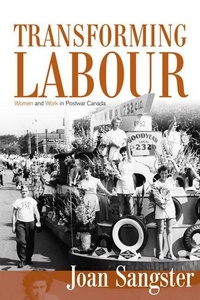
Transforming Labour
Women and Work in Postwar Canada
Will be published approx. on 22. May 2010
Book
Paperback/Softback
416 pages
978-0-8020-9652-4 (ISBN)
Description
The increased participation of women in the labour force was one of the most significant changes to Canadian social life during the quarter century after the close of the Second World War. Transforming Labour offers one of the first critical assessments of women's paid labour in this era, a period when more and more women, particularly those with families, were going 'out to work'.
Using case studies from across Canada, Joan Sangster explores a range of themes, including women's experiences within unions, Aboriginal women's changing patterns of work, and the challenges faced by immigrant women. By charting women's own efforts to ameliorate their work lives as well as factors that re-shaped the labour force, Sangster challenges the commonplace perception of this era as one of conformity, domesticity for women, and feminist inactivity. Working women's collective grievances fuelled their desire for change, culminating in challenges to the status quo in the 1960s, when they voiced their discontent, calling for a new world of work and better opportunities for themselves and their daughters.
Using case studies from across Canada, Joan Sangster explores a range of themes, including women's experiences within unions, Aboriginal women's changing patterns of work, and the challenges faced by immigrant women. By charting women's own efforts to ameliorate their work lives as well as factors that re-shaped the labour force, Sangster challenges the commonplace perception of this era as one of conformity, domesticity for women, and feminist inactivity. Working women's collective grievances fuelled their desire for change, culminating in challenges to the status quo in the 1960s, when they voiced their discontent, calling for a new world of work and better opportunities for themselves and their daughters.
Reviews / Votes
'Sangster's book is a welcome addition to the growing body of research on women's work and family lives in the three decades after the Second World War...It is refreshing to find a book that still sees working women as historical subjects rather than as abstract constructs.'- June Hannam , Labour/le Travail, vol68: 2011
More details
Language
English
Place of publication
Toronto
Canada
Target group
College/higher education
Professional and scholarly
Product notice
Paperback (trade)
Illustrations
12 illustrations
Dimensions
Height: 226 mm
Width: 150 mm
Thickness: 28 mm
Weight
635 gr
ISBN-13
978-0-8020-9652-4 (9780802096524)
Copyright in bibliographic data and cover images is held by Nielsen Book Services Limited or by the publishers or by their respective licensors: all rights reserved.
Schweitzer Classification
Person
Joan Sangster is a Vanier Professor Emeritus at Trent University.
Content
Table of Contents
Acknowledgements
Introduction
Chapter 1: Representations and Realities: The Shifting Boundaries of Women's Work
Chapter 2: Gender, Ethnicity, and Immigrant Women in Postwar-Canada: The Dionne Textile Workers
Chapter 3: Women and the Canadian Labour Movement during the Cold War
Chapter 4: 'Souriez Pour les Clients': Retail Work, Dupuis Freres, and Union Protest
Chapter 5: Discipline and Grieve: Gendering the Fordist Accord
Chapter 6: Aboriginal Women and Work in Prairie Communities
Chapter 7: Tackling the "Problem": of the Woman Worker: The Labour Movement, Working Women and the Royal Commission on the Status of Women
Conclusion: Putting Contradictions in Context
Notes
Bibliography
Index
Acknowledgements
Introduction
Chapter 1: Representations and Realities: The Shifting Boundaries of Women's Work
Chapter 2: Gender, Ethnicity, and Immigrant Women in Postwar-Canada: The Dionne Textile Workers
Chapter 3: Women and the Canadian Labour Movement during the Cold War
Chapter 4: 'Souriez Pour les Clients': Retail Work, Dupuis Freres, and Union Protest
Chapter 5: Discipline and Grieve: Gendering the Fordist Accord
Chapter 6: Aboriginal Women and Work in Prairie Communities
Chapter 7: Tackling the "Problem": of the Woman Worker: The Labour Movement, Working Women and the Royal Commission on the Status of Women
Conclusion: Putting Contradictions in Context
Notes
Bibliography
Index