

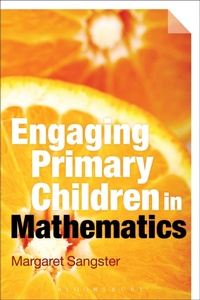
Engaging Primary Children in Mathematics
Published on 25. February 2016
Book
Hardback
176 pages
978-1-4725-8027-6 (ISBN)
Description
A 2017 Choice Outstanding Academic Title
Effective teaching is a combination of technical skills and knowledge but good teachers also need to understand how children learn and how they can most effectively be taught. Engaging Primary Children in Mathematics explores the various strategies for engaging children in mathematical learning in the light of theory and practice and is designed to talk straight to the teacher/student about their classroom approach to the teaching of primary mathematics.
The importance of creating a learning environment in which children can learn to be young mathematicians, where they can explore, create and solve problems, cannot be underestimated. Margaret Sangster explores how students and practitioners can develop their practice by reviewing a range of approaches to the teaching of mathematics and the development of those young mathematicians, with examples of thought-provoking activities to inform their own practice.
Effective teaching is a combination of technical skills and knowledge but good teachers also need to understand how children learn and how they can most effectively be taught. Engaging Primary Children in Mathematics explores the various strategies for engaging children in mathematical learning in the light of theory and practice and is designed to talk straight to the teacher/student about their classroom approach to the teaching of primary mathematics.
The importance of creating a learning environment in which children can learn to be young mathematicians, where they can explore, create and solve problems, cannot be underestimated. Margaret Sangster explores how students and practitioners can develop their practice by reviewing a range of approaches to the teaching of mathematics and the development of those young mathematicians, with examples of thought-provoking activities to inform their own practice.
Reviews / Votes
The book takes an interesting approach drawing together many accepted approaches to teaching mathematics with some new insights. Though there is still some question about the direct role neuroscience can play in informing practice, it is important to engage with this growing influence on thinking about learning. It is also good to see calculators being rescued from the bad press around their use. The issues addressed in each chapter will provide good discussion points for our intending teachers. * Sandy Pepperell, Principal Lecturer in Mathematics, Roehampton University, UK *More details
Language
English
Place of publication
London
United Kingdom
Publishing group
Bloomsbury Publishing PLC
Target group
College/higher education
Professional and scholarly
Illustrations
10 bw illus
Dimensions
Height: 240 mm
Width: 161 mm
Thickness: 16 mm
Weight
482 gr
ISBN-13
978-1-4725-8027-6 (9781472580276)
Copyright in bibliographic data and cover images is held by Nielsen Book Services Limited or by the publishers or by their respective licensors: all rights reserved.
Schweitzer Classification
Person
Margaret Sangster was formerly Principal Lecturer and Programme Director of the BA (Hons) in Primary Education at Canterbury Christ Church University, UK. She worked for many years as a primary teacher, and as a mathematics advisory teacher before moving to Higher Education. She is the editor of Developing Teacher Expertise (Bloomsbury, 2012) and Challenging Perceptions in Primary Education (Bloomsbury, 2015), and author of several books on mathematics, primary and secondary teaching.
Content
Introduction
Part I How Children Learn Primary Mathematics
1 Constructing Mathematical Knowledge
The neurological story
Is there an innate ability to learn mathematics?
Effective learning of mathematics
2 Recalling and Transferring Mathematical Knowledge
How can we help children recall and apply knowledge in new situations?
Transfer (and generalization)
3 Desirable Outcomes and Motivations
External pressures
Motivation
Engaging children in mathematics
4 Independent Mathematicians
What do we mean by independence?
Part II The Development of the Primary Mathematics Curriculum
5 The Map of Mathematics
Progression through topics
A lack of progression
Connections across mathematical topics
The curriculum is the content - the maths to be taught
6 Young Children Learning Mathematics
Do babies have an innate ability to understand mathematics?
Significant aspects of early mathematics learning
7 The Role of Mental Mathematics and Its Relationship to Calculation
Confidence, rehearsal and flexibility
Transition to written calculations
8 Approaches to Numerical Calculation
Early number
The numbers in-between
9 Mathematics in Context
Measures
Data handling
Ratio and proportion
Part III Four Key Issues in Learning Primary Mathematics
10 The Role of the Calculator
Questions often arising from calculator use
11 Children Solving Mathematical Problems
Simple word problems - calculations with words
Why is problem solving generally so difficult?
Possible ways forward
Prompts to assist solving problems
12 Difficult and Easy
Learning, unlearning and relearning
The nature of misconception
Difficult mathematics
Mathematically high attaining children?
13 Relationships, Patterns and Generalization
Relationships
Patterns
Pattern-seeking skills
Generalizing
Part IV The Teacher's Influence on Children Learning Primary Mathematics
14 The Nature of Mathematical Knowledge for Teaching
Teacher beliefs
Self-concept and confidence
15 Creating a Good Learning Environment
Teacher input
Resources and displays
Other environments
Task type
Working with others
16 Teaching Style
School structures
Structure of the lesson
Ways of teaching
Task type
17 The Role of Questioning in Enhancing Mathematical Learning
Applying questioning strategies to stages of a lesson
18 Planning for Progress
Children's progress and achievement
Long-, medium- and short-term planning
The shape of the lesson
Measuring progress
Creating a classroom where formative assessment can take place
19 Other Factors Influencing the Teaching of Mathematics
National and international league tables
The role of government in promoting primary school mathematics
Teacher training
Cultural and societal expectation
The curriculum
Social factors
20 A Teacher's Voice
Index
Part I How Children Learn Primary Mathematics
1 Constructing Mathematical Knowledge
The neurological story
Is there an innate ability to learn mathematics?
Effective learning of mathematics
2 Recalling and Transferring Mathematical Knowledge
How can we help children recall and apply knowledge in new situations?
Transfer (and generalization)
3 Desirable Outcomes and Motivations
External pressures
Motivation
Engaging children in mathematics
4 Independent Mathematicians
What do we mean by independence?
Part II The Development of the Primary Mathematics Curriculum
5 The Map of Mathematics
Progression through topics
A lack of progression
Connections across mathematical topics
The curriculum is the content - the maths to be taught
6 Young Children Learning Mathematics
Do babies have an innate ability to understand mathematics?
Significant aspects of early mathematics learning
7 The Role of Mental Mathematics and Its Relationship to Calculation
Confidence, rehearsal and flexibility
Transition to written calculations
8 Approaches to Numerical Calculation
Early number
The numbers in-between
9 Mathematics in Context
Measures
Data handling
Ratio and proportion
Part III Four Key Issues in Learning Primary Mathematics
10 The Role of the Calculator
Questions often arising from calculator use
11 Children Solving Mathematical Problems
Simple word problems - calculations with words
Why is problem solving generally so difficult?
Possible ways forward
Prompts to assist solving problems
12 Difficult and Easy
Learning, unlearning and relearning
The nature of misconception
Difficult mathematics
Mathematically high attaining children?
13 Relationships, Patterns and Generalization
Relationships
Patterns
Pattern-seeking skills
Generalizing
Part IV The Teacher's Influence on Children Learning Primary Mathematics
14 The Nature of Mathematical Knowledge for Teaching
Teacher beliefs
Self-concept and confidence
15 Creating a Good Learning Environment
Teacher input
Resources and displays
Other environments
Task type
Working with others
16 Teaching Style
School structures
Structure of the lesson
Ways of teaching
Task type
17 The Role of Questioning in Enhancing Mathematical Learning
Applying questioning strategies to stages of a lesson
18 Planning for Progress
Children's progress and achievement
Long-, medium- and short-term planning
The shape of the lesson
Measuring progress
Creating a classroom where formative assessment can take place
19 Other Factors Influencing the Teaching of Mathematics
National and international league tables
The role of government in promoting primary school mathematics
Teacher training
Cultural and societal expectation
The curriculum
Social factors
20 A Teacher's Voice
Index