

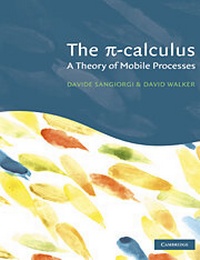
The Pi-Calculus
A Theory of Mobile Processes
Published on 19. July 2001
Book
Hardback
592 pages
978-0-521-78177-0 (ISBN)
Description
Mobile systems, whose components communicate and change their structure, now pervade the informational world and the wider world of which it is a part. The science of mobile systems is as yet immature, however. This book presents the pi-calculus, a theory of mobile systems. The pi-calculus provides a conceptual framework for understanding mobility, and mathematical tools for expressing systems and reasoning about their behaviours. The book serves both as a reference for the theory and as an extended demonstration of how to use pi-calculus to describe systems and analyse their properties. It covers the basic theory of pi-calculus, typed pi-calculi, higher-order processes, the relationship between pi-calculus and lambda-calculus, and applications of pi-calculus to object-oriented design and programming. The book is written at the graduate level, assuming no prior acquaintance with the subject, and is intended for computer scientists interested in mobile systems.
More details
Language
English
Place of publication
Cambridge
United Kingdom
Target group
Professional and scholarly
Dimensions
Height: 253 mm
Width: 181 mm
Thickness: 34 mm
Weight
1398 gr
ISBN-13
978-0-521-78177-0 (9780521781770)
Copyright in bibliographic data and cover images is held by Nielsen Book Services Limited or by the publishers or by their respective licensors: all rights reserved.
Schweitzer Classification
Other editions
New editions
Book
10/2003
Cambridge University Press
€90.90
Shipment within 15-20 days
Additional editions
Book
10/2003
Cambridge University Press
€90.90
Shipment within 15-20 days
Persons
Content
Preface; Introduction; Part I. The p-Calculus: 1. Processes; 2. Behavioural equivalence; Part II. Variations of the p-Calculus: 3. Polyadicity and recursion; 4. Behavioural equivalence, continued; 5. Subcalculi; Part III. Typed p-Calculi: 6. Foundations; 7. Subtyping; 8. Advanced type systems; Part IV. Reasoning about Processes Using Types: 9. Groundwork; 10. Behavioural effects of i/o types; 11. Techniques for advanced type systems; Part V. The Higher-Order Paradigm: 12. Higher-order p-calculus; 13. Comparing first-order and higher-order calculi; Part VI. Functions as Processes: 14. The l-calculus; 15. Interpreting l-calculi; 16. Interpreting typed l-calculi; 17. Full abstraction; 18. The local structure of the interpretations; Part VII. Objects and p-Calculus: 19. Semantic definition; 20. Applications; List of notations; Bibliography; Index.