

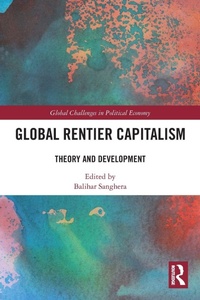
Global Rentier Capitalism
Theory and Development
1st Edition
Will be published approx. on 20. July 2026
Book
Paperback/Softback
280 pages
978-1-032-42347-0 (ISBN)
Description
Recent work on rent and rentierism has offered a distinctive and fresh approach to understanding and explaining contemporary capitalism. Drawing on political economy, economics, geography and sociology, this research has brought together distinct theoretical traditions in original and fertile ways to reshape the study of issues related to class, political-economic change and environmental challenges.
This book critically engages with these theoretical resources to analyse and evaluate economies in the Global North and South. It offers historical, theoretical and empirical accounts of rentierism, making important cross-disciplinary and global connections. Its four parts address global rentier capitalism under the headings of historical lessons, theoretical developments and empirical studies of rentierism in the Global North and South. It will be the first book of its kind to offer a global account of rentier capitalism.
It will be of immense interest to readers in economics, political economy, sociology, geography and development studies.
This book critically engages with these theoretical resources to analyse and evaluate economies in the Global North and South. It offers historical, theoretical and empirical accounts of rentierism, making important cross-disciplinary and global connections. Its four parts address global rentier capitalism under the headings of historical lessons, theoretical developments and empirical studies of rentierism in the Global North and South. It will be the first book of its kind to offer a global account of rentier capitalism.
It will be of immense interest to readers in economics, political economy, sociology, geography and development studies.
Reviews / Votes
This is an excellent collection of case studies on how rentier capitalism hampers industrial growth and raises the cost structure of countries, privatising what a century ago was expected to be public infrastructure that provided basic services at subsidised prices or even freely for basic needs. This book is the first volume of its kind that looks at rentier capitalism from a global perspective, and it is a must-read for everyone interested in political economy and the crisis of today's capitalism. It will appeal to those who want to know how rentier capitalism differs from the 19th-century ethic of industrial capitalism, which aimed at freeing the market from a landlord class and its economic rent, and from monopolies and financial overhead. The optimistic conclusion is that there is an alternative to such rentier overhead. Only by recognising its detrimental cost can economies be freed from such charges. This book is an excellent start.- Professor Michael Hudson, University of Missouri
A timely and fascinating account of rentier capitalism. From early philosophers such as Aristotle, through religious prohibitions of usury, to popular writers such as Henry George, there has been deep concern about incomes derived simply through ownership. Today, rentier income is a major source of economic inequality. Whether you agree or disagree on the details, there is no doubt about the importance of the topic.
- Geoffrey M. Hodgson, Emeritus Professor, Loughborough University London
Entrepreneurs' capitalism is the past. Global Rentier Capitalism deals with the central issue of rents and their main beneficiaries, rentiers and financiers. I wholeheartedly welcome this critical collection of essays.
- Luiz Carlos Bresser-Pereira, Emeritus Professor, Getulio Vargas Foundation
More details
Series
Language
English
Place of publication
London
United Kingdom
Publishing group
Taylor & Francis Ltd
Target group
College/higher education
Postgraduate
Illustrations
9 s/w Photographien bzw. Rasterbilder, 16 s/w Zeichnungen, 11 s/w Tabellen, 25 s/w Abbildungen
11 Tables, black and white; 16 Line drawings, black and white; 9 Halftones, black and white; 25 Illustrations, black and white
Dimensions
Height: 234 mm
Width: 156 mm
ISBN-13
978-1-032-42347-0 (9781032423470)
Copyright in bibliographic data and cover images is held by Nielsen Book Services Limited or by the publishers or by their respective licensors: all rights reserved.
Schweitzer Classification
Other editions
Additional editions
E-Book
09/2024
1st Edition
Routledge
€60.49
Available for download
Book
09/2024
1st Edition
Routledge
€206.80
Shipment within 10-20 days
E-Book
09/2024
1st Edition
Routledge
€60.49
Available for download
Person
Balihar Sanghera is Reader in Sociology at the University of Kent. His research has focused on class, morality and rentier capitalism in Central Asia. He has published in leading journals, including the Cambridge Journal of Economics, Capital and Class, Theory and Society, International Sociology and The Sociological Review. He is a co-author with Elmira Satybaldieva of Rentier Capitalism and Its Discontents: Power, Morality and Resistance in Central Asia (Palgrave Macmillan, 2021) and co-editor with Gideon Calder of Ethics, Economy and Social Science: Dialogues with Andrew Sayer (Routledge, 2022).
Content
Introduction Part I: Historical lessons 1. Rival benchmarks for measuring rent: a history of incoherence and a solution for discussion 2. Henry George, economic solutionalism and the reappearance of economic rent 3. Grounding rent in value: considering the price of fungible rents for rentier capitalism studies Part II: Theoretical developments 4.Rentier regimes and the Regulation Theory: an overview 5. Rentierism and speculation in a finance-led capitalism 6. Big Tech: four emerging forms of digital rentiership 7. Rentierism and the question of capitalist development Part III: Studies of rentierism in the Global North 8. Urban entrepreneurs as global rentiers: real estate clientelism and hegemony in Belgium and Spain 9. Labour, labour law and capitalist rent-seeking: rentier capitalism and labour in historical perspective 10. The labour economics of rents in the Global North 11. US rentierism, hegemony and militarism: corporate harm and state violence Part IV: Studies of rentierism in the Global South 12. Mozambique: turning a poor country into a rentier state 13. Rentier capitalism and global economic imaginaries in Central Asia 14. Rentier income and mass-based financialisation: the limits of redistributive policies during the Pink Tide in Brazil 15. Surplus, rent, and unequal development: raw materials and remittances as the motor of rent societies in the Global South? 16. The rentier economies in Latin America 17. Conclusion