

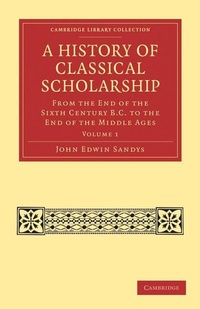
A History of Classical Scholarship
From the End of the Sixth Century B.C. to the End of the Middle Ages
Published on 17. February 2011
Book
Paperback/Softback
706 pages
978-1-108-02706-9 (ISBN)
Description
Sir John Edwin Sandys (1844-1922) was a leading Cambridge classicist and a Fellow of St. John's College. His most famous work is this three-volume History of Classical Scholarship, published between 1903 and 1908, which remains the only large-scale work on the subject to span the entire period from the sixth century BCE to the end of the nineteenth century. The history of classical studies was a popular topic during the nineteenth century, particularly in Germany, but Sandys stands out for the ambitious scope of his work, even though much of it was based on earlier scholarship. His chronological account is subdivided by genre and region, with some chapters devoted to particularly influential individuals. Volume 1 covers the Classical period, Byzantine scholarship, and the medieval West to 1350.
More details
Series
Language
English
Place of publication
Cambridge
United Kingdom
Target group
College/higher education
Product notice
Paperback (trade)
Illustrations
2 Plates, black and white; 18 Halftones, black and white
Dimensions
Height: 216 mm
Width: 140 mm
Thickness: 41 mm
Weight
980 gr
ISBN-13
978-1-108-02706-9 (9781108027069)
Copyright in bibliographic data and cover images is held by Nielsen Book Services Limited or by the publishers or by their respective licensors: all rights reserved.
Schweitzer Classification
Content
Preface; List of illustrations; Titles of certain works of reference; Abbreviations; Addenda and corrigenda; 1. Definition of 'scholar' and 'scholarship'; Book I. The Athenian Age, c.600-c.300 B.C.: 2. The study of epic poetry; 3. The study of lyric poetry; 4. The study and criticism of dramatic poetry; 5. The theory of poetry in Homer, Democritus, Plato and Aristotle; 6. The rise of rhetoric, and the study of prose; 7. The beginnings of grammar and etymology; Book II. The Alexandrian Age, c.300-1 B.C.: 8. The school of Alexandria; 9. The Stoics and the school of Pergamon; Book III. The Roman Age of Latin Scholarship, c.168 B.C.-c.530 A.D.: 10. Latin scholarship from the death of Ennius (169 B.C.) to the Augustan Age; 11. Latin scholarship from the Augustan Age to 300 A.D.; 12. Latin scholarship from 300 to 500 A.D.; 13. Latin scholarship from 500 to 530 A.D.; Book IV. The Roman Age of Greek Scholarship, c.1-c.530 A.D.: 14. Roman study of Greek between 164 B.C. and 143 A.D.; 15. Greek literary criticism in the first century of the Empire; 16. Verbal scholarship in the first century of the Empire; 17. The literary revival at the end of the first century; 18. Greek scholarship in the second century; 19. Greek scholarship in the third century; 20. Greek scholarship in the fourth century; 21. Greek scholarship from 400 to 530 A.D.; Book V. The Byzantine Age, c.530-c.1350 A.D.: 22. Byzantine scholarship from 529 to 1000 A.D.; 23. Period III 850-1350 continued; Book VI. The Middle Ages in the West c.530-c.1350 A.D.: 24. Gregory the Great; 25. Charles the Great and Alcuin; 26. The tenth century; 27. The eleventh century; 28. The twelfth century; 29. The twelfth century continued; 30. The thirteenth century; 31. The thirteenth century and after; 32. The mediaeval copyists and the classics; Index; Greek index.