

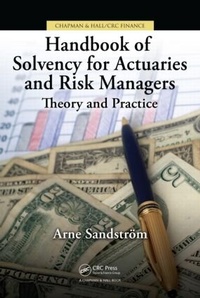
Handbook of Solvency for Actuaries and Risk Managers
Theory and Practice
1st Edition
Published on 8. November 2010
Book
Hardback
1114 pages
978-1-4398-2130-5 (ISBN)
Description
Reflecting the author's wealth of experience in this field, Handbook of Solvency for Actuaries and Risk Managers: Theory and Practice focuses on the valuation of assets and liabilities, the calculation of capital requirement, and the calculation of the standard formula for the European Solvency II project.
The first three sections of the book examine the solvency concept, historical development, and the role of solvency in an enterprise risk management approach. The text provides a general discussion on valuation, investment, and capital, along with modeling and measuring. It also covers dependence, risk measures, capital requirements, subrisks, aggregation, the main risks market, and credit, operational, liquidity, and underwriting risks.
The last three sections focus on the European Solvency II project. Basing the material on CEIOPS final advice, the author presents the general ideas, valuation, investments, and funds of this project as well as the standard formula framework. He also includes all calibrations from previous quantitative impact studies and discusses the political progress of the project.
A one-stop shop for actuaries and risk managers, this handbook offers a complete overview of solvency and the European Solvency II standard formula. It gives a clear definition and broad historical review of solvency and incorporates a comprehensive discussion of the theory behind the calculation of the capital requirement. Updates on solvency projects and issues are available at www.SolvencyII.nu
The first three sections of the book examine the solvency concept, historical development, and the role of solvency in an enterprise risk management approach. The text provides a general discussion on valuation, investment, and capital, along with modeling and measuring. It also covers dependence, risk measures, capital requirements, subrisks, aggregation, the main risks market, and credit, operational, liquidity, and underwriting risks.
The last three sections focus on the European Solvency II project. Basing the material on CEIOPS final advice, the author presents the general ideas, valuation, investments, and funds of this project as well as the standard formula framework. He also includes all calibrations from previous quantitative impact studies and discusses the political progress of the project.
A one-stop shop for actuaries and risk managers, this handbook offers a complete overview of solvency and the European Solvency II standard formula. It gives a clear definition and broad historical review of solvency and incorporates a comprehensive discussion of the theory behind the calculation of the capital requirement. Updates on solvency projects and issues are available at www.SolvencyII.nu
Reviews / Votes
...this book is a must for any actuary and risk manager in insurance. It gives a comprehensive overview on all the relevant material concerning Solvency II. This makes the book also valuable for researchers working in risk management. Many graphs illustrate the theoretical background. Simple explanations are given, and most formulae are without proof. This makes it understandable for anybody working in the field. An extensive list of references gives more material. In particular, a researcher may find there hints to the proofs and the background theory behind the formulae.-Hanspeter Schmidli, Zentralblatt MATH 1209
As an actuary working in a risk team with predominantly non-actuaries, I was interested in reviewing this book from two angles. Firstly, could there really be that much to write about solvency (it is a hefty volume) and secondly, would my non-actuarial colleagues find it useful in practice? ... I feel that I have learnt a huge amount in a short time and am bracing myself for a return visit to the section on copulas. As to the answers to my opening two questions, they are most definitely 'yes' on both counts. This is an excellent reference manual for anyone working in a risk environment, irrespective of their level of involvement in the Solvency II project.
-Annals of Actuarial Science, Vol. 5, June 2011
In this handbook he [Sandstrom] offers a clear definition of solvency, a broad historical review, and a comprehensive treatment of the capital requirement. These general ideas are covered in the first section, and the second section addresses in detail the European Solvency II project. ... He also advises readers that the most current developments from CEIOPS will be published at his website. This handbook is for professionals in the field but can be used as well as for the education of future actuaries and risk managers.
-SciTech Book News, February 2011
More details
Series
Language
English
Place of publication
Oxford
United States
Publishing group
Taylor & Francis Inc
Target group
College/higher education
Actuaries and risk managers; researchers and professionals in finance.
Illustrations
73 s/w Abbildungen, 146 s/w Tabellen
146 Tables, black and white; 73 Illustrations, black and white
Dimensions
Height: 254 mm
Width: 178 mm
Weight
2230 gr
ISBN-13
978-1-4398-2130-5 (9781439821305)
Copyright in bibliographic data and cover images is held by Nielsen Book Services Limited or by the publishers or by their respective licensors: all rights reserved.
Schweitzer Classification
Other editions
Additional editions
E-Book
04/2016
Chapman & Hall/CRC
€310.99
Available for download
E-Book
04/2016
1st Edition
Chapman and Hall
€311.99
Available for download
Person
Arne Sandstroem is the chief actuary of the Swedish Insurance Federation, where he has worked since 1985. Dr. Sandstroem is a member of IAA's Solvency Subcommittee, CEA's Solvency II Steering Group, and the Groupe Consultatif Pillar I Non-Life Working Group.
Content
Solvency Introduction. Valuation, Investments, and Capital. Modeling and Measuring. The European Solvency II General Ideas, Valuation, and Investment: Final Advice. The European Solvency II Standard Formula: Final Advice. Backgrounds and Calibrations. References. Index.