

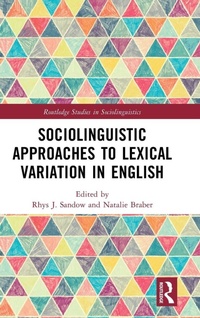
Sociolinguistic Approaches to Lexical Variation in English
1st Edition
Will be published approx. on 27. November 2025
Book
Hardback
330 pages
978-1-032-83525-9 (ISBN)
Description
This volume offers an in-depth and up-to-date exploration of lexical variation from sociolinguistic perspectives, addressing a notable gap in lexis-focused research within the field. Drawing on a wide array of examples from the English language, the collection showcases cutting-edge approaches to understanding how lexical variation operates across different social and linguistic contexts.
Organised into three thematic sections, the book begins with a focus on contemporary developments in dialectology. The first section not only highlights regional and social variation in lexis but also offers critical insights into the methodological innovations shaping 21st-century dialect research. The second section highlights innovative perspectives emerging from corpus linguistics, wheras the final section examines lexical variation through the lens of social meaning, including contributions from third-wave variationist sociolinguistics. Together, these chapters argue for the significance of lexical analysis in sociolinguistic inquiry - both as a window into society and as a means of uncovering mechanisms of language variation and change.
This collection will be a valuable resource for students, researchers, and scholars in language variation and change, dialectology, corpus linguistics, and sociolinguistics more broadly.
Organised into three thematic sections, the book begins with a focus on contemporary developments in dialectology. The first section not only highlights regional and social variation in lexis but also offers critical insights into the methodological innovations shaping 21st-century dialect research. The second section highlights innovative perspectives emerging from corpus linguistics, wheras the final section examines lexical variation through the lens of social meaning, including contributions from third-wave variationist sociolinguistics. Together, these chapters argue for the significance of lexical analysis in sociolinguistic inquiry - both as a window into society and as a means of uncovering mechanisms of language variation and change.
This collection will be a valuable resource for students, researchers, and scholars in language variation and change, dialectology, corpus linguistics, and sociolinguistics more broadly.
More details
Series
Language
English
Place of publication
London
United Kingdom
Publishing group
Taylor & Francis Ltd
Target group
College/higher education
Postgraduate
Illustrations
12 s/w Photographien bzw. Rasterbilder, 56 s/w Zeichnungen, 50 s/w Tabellen, 68 s/w Abbildungen
50 Tables, black and white; 56 Line drawings, black and white; 12 Halftones, black and white; 68 Illustrations, black and white
Dimensions
Height: 235 mm
Width: 157 mm
Thickness: 23 mm
Weight
655 gr
ISBN-13
978-1-032-83525-9 (9781032835259)
Copyright in bibliographic data and cover images is held by Nielsen Book Services Limited or by the publishers or by their respective licensors: all rights reserved.
Schweitzer Classification
Other editions
Additional editions
Rhys J. Sandow | Natalie Braber
Sociolinguistic Approaches to Lexical Variation in English
E-Book
11/2025
Routledge
€60.99
Available for download
Rhys J. Sandow | Natalie Braber
Sociolinguistic Approaches to Lexical Variation in English
E-Book
11/2025
Routledge
€60.99
Available for download
Persons
Rhys J. Sandow is a senior research associate at Concept Analytics Lab, University of Sussex, UK
Natalie Braber is Professor of Linguistics at Nottingham Trent University, UK.
Natalie Braber is Professor of Linguistics at Nottingham Trent University, UK.
Content
Foreword: The Cinderella of sociolinguistics - Joan C. Beal; Acknowledgements; 1. Introduction: An overview of sociolinguistic approaches to lexical variation in English - Rhys J. Sandow and Natalie Braber. Section I: Dialectology 2. A socio-geographical investigation of lexical variability in England: Evidence from the English Dialects App - David Britain, Tamsin Blaxter and Adrian Leemann; 3. Lexical variation among mobile speakers: A case study of words for bread in the United Kingdom - George Bailey, Laurel MacKenzie and Danielle Turton; 4. Welsh-English social-media lexicon in comparative context: Adjectives of positive evaluation and terms of address - David Willis; 5. Lexical variation in Irish English - Raymond Hickey; 6. 'Pit talk' of UK coal miners - a comparative study - Natalie Braber and John Bellamy. Section II: Corpus linguistics 7. Lexico-grammatical variation in spoken British English corpora - Robbie Love and Nele Poldvere; 8. Light verbs on the contact continuum - Gabriel Ozon and Melanie Green; 9. The social conditioning of lexical items for man in British English: The demise of man and the rise of guy - James M. Stratton; 10. Conceptual variation: Gendered differences in the lexicalization of the concept of COMMODITY in environmental narratives - Justyna A. Robinson, Rhys J. Sandow and Albertus Andito; 11. 'Our speech defines us': The language of Caribbean female prime ministers - Guyanne Wilson. Section III: Social meaning 12. Bare social meanings: The production and perception of the quantifier bare - Rhys J. Sandow, Christian Ilbury, George Bailey, and Natalie Braber; 13. A word in a word: Social perceptions of expletive infixation - Matthew Hunt and Linnaea Stockall; 14. 'Well first of all, you spelled sus wrong': Epistemic authority and the social negotiation of 'slang' - Teresa Pratt; 15. Disenregistering dude: Shifts in familiarizing vocative meaning and use in American English - Scott F. Kiesling and Soobin Choi; 16. 'TikTok Slang': Lexical variation and change in social media - Christian Ilbury; 17. Perspectives on lexical variation of English in Vietnam - John Bellamy and Mai Xuan Nhat Chi Nguyen