

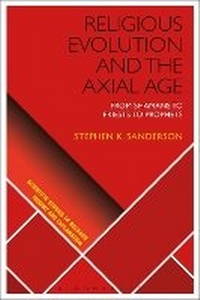
Religious Evolution and the Axial Age
From Shamans to Priests to Prophets
Published on 25. January 2018
Book
Hardback
320 pages
978-1-350-04742-6 (ISBN)
Description
Religious Evolution and the Axial Age describes and explains the evolution of religion over the past ten millennia. It shows that an overall evolutionary sequence can be observed, running from the spirit and shaman dominated religions of small-scale societies, to the archaic religions of the ancient civilizations, and then to the salvation religions of the Axial Age.
Stephen K. Sanderson draws on ideas from new cognitive and evolutionary psychological theories, as well as comparative religion, anthropology, history, and sociology. He argues that religion is a biological adaptation that evolved in order to solve a number of human problems, especially those concerned with existential anxiety and ontological insecurity.
Much of the focus of the book is on the Axial Age, the period in the second half of the first millennium BCE that marked the greatest religious transformation in world history. The book demonstrates that, as a result of massive increases in the scale and scope of war and large-scale urbanization, the problems of existential anxiety and ontological insecurity became particularly acute. These changes evoked new religious needs, especially for salvation and release from suffering. As a result entirely new religions-Zoroastrianism, Judaism, Christianity, Hinduism, Buddhism, Confucianism, and Daoism-arose to help people cope with the demands of the new historical era.
Stephen K. Sanderson draws on ideas from new cognitive and evolutionary psychological theories, as well as comparative religion, anthropology, history, and sociology. He argues that religion is a biological adaptation that evolved in order to solve a number of human problems, especially those concerned with existential anxiety and ontological insecurity.
Much of the focus of the book is on the Axial Age, the period in the second half of the first millennium BCE that marked the greatest religious transformation in world history. The book demonstrates that, as a result of massive increases in the scale and scope of war and large-scale urbanization, the problems of existential anxiety and ontological insecurity became particularly acute. These changes evoked new religious needs, especially for salvation and release from suffering. As a result entirely new religions-Zoroastrianism, Judaism, Christianity, Hinduism, Buddhism, Confucianism, and Daoism-arose to help people cope with the demands of the new historical era.
Reviews / Votes
This is a major contribution to the evolutionary study of religion. Sanderson masterfully engages both the rich historical scholarship on religion and the contemporary theoretical work on the evolution of religion, offering a novel and insightful analysis. The evolutionary study of religion is fortunate to have a scholar of such breadth, proficiency, and dedication wrestle with the most pressing questions in the field. * Richard Sosis, James Barnett Professor of Humanistic Anthropology, University of Connecticut, USA * Sanderson makes an important contribution to the question of diversity, arguing that religions are essentially biosocial adaptations to changing environments. This bold new theory deserves serious attention from, and systematic testing by, a wide range of scholars and scientists. * Harvey Whitehouse, Director of the Institute of Cognitive and Evolutionary Anthropology, University of Oxford, UK * Sanderson argues persuasively that such movements as the transcendental "world" religions of the Axial and subsequent ages reflect changing social conditions. These religions were responses, he holds, to increasing population pressures, political and ethnic alienation, and warfare, from which their adherents sought salvation. * Stewart Elliott Guthrie, Professor Emeritus of Anthropology, Fordham University, USA *More details
Series
Language
English
Place of publication
London
United Kingdom
Publishing group
Bloomsbury Publishing PLC
Target group
College/higher education
Illustrations
1 Maps
Dimensions
Height: 234 mm
Width: 156 mm
Weight
621 gr
ISBN-13
978-1-350-04742-6 (9781350047426)
Copyright in bibliographic data and cover images is held by Nielsen Book Services Limited or by the publishers or by their respective licensors: all rights reserved.
Schweitzer Classification
Other editions
Additional editions
E-Book
01/2018
1st Edition
Bloomsbury Academic
€38.49
Available for download
Person
Stephen K. Sanderson is Research Associate at the Institute for Research on World-Systems at the University of California, Riverside, USA. He is the author of numerous books, most recently Modern Societies: A Comparative Perspective (2015) and Human Nature and the Evolution of Society (2014).
Content
Preface and Acknowledgements
List of Figures
List of Tables
Prologue
1. What Religion Is
2. The Evolutionary Forms of the Religious Life
3. The Religions of the Axial Age
4. Explaining Religion
5. Religion as an Evolutionary Adaptation
6. The Sociocultural Evolution of Religion, 1: The Overall Pattern
7. The Sociocultural Evolution of Religion, 2: The Axial Age
8. Religion Past, Present, and Future
Appendix A. Codes for Stage of Religious Evolution in the Standard Cross-cultural Sample
Appendix B. Ancient Cities and Estimated City Sizes
Notes
Bibliography
Index
List of Figures
List of Tables
Prologue
1. What Religion Is
2. The Evolutionary Forms of the Religious Life
3. The Religions of the Axial Age
4. Explaining Religion
5. Religion as an Evolutionary Adaptation
6. The Sociocultural Evolution of Religion, 1: The Overall Pattern
7. The Sociocultural Evolution of Religion, 2: The Axial Age
8. Religion Past, Present, and Future
Appendix A. Codes for Stage of Religious Evolution in the Standard Cross-cultural Sample
Appendix B. Ancient Cities and Estimated City Sizes
Notes
Bibliography
Index