

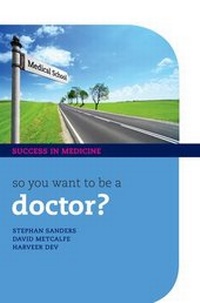
So You Want to be a Doctor?
The Ultimate Guide to Getting into Medical School
1st Edition
Published on 9. December 2010
Book
Paperback/Softback
352 pages
978-0-19-957332-5 (ISBN)
Description
More people are applying to medical school than ever before, and 'So you want to be a Doctor?' will give you the best head start. It distils the wisdom of over 100 medical students, admissions specialists and doctors, revealing the truth about the medical school application process. This comprehensive guide leads the reader through every stage of the process, from deciding if you want to be a doctor, through to moving to university and coping with the first year at medical school. With a detailed profile for every undergraduate and graduate medical school in the UK, it will help students to choose the best medical school for them. It will also help with the other big decisions that need to be made, such as which A-level subjects to take and whether to apply to Oxbridge. All the essential information is covered, including: BLhow much medical school costs, BLwhat work experience is best, and how to get it, BLcompleting the UCAS form, BLsurviving the UKCAT and BMAT admission tests, BLgetting through the interview.
Written by an author team of a medical student, recent graduate and a widely experienced clinician, the book also contains first-hand accounts of students' personal experiences, and advice and information from people on the inside of the admissions process.
Written by an author team of a medical student, recent graduate and a widely experienced clinician, the book also contains first-hand accounts of students' personal experiences, and advice and information from people on the inside of the admissions process.
More details
Series
Language
English
Place of publication
Oxford
United Kingdom
Target group
Any student who is interested in applying to medical school. Parents, careers advisors and teachers will also find it a useful resource when helping medical school applicants.
Illustrations
Black and white photos and line drawings
black and white photos and line drawings
Dimensions
Height: 234 mm
Width: 170 mm
Thickness: 15 mm
Weight
523 gr
ISBN-13
978-0-19-957332-5 (9780199573325)
Copyright in bibliographic data and cover images is held by Nielsen Book Services Limited or by the publishers or by their respective licensors: all rights reserved.
Schweitzer Classification
Persons
Stephan Sanders, Postdoctoral Associate, Department of Genetics, Yale University, USA, Harveer Dev, Student Doctor, Cambridge University School of Medicine, Cambridge, UK, and David Metcalfe, Student Doctor, Warwick Medical School, Coventry, UK
Stephan Sanders is a paediatrician who trained at Nottingham Medical School. He is currently working on research at Yale University to use the latest genetic sequencing technologies to discover the cause of autism. He wrote the 'Oxford Handbook for the Foundation Programme', which is used by most first-year doctors in the UK, and the bestselling 'So you want to be a Brain Surgeon?', and was recently highly commended in the BMA book prizes. Stephan also worked as an expedition doctor accompanying a group of children on the BBC Serious Series (Serious Andes, Serious Ocean and Serious Explorers - Livingstone).
David Metcalfe graduated with a first class BSc(Hons) in Biological Sciences with Molecular Genetics from the University of Warwick. He is due to graduate with an MB ChB from Warwick in July 2010 and LLB (Hons) in Law from The Open University in 2011. From August 2010 he will be a Foundation Year 1 Doctor at Kingston Hospital in Surrey then a FY2 at St George's Hospital, London, on an Academic Foundation Programme (vascular surgery).
Harveer Dev read medicine at St John's College, Cambridge University. His undergraduate research focused on the structure of ion channels, which culminated in a BA in Natural Sciences. His clinical training has taken place at Cambridge University School of Medicine, where he has developed an interest in Urology, specifically, robotic-assisted laparoscopic procedures. Throughout this time, in roles such as the Education Officer for Cambridge University Students' Union, he has maintained an active interest in mentoring students, encouraging higher education and developing pedagogic support.
Stephan Sanders is a paediatrician who trained at Nottingham Medical School. He is currently working on research at Yale University to use the latest genetic sequencing technologies to discover the cause of autism. He wrote the 'Oxford Handbook for the Foundation Programme', which is used by most first-year doctors in the UK, and the bestselling 'So you want to be a Brain Surgeon?', and was recently highly commended in the BMA book prizes. Stephan also worked as an expedition doctor accompanying a group of children on the BBC Serious Series (Serious Andes, Serious Ocean and Serious Explorers - Livingstone).
David Metcalfe graduated with a first class BSc(Hons) in Biological Sciences with Molecular Genetics from the University of Warwick. He is due to graduate with an MB ChB from Warwick in July 2010 and LLB (Hons) in Law from The Open University in 2011. From August 2010 he will be a Foundation Year 1 Doctor at Kingston Hospital in Surrey then a FY2 at St George's Hospital, London, on an Academic Foundation Programme (vascular surgery).
Harveer Dev read medicine at St John's College, Cambridge University. His undergraduate research focused on the structure of ion channels, which culminated in a BA in Natural Sciences. His clinical training has taken place at Cambridge University School of Medicine, where he has developed an interest in Urology, specifically, robotic-assisted laparoscopic procedures. Throughout this time, in roles such as the Education Officer for Cambridge University Students' Union, he has maintained an active interest in mentoring students, encouraging higher education and developing pedagogic support.
Content
1. Making the decision ; 2. Succeeding at A-level ; 3. Taking a gap year ; 4. Getting a life ; 5. Work experience ; 6. Preparing for admission tests ; 7. Choosing a medical school ; 8. Undergraduate medical schools ; 9. Perfecting the UCAS form ; 10. Getting into Oxbridge ; 11. Graduate entry medicine ; 12. Graduate entry medical schools ; 13. Non-traditional applications ; 14. How to succeed at interview ; 15. If things don't work out ; 16. Making the most of medical school ; 17. Appendix - UKCAT and BMAT sample questions, answers and explanations ; 18. Useful resources