

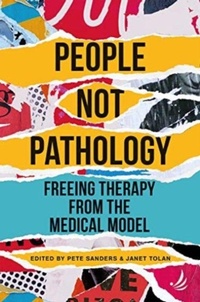
People Not Pathology
Freeing therapy from the medical model
Published on 12. January 2023
Book
Paperback/Softback
270 pages
978-1-915220-23-3 (ISBN)
Description
It is only in the last two or three decades that the medical model has come to dominate psychological theory and practice. This book considers the evidence that points us towards freeing ourselves from this creeping medicalisation and recognising the influence of our environments and circumstances on our psychological wellbeing. Contributors from a range of modalities illustrate how to practise in a demedicalised way. Drawing on these examples from the field and perspectives from different theoretical models, the book demonstrates that an approach freed from the medical model provides the ethically axiomatic framework for psychological practice today.
Reviews / Votes
'This brilliant book is a vital resource for the increasing number of therapists concerned by the growing medicalisation of counselling and psychotherapy. It should be compulsory reading for all therapy trainees and practitioners. What a timely and vital intervention.' James Davies, Associate Professor of Psychology and Medical Anthropology, University of Roehampton; '... a coherent and powerful narrative for the philosophy of therapy as a social, psychological and community activity. It will help to inform thinking and debate for years to come.' Professor Andrew Reeves, Professor in Counselling Professions and Mental Health, University of Chester; '... a testament to its editors' tireless work to challenge injustice in this world; a breath of fresh air'. Professor Emmy van Deurzen, Principal, New School of Psychotherapy and Counselling; '... a must-read not only for students, professionals and service providers but also anyone contemplating entering the mental health profession.' Mamood Ahmad, psychotherapist and founder of The Anti-Discrimination Focus.More details
Language
English
Place of publication
Manchester
United Kingdom
Target group
College/higher education
Professional and scholarly
Product notice
Paperback (UK-trade)
Dimensions
Height: 233 mm
Width: 156 mm
Thickness: 18 mm
Weight
416 gr
ISBN-13
978-1-915220-23-3 (9781915220233)
Copyright in bibliographic data and cover images is held by Nielsen Book Services Limited or by the publishers or by their respective licensors: all rights reserved.
Schweitzer Classification
Other editions
Additional editions
E-Book
01/2023
PCCS Books
€27.99
Available for download
Persons
Pete Sanders was white British. He worked as a volunteer at 'Off The Record', Newcastle-upon Tyne, in 1972 before completing a degree in psychology at the university there, and then the postgraduate diploma in counselling at Aston University. He practised as a counsellor, educator and clinical supervisor for more than 30 years, and published widely on many aspects of counselling, psychotherapy and mental health, as well as co-founding PCCS Books in 1993. After practising and teaching counselling, he continued to have an active interest in developing person-centred theory, the politics of counselling and psychotherapy and the demedicalisation of distress. He died in February 2022. - Janet Tolan has worked in counselling since 1979, first as a volunteer, then as a full-time counsellor. She is a senior accredited counsellor/psychotherapist and a Fellow of BACP. She qualified in 1984 and completed her supervisor training with Brigid Proctor and Francesca Inskipp in 1988. Her last employed role was as head of the master's programme in counselling and psychotherapy at Liverpool John Moores University. She is now in private practice, working with individuals, couples, groups and teams. Along the way, she has worked in teacher training and in team and management development.
Content
Introduction - Pete Sanders and Janet Tolan. Section 1: Why demedicalised counselling and psychotherapy?, 1. The history of medicalisation of counselling and psychotherapy - Janet Tolan and Pete Sanders, 2. Challenging the medicalisation of psychological disorders - Richard Bentall. Section 2: Demedicalised counselling and psychotherapy, 3. A demedicalised approach to psychodynamic therapy - Suzanne Martin, 4. A demedicalised approach to person-centred therapy - Pete Sanders, 5. A demedicalised approach to cognitive behavioural psychotherapy - James Binnie, 6. Demedicalised integrative therapy - Garthine Walker, 7. The power threat meaning framework and de-medicalising counselling and psychotherapy - Jo Watson, 8. A non-medical approach to therapy with people who hear voices - Kirshen Rundle, 9. Incorporating demedicalised therapy into training and continuing professional development - Rachel Freeth. Section 3: Inappropriately medicalised and over-medicalised groups, 10. Demedicalised counselling and psychotherapy with children and young people - Ani de la Prida, 11. Demedicalising disability in counselling and psychotherapy practice - Chris Coombs, 12. Demedicalised counselling and psychotherapy with gender, sexual and relationship diversity - Paula J. Williams, 13. Demedicalised counselling and psychotherapy and the racist overmedicalisation of people in Black diaspora - Sarah Henry, 14. Demedicalised counselling and psychotherapy with women diagnosed with 'borderline personality disorder' - Gillian Proctor. Section 4: Demedicalised counselling and psychotherapy services, 15. The Mavam Group - Matthew Morris, 16. The Market Place - Lisa Norfolk, 17. Women and Girls Network - Akima Thomas. Contributors' biographies. Name index. Subject index.