

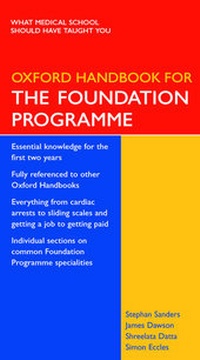
Oxford Handbook for the Foundation Programme
Published on 1. September 2005
Book
Spiral bound
604 pages
978-0-19-856789-9 (ISBN)
Description
The Oxford Handbook for the Foundation Programme is the first book to be written for doctors on the new UK Foundation Programme. It has been written by junior doctors with specific reference to the different style of training offered by the new changes in postgraduate education. It is the most useful book you can carry during the critical first two years after medical school. As you start your job it will guide you through your on-call emergencies, day-to-day ward life and specialty attachments whilst helping you adapt to your career, get the most out of your job and choose a specialty. It contains the simple factual guidance you'd expect from an Oxford Handbook. The clinical sections are arranged by symptom and have a clear, step-by-step format for the emergency management of your patients. This book gives you the best questions to ask for the history, tells you what to look for in examination, and guides you to the correct diagnosis and treatment. This presentation-based approach ensures you can offer the best treatment for your patients, whose diagnoses often aren't clear at first.A practical, ward-based approach is taken for common on-call problems - including sliding scales, warfarin dosing, and falls.
The specialty sections range from A & E to urology, highlighting the important differences in approach, with a succinct guide to the management of common specialist conditions. Also covered are practical procedures ranging from cannulation to chest drains, outlining indications, equipment and the actual procedure. Wherever possible, hints for success have been included. Interpretation of investigation results includes the ECG, CXR and blood tests, providing a quick reference scheme invaluable for years to come. The book ends with the common drug doses that all doctors should know, but sometimes need to double check. The Oxford Handbook for the Foundation Programme also contains a non-clinical section tackling issues from interview technique to tax assessment. It includes all relevant addresses and website references to help you find the information you need.
The specialty sections range from A & E to urology, highlighting the important differences in approach, with a succinct guide to the management of common specialist conditions. Also covered are practical procedures ranging from cannulation to chest drains, outlining indications, equipment and the actual procedure. Wherever possible, hints for success have been included. Interpretation of investigation results includes the ECG, CXR and blood tests, providing a quick reference scheme invaluable for years to come. The book ends with the common drug doses that all doctors should know, but sometimes need to double check. The Oxford Handbook for the Foundation Programme also contains a non-clinical section tackling issues from interview technique to tax assessment. It includes all relevant addresses and website references to help you find the information you need.
Reviews / Votes
I have found this book extremely useful as a final year medical student and have aoften referred to it whilst on the ward. I would recommend it to any final year medical student starting their 5th year placement as well as newly qualified doctors. GKT Gazette This book, which like all Oxford Handbooks can slip into your white coat pocket with ease, really does have within its 574 pages all you are likely to come across in your first two years post qualification - in short, it's what medical school should have taught you but as we all know, there's a fair sized gap between having the knowledge and actually putting it into clinical practice. Dr Jeremy Sager This book is a product of the daily experience of junior docs and it shows, there are top tips galore and sound advice. Glasgow Medical School Journal The Oxford Handbook for the Foundation Programme (OHFP) is a comfort blanket for all newly qualified, shiny badged doctors. The opening chapter has a feel good component to it, which similar rival publications are lacking. All is disclosed here to spare your graces on the ward rounds and in front of the dreaded ward sister. Important pieces on life organisation, money management, making referrals, managing on-calls, writing discharge summaries, and even what to carry in your limited pocket space are addressed. This section alone is worth parting with cash for. Much of the unwritten hospital etiquette and concerns when starting out in medicine are answered with reassurance dynamic and comforting. BMJMore details
Language
English
Place of publication
Oxford
United Kingdom
Target group
Professional and scholarly
Illustrations
b/w ill., line drawings, num. tab.
numerous tables, line drawings, black and white illustrations
Dimensions
Height: 180 mm
Width: 100 mm
ISBN-13
978-0-19-856789-9 (9780198567899)
Copyright in bibliographic data and cover images is held by Nielsen Book Services Limited or by the publishers or by their respective licensors: all rights reserved.
Schweitzer Classification
Other editions
New editions
Nathalie Hurley | James Dawson | Stephan Sanders
Oxford Handbook for the Foundation Programme
Book
08/2008
2nd Edition
Oxford University Press
€34.61
Article exhausted; check for reprint
Persons
Content
THE JOB; 1. Before You Start; 2. How to be a PRHO; 3. Clinical Notes; 4. Prescribing; 5. Daily Duties; 6. Ward Round; 7. Difficult Patients; 8. Discharge/TTOs; 9. Driving Regulations; 10. Referrals; 11. Being On Call; 12. The Night Shift; 13. Surviving; 14. The Medical Team - us; 15. Multi-Disciplinary - Them; 16. Labs; 17. Occupational Health; YOUR CAREER; 18. Teaching/Presentations; 19. Continuing Your Education; 20. Research and Academia; 21. Statistics; 22. Keeping Track; 23. Exams and Royal Colleges; 24. Career Progression; 25. Choosing a Job; 26. List of Careers/Specialties; 27. Getting a Job; 28. Moving/Finding a House; 29. Starting Work in the UK; 30. Working Abroad; COMMUNICATION; 31. Communication and Conduct; 32. Patient Communication; 33. Patient Centred Care; 34. Violence and Aggression; 35. Language; 36. Outside Agencies; ETHICS; 37. Dealing with Death; 38. Death Process; 39. Religion; 40. Confidentiality and Capacity; 41. Consent; WHEN THINGS GO WRONG; 42. Medical Errors; 43. Incident Reporting; 44. Hating Your Job; 45. Negligence and Complaints; 46. Colleagues and Problems; BORING BUT IMPORTANT; 47. NHS Structure; 48. Clinical Governance; 49. Benefits; 50. Finance; 51. Other Money; CLINICAL PRESENTATIONS; 52. History and Exam; 53. Early Warning Scores; 54. Arrest; 55. Cardiovascular; 56. Respiratory; 57. Abdomen; 58. Neuro; 59. Endocrine/Metabolic; 60. Infectious; 61. Ward Cover; 62. Night Sedation; 63. Limbs; SPECIALTIES; 64. Surgery; 65. Paediatrics; 66. Obs and Gynae; 67. Psychiatry; 68. General Practice; 69. A&E; 70. ITU and Anaesthetics; 71. Orthopaedics; 72. Rheumatology; 73. ENT; 74. Urology; 75. Ophthalmology; 76. Dermatology; 77. Haematology; 78. Oncology; 79. Palliative Care; PROCEDURES; 80. Introduction; 81. Venepuncture; 82. Blood cultures; 83. Femoral stab; 84. IV cannulation; 85. Arterial blood gases; 86. Injections - SC and IM; 87. Giving IV drugs; 88. ECG; 89. Cardiac monitors; 90. Exercise testing; 91. Cardioversion; 92. Central lines; 93. Pleural taps; 94. Chest drains; 95. Catheterisation; 96. NG tubes; 97. Ascitic tap; 98. Lumbar puncture; 99. Joint aspiration; 100. Local anaesthetics; INTERPRETING RESULTS; Venous blood tests; 101. Full blood count (FBC); 102. Clotting; 103. Cardiac markers; 104. Inflammatory response; 105. Urea and electrolytes (U+E); 106. Liver function tests (LFT) and amylase; 107. Calcium and phosphate; Other fluids; 108. CSF; 109. Urine; 110. Arterial blood gases (ABG); X-rays; 111. Chest X-ray (CXR); 112. Abdomen X-ray (AXR); Others; 113. Respiratory function tests; 114. Electrocardiogram (ECG); APPENDICES; Useful numbers and websites; Height conversion; Weight conversion; Body mass index; Interesting cases; Blank telephone No 1; Blank timetable 1; Blank telephone No 2; Blank timetable 2; Blank telephone No 3; Blank timetable 3