

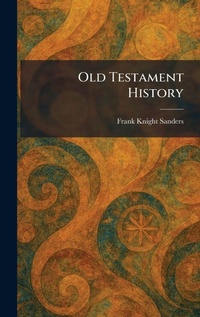
Old Testament History
Description
"Old Testament History" by Frank Knight Sanders provides a comprehensive and scholarly overview of the historical narrative found within the Hebrew Bible. Designed as a guide for students and serious readers, the work traces the development of the Hebrew people from their ancestral beginnings through the Babylonian exile and into the post-exilic period. Sanders expertly navigates the chronological sequence of events, offering insights into the political, social, and religious transformations that shaped the identity of ancient Israel.
This volume focuses on the significance of the biblical narrative as a foundational element of religious history. It examines the roles of patriarchs, prophets, and kings, placing their stories within the broader context of the ancient Near East. By synthesizing archaeological insights and meticulous biblical analysis, "Old Testament History" remains a valuable resource for those seeking to understand the historical framework of the Old Testament and the enduring legacy of its teachings. Through its clear structure and insightful commentary, the work highlights the evolution of monotheism and the cultural heritage of the Jewish people, making it an essential text for biblical studies and historical research.
This work has been selected by scholars as being culturally important, and is part of the knowledge base of civilization as we know it. This work was reproduced from the original artifact, and remains as true to the original work as possible. Therefore, you may see the original copyright references, library stamps (as most of these works have been housed in our most important libraries around the world), and other notations in the work.
This work is in the public domain in the United States of America, and possibly other nations. Within the United States, you may freely copy and distribute this work, as no entity (individual or corporate) has a copyright on the body of the work.
As a reproduction of a historical artifact, this work may contain missing or blurred pages, poor pictures, errant marks, etc. Scholars believe, and we concur, that this work is important enough to be preserved, reproduced, and made generally available to the public. We appreciate your support of the preservation process, and thank you for being an important part of keeping this knowledge alive and relevant.