

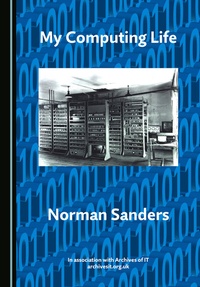
My Computing Life
Published on 23. February 2021
Book
Hardback
125 pages
978-1-5275-6216-5 (ISBN)
Description
This book covers the history of an important window of the computer era from about 1950 to 1970. No one proclaimed it: computing evolved haphazardly, as people and equipment sparked progress. Academics and engineers invented the computer in several places at more or less the same time, but it was a different profession-programming-that ushered it into business, government and defence. More recently of course, computing in the form of phones and tablets has become accessible to over five billion people around the world. What was originally intended solely as an arithmetic machine evolved in less than a century into a cornerstone of global society. No one saw this coming.The book will appeal to historians and teachers of technology and sociology; it should also resonate with managers, technologists and politicians. In addition, anyone who has ever wondered where the phone in their pocket came from, or how their PC and iPad came to be, will also be interested in the early days of computing, how the pioneers laid the platform to the global social revolution which is still upon us.
More details
Edition
Unabridged edition
Language
English
Place of publication
Newcastle upon Tyne
United Kingdom
Target group
Professional and scholarly
Edition type
Unabridged edition
Product notice
With dust jacket
Dimensions
Height: 212 mm
Width: 148 mm
ISBN-13
978-1-5275-6216-5 (9781527562165)
Copyright in bibliographic data and cover images is held by Nielsen Book Services Limited or by the publishers or by their respective licensors: all rights reserved.
Schweitzer Classification
Other editions
Additional editions

Norman Sanders
My Computing Life
Book
04/2023
Cambridge Scholars Publishing
€57.13
Shipment within 15-20 days
Norman Sanders
My Computing Life
E-Book
01/2021
1st Edition
Cambridge Scholars Publishing
€204.99
Available for download
Person
Norman Sanders is a retired computer programmer from the very beginning of the modern computer era. He helped forge the link between computer manufacturers and the organisations that gradually, and sometimes despite themselves, embraced the benefits computers brought. He is a mathematician from Cambridge University, and his involvement in this new cultural and industrial revolution took him to a wide span of organisations, including the University of British Columbia and the Norwegian Technical University, Boeing, UNIVAC and the United Nations. He was also influential in bringing the computer to bear on British industry through his friendship with Prime Minister Sir Harold Wilson. His career has been that of a practitioner coping with the ecological intrusion of this radically new technology in otherwise traditional enterprises; essentially transforming what had been originally intended solely as an automatic arithmetic device into a tool for the world's factories.