

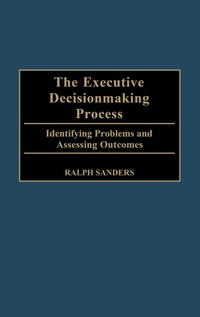
The Executive Decisionmaking Process
Identifying Problems and Assessing Outcomes
Published on 30. September 1999
Book
Hardback
192 pages
978-1-56720-293-9 (ISBN)
Description
Decisionmaking literature, which has emphasized the act of solving problems, has long neglected the need to identify problems as precisely as possible. This book examines the nature of problems and decisionmaking and their impact on people who direct an organization. It further focuses on how executives respond to take action at the upper levels of their organizations.
The book stresses problem identification, which executives frequently ignore because of their preoccupation with problem solving. It looks at the need to avoid viewing solutions as remedies achieved at predetermined milestones. It examines options other than solutions, such as accommodation and coping, and it looks at the executive environment associated with outcomes along a spectrum ranging from perfection, to progress, to failure. The author argues that executives should abandon the attempt to predetermine objectives over time and adopt a Problem Exchange Ratio (PER) concept. The executive then compares the status of problems over time, creating a ratio. The PER approach considers the problems that solutions themselves trigger. It then allows executives to see where they stand and suggests ways of ameliorating unwanted conditions. The author provides illustrative cases and episodes from both the public and private sectors. Combining theory and practical aspects of executive decisionmaking, this book gives the reader a fuller understanding of the link between decisions and problems.
The book stresses problem identification, which executives frequently ignore because of their preoccupation with problem solving. It looks at the need to avoid viewing solutions as remedies achieved at predetermined milestones. It examines options other than solutions, such as accommodation and coping, and it looks at the executive environment associated with outcomes along a spectrum ranging from perfection, to progress, to failure. The author argues that executives should abandon the attempt to predetermine objectives over time and adopt a Problem Exchange Ratio (PER) concept. The executive then compares the status of problems over time, creating a ratio. The PER approach considers the problems that solutions themselves trigger. It then allows executives to see where they stand and suggests ways of ameliorating unwanted conditions. The author provides illustrative cases and episodes from both the public and private sectors. Combining theory and practical aspects of executive decisionmaking, this book gives the reader a fuller understanding of the link between decisions and problems.
More details
Language
English
Place of publication
United States
Publishing group
Bloomsbury Publishing Plc
Target group
College/higher education
Professional and scholarly
Dimensions
Height: 240 mm
Width: 161 mm
Thickness: 15 mm
Weight
458 gr
ISBN-13
978-1-56720-293-9 (9781567202939)
Copyright in bibliographic data and cover images is held by Nielsen Book Services Limited or by the publishers or by their respective licensors: all rights reserved.
Schweitzer Classification
Other editions
Additional editions
E-Book
09/1999
1st Edition
Praeger Publishers Inc
€82.49
Available for download
Person
RALPH SANDERS is J. Carlton Ward, Jr. Distinguished Professor Emeritus at the National Defense University/Industrial College of the Armed Forces. He taught part-time at American University and at Johns Hopkins University, and served at the White House and on the staff of the secretary of defense. He is the recipient of the Army's highest civilian award. He has published extensively, including the books Arms Industries: New Supplies and Regional Security (1990) and International Dynamics of Technology (Greenwood Press, 1983).
Content
Preface Problem Identification Introduction Doing the Job The Information Base Information Tendencies Different Prisms Critical Factors Hidden Information Skills Alternate Outcomes Problem Substitution Degrees of Effectiveness Perceived Outcomes References