

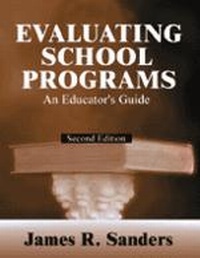
Evaluating School Programs
An Educator's Guide
2nd Edition
Published on 29. June 2000
Book
Hardback
88 pages
978-0-7619-7502-1 (ISBN)
Description
This guide was written to provide teachers and administrators in primary and secondary school systems with basic programme evaluation principals and procedures to aid them in planning and evaluating school programmes.
Evaluating School Programs provides concise, yet comprehensive coverage of a complex topic in a highly usable format. It will take the reader through the five tasks of school programme evaluation (focusing the evaluation, collecting information, organizing and analyzing information, reporting information, and administering the evaluation), providing examples along the way. The examples are designed to help the reader develop competence and confidence in programme evaluation. James Sanders shows how to successfully manage the many logistical, budgetary, and scheduling problems encountered, and provides tips on how to deal with school politics, ethical considerations, and interpersonal relations as well.
Evaluating School Programs provides concise, yet comprehensive coverage of a complex topic in a highly usable format. It will take the reader through the five tasks of school programme evaluation (focusing the evaluation, collecting information, organizing and analyzing information, reporting information, and administering the evaluation), providing examples along the way. The examples are designed to help the reader develop competence and confidence in programme evaluation. James Sanders shows how to successfully manage the many logistical, budgetary, and scheduling problems encountered, and provides tips on how to deal with school politics, ethical considerations, and interpersonal relations as well.
More details
Edition
2nd Revised edition
Language
English
Place of publication
Thousand Oaks
United States
Publishing group
SAGE Publications Inc
Target group
Professional and scholarly
Edition type
Revised edition
Dimensions
Height: 279 mm
Width: 216 mm
Weight
567 gr
ISBN-13
978-0-7619-7502-1 (9780761975021)
Copyright in bibliographic data and cover images is held by Nielsen Book Services Limited or by the publishers or by their respective licensors: all rights reserved.
Schweitzer Classification
Other editions
New editions
Book
02/2006
3rd Edition
Corwin Press Inc
€90.57
Shipment within 10-20 days
Person
James R. Sanders is Professor of Education and Associate Director of the Evaluation Center at Western Michigan University. He received his master's degree in educational research from Bucknell University and his PhD in educational research and evaluation from the University of Colorado. He has served as a visiting professor at St. Patrick's College (in Dublin, Ireland), Utah State University, and the University of British Columbia. He is coauthor of Educational Evaluation:Theory and Practice (1973), Practices and Problems in Competency-Based Measurement (1979), Educational Evaluation: Alternative Approaches and Practical Guidelines (1987), and Program Evaluation (2004). He is author or coauthor of numerous articles, monographs, and technical reports in the area of program evaluation. His articles have appeared in Review of Educational Research, Educational Researcher, Educational and Psychological Measurement, Journal of Educational Psychology, Journal of School Psychology, New Directions for Program Evaluation, Evaluation News, Educational Technology, Journal of Research and Development in Education, Educational Measurement, and American Journal of Evaluation.
James R. Sanders has served as director or codirector of training institutes in evaluation for the American Educational Research Association, the American Evaluation Association, the Association for Supervision and Curriculum Development, and the Western Michigan University Evaluation Center. He has served as a member of the board of directors for the Evaluation Network and the American Evaluation Association and on standing committees for the American Educational Research Association, the National Council on Measurement in Education, the National Science Foundation, Phi Delta Kappa, Independent Sector, and the United Way of America. He has directed research and evaluation projects funded by the U.S. Department of Defense, U.S. Department of Education, National Science Foundation, and several state agencies. He has consulted with numerous school districts, private industries, instructional businesses, government agencies, research and development corporations, community agencies, and major universities. From 1988 to 1998, he served as chair of the Joint Committee on Standards for Educational Evaluation, a coalition of 16 professional organizations concerned with the quality of evaluations done in education. He was elected by the American Evaluation Association to serve as President-elect in 2000, President in 2001, and Past President in 2002.
James R. Sanders has served as director or codirector of training institutes in evaluation for the American Educational Research Association, the American Evaluation Association, the Association for Supervision and Curriculum Development, and the Western Michigan University Evaluation Center. He has served as a member of the board of directors for the Evaluation Network and the American Evaluation Association and on standing committees for the American Educational Research Association, the National Council on Measurement in Education, the National Science Foundation, Phi Delta Kappa, Independent Sector, and the United Way of America. He has directed research and evaluation projects funded by the U.S. Department of Defense, U.S. Department of Education, National Science Foundation, and several state agencies. He has consulted with numerous school districts, private industries, instructional businesses, government agencies, research and development corporations, community agencies, and major universities. From 1988 to 1998, he served as chair of the Joint Committee on Standards for Educational Evaluation, a coalition of 16 professional organizations concerned with the quality of evaluations done in education. He was elected by the American Evaluation Association to serve as President-elect in 2000, President in 2001, and Past President in 2002.
Content
Acknowledgments
About the Author
Introduction: The Purpose of This Guide and How to Use It
1. Why Evaluate Your School Programs?
2. Focusing the Evaluation
3. Collecting Information
4. Organizing and Analyzing Information
5. Reporting Information
6. Administering the Evaluation
Epilogue
Resource A: Annotated Bibliography on Program Evaluation
Resource B: Taxonomy of Cognitive Objectives
Resource C: Standards for Program Evaluations
References
Index
About the Author
Introduction: The Purpose of This Guide and How to Use It
1. Why Evaluate Your School Programs?
2. Focusing the Evaluation
3. Collecting Information
4. Organizing and Analyzing Information
5. Reporting Information
6. Administering the Evaluation
Epilogue
Resource A: Annotated Bibliography on Program Evaluation
Resource B: Taxonomy of Cognitive Objectives
Resource C: Standards for Program Evaluations
References
Index