

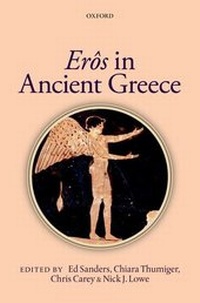
Eros in Ancient Greece
Published on 31. January 2013
Book
Hardback
368 pages
978-0-19-960550-7 (ISBN)
Description
This edited volume brings together eighteen articles which examine the role of eros as an emotion in ancient Greek culture. Arising out of a conference held at University College London in 2009, the volume ranges from Archaic epic and lyric poetry, through tragedy and comedy, to philosophical and technical treatises and more, and includes contributions from a variety of international scholars well published in the field of ancient Greek emotions.
Taking into account all important thinking about the nature of eros from the eighth century BCE to the third century CE, and covering a very broad range of sources and theoretical approaches, both in the chronological and the generic sense, it considers the phenomenology, psychology, and physiology of eros; its associated language, metaphors, and imagery; the overlap of eros with other emotions (jealousy, madness, philia, pothos); its role in political society; and the relationship between the human emotion and Eros the god. These topics build on recent advances in the understanding of ancient Greek homo- and heterosexual customs and practices, visual and textual erotica, and philosophical approaches to eros as manageable appetite or passion. However, the principal aim of the volume is to apply to the study of eros the theoretical insights offered by the rapidly expanding field of emotion studies, both in ancient cultures and elsewhere in the humanities and social sciences, thus maintaining throughout the focus on eros as emotion.
Taking into account all important thinking about the nature of eros from the eighth century BCE to the third century CE, and covering a very broad range of sources and theoretical approaches, both in the chronological and the generic sense, it considers the phenomenology, psychology, and physiology of eros; its associated language, metaphors, and imagery; the overlap of eros with other emotions (jealousy, madness, philia, pothos); its role in political society; and the relationship between the human emotion and Eros the god. These topics build on recent advances in the understanding of ancient Greek homo- and heterosexual customs and practices, visual and textual erotica, and philosophical approaches to eros as manageable appetite or passion. However, the principal aim of the volume is to apply to the study of eros the theoretical insights offered by the rapidly expanding field of emotion studies, both in ancient cultures and elsewhere in the humanities and social sciences, thus maintaining throughout the focus on eros as emotion.
Reviews / Votes
There are many delights in this substantial volume. * Helen Morales, The Times Literary Supplement *More details
Language
English
Place of publication
Oxford
United Kingdom
Target group
College/higher education
This volume will be of interest to students and scholars interested in Classical studies, ancient philosophy, psychology, and socialogy; as well as historians of emotions and emotionologists.
Illustrations
13 in-text black and white illustrations
Dimensions
Height: 240 mm
Width: 162 mm
Thickness: 26 mm
Weight
702 gr
ISBN-13
978-0-19-960550-7 (9780199605507)
Copyright in bibliographic data and cover images is held by Nielsen Book Services Limited or by the publishers or by their respective licensors: all rights reserved.
Schweitzer Classification
Persons
Ed Sanders is a Leverhulme Early Career Fellow at Royal Holloway, University of London. His research focuses on emotions in ancient Greece, especially in the literature of the Classical period. His forthcoming monograph, based on his PhD, is entitled Envy and Jealousy in Classical Athens (OUP).
Chiara Thumiger is a Research Associate at the Humboldt Universitaet zu Berlin. Her present research focuses on mental insanity and its ancient representations in the Hippocratic texts and other literary sources. She has also worked on Greek tragedy and on animals in ancient literature, and is the author of Hidden Paths: Self and Characterization in Greek tragedy: Euripides' Bacchae.
Christopher Carey is Professor of Greek at University College London. His research interests are very broad, including Pindar, drama, and above all oratory. He is the author of Democracy in Classical Athens as well as a large number of articles. He has also published a range of translations, commentaries, and edited volumes, in particular relating to the Attic oratorical corpus; these include the recent Oxford Classical Text Lysiae orationes cum fragmentis (Oxford, 2007), The speeches of Aeschines, Lysias: Selected Speeches, and Trials from Classical Athens.
Nick J. Lowe is Reader in Classical Literature at Royal Holloway, University of London. He is both a Greek and Latin literary specialist, and is particularly interested in comedy, prose fiction, narrative, and the interface between literary theory and cognitive science. He is the author of The Classical Plot and the Invention of Western Narrative and Comedy.
Chiara Thumiger is a Research Associate at the Humboldt Universitaet zu Berlin. Her present research focuses on mental insanity and its ancient representations in the Hippocratic texts and other literary sources. She has also worked on Greek tragedy and on animals in ancient literature, and is the author of Hidden Paths: Self and Characterization in Greek tragedy: Euripides' Bacchae.
Christopher Carey is Professor of Greek at University College London. His research interests are very broad, including Pindar, drama, and above all oratory. He is the author of Democracy in Classical Athens as well as a large number of articles. He has also published a range of translations, commentaries, and edited volumes, in particular relating to the Attic oratorical corpus; these include the recent Oxford Classical Text Lysiae orationes cum fragmentis (Oxford, 2007), The speeches of Aeschines, Lysias: Selected Speeches, and Trials from Classical Athens.
Nick J. Lowe is Reader in Classical Literature at Royal Holloway, University of London. He is both a Greek and Latin literary specialist, and is particularly interested in comedy, prose fiction, narrative, and the interface between literary theory and cognitive science. He is the author of The Classical Plot and the Invention of Western Narrative and Comedy.
Content
PREFACE; ACKNOWLEDGEMENTS; ABBREVIATIONS; NOTES; LIST OF CONTRIBUTORS; PART 1: PHENOMENOLOGY AND PSYCHOLOGY OF EROS; PART 2: DEFINING EROS: PHILOSOPHY AND SCIENCE; PART 3: DIVINE EROS AND HUMAN EROS; PART 4: IMAGERY AND LANGUAGE OF EROS; BIBLIOGRAPHY; INDEX