

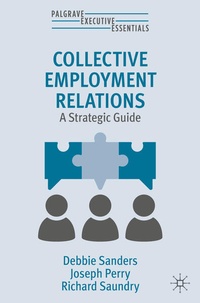
Collective Employment Relations
Description
In an era of rapid technological, economic and political change, there is a growing awareness of the challenges of income inequality, employment insecurity and workplace conflict. In this context, positive relationships between management and trade unions offer an opportunity to negotiate change and create fairer and more productive workplaces. Part of the Palgrave Executive Essentials series, this engaging text is the only dedicated resource for executive learners, professionals and students of human resources and labour relations, providing a strategic management guide to employee relations in the unionised workplace. Combining theory with practical examples and tools relating to negotiations with unions and management of a unionised workforce, this book is a one-stop-shop for students, instructors and practitioners looking to supplement their understanding of employment relations with hands-on knowledge of this vitally important context. It includes case studies, reflective questions, suggested resources and further reading for additional learning. It will be a vital resource for executive education courses on employment relations and managing a unionised workforce, as well as MBA students and exec-MA students, as well as the wider practitioner community.
Reviews / Votes
"This is a timely contribution to the debate about the future of employee and Union relations. If there is one thing practitioners agree on, it is that we must rediscover the skills of negotiation and compromise to address the good work agenda, productivity challenges and technological change. The narrative asks searching questions of the prevailing HR orthodoxy of the last few decades and is essential reading for those studying and working in the field of employee relations." (Mike Clancy, General Secretary, Prospect, UK)
"A brilliant book which is essential reading for anyone studying industrial relations or who works with trade unions and must create an industrial relations strategy. The authors capture the essential skills needed by every industrial relations practitioner." (Emily Cox, Director of Colleague Relations, Lloyds Banking Group, UK)
"This is a very welcome and timely book, which explains how collective employment relations and collective voice, despite being marginalised within many HR departments, have become increasingly relevant in recent years. It makes a compelling case for a more strategic approach to the development of high-trust employment relations and for engaging constructively with trade unions. Drawing on a wealth of case study examples, it offers clear guidance to practitioners in developing and evaluating organisational policies around consultation, negotiation and conflict management. Written in an engaging and accessible style, it will be a superb resource for under-graduate students, those taking CIPD-accredited courses, as well as for managers and trade union representatives." (Chris Rees, Professor of Employment Relations, Royal Holloway, University of London, UK)
More details
Other editions
Additional editions
Persons
Debbie Sanders is an employment relations specialist with over 30 years' experience as a consultant, researcher, writer, and lecturer in this field. She has also led ER teams in unionised companies and been a union official. Today she runs Make Work Better, an employment relations consultancy, where she designed and delivers an executive education programme for some of the UK's largest unionised organisations, helping to build capability in collective employment relations.
Joseph Perry has extensive employment relations experience in unionised public, private and third-sector organisations including transport, law enforcement, utilities and politics. He has led HR and ER functions and worked internationally supporting organisations to achieve their goals through the effective management of collective employment relations and high performing teams. Joseph co-delivers the UKs only executive education programme for employment relations with Debbie Sanders. He studied Industrial Relations at the University of Keele.
Richard Saundry is a leading academic authority on the management of discipline, grievance and workplace conflict. Having previously held posts at the Universities of Leeds, Sheffield, Central Lancashire and Plymouth, he is currently working on the development of the groundbreaking Skilled Managers research project at the University of Westminster. He is an author of 'Managing Employment Relations', the core CIPD text for Employee Relations, and edited 'Reframing Resolution' (Palgrave Macmillan, 2016). His research has been published in a wide range of leading international academic journals.
Content
Part I Introduction and Context .- Chapter 1 Introduction.- Chapter 2 Context and Concepts in Contemporary Collective Employment Relations.- Part II Strategy and Implementation .- Chapter 3 Creating an Effective Employment Relations Strategy.- Chapter 4 Building Employment Relations Teams.- Chapter 5 Constructive Behaviours for Effective Employment Relations.- Part III Working with Unions and Collective Voic e.- Chapter 6 Informing and Consulting - Practical Processes and Structures for Employee Voice.- Chapter 7 Negotiation in Collective Employment Relations.- Chapter 8 Problem-solving with trade unions.- Part IV Managing Conflict .- Chapter 9 Managing industrial action.- Chapter 10 Rebuilding employment relationships.- Chapter 11 Measurement, evaluation and reporting .- Chapter 12 Concluding remarks - Building a strategic approach to employment relations.