

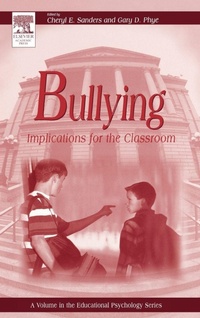
Bullying
Implications for the Classroom
Published on 11. June 2004
Book
Hardback
261 pages
978-0-12-617955-2 (ISBN)
Description
In recent years there have been an increasing number of incidents where children have either perpetrated or been the victims of violence in the schools. Often times the children who perpetrated the violence had been the victims of school bullying. If bullying once was a matter of extorting lunch money from one's peers, it has since escalated into slander, sexual harassment, and violence. And the victims, unable to find relief, become depressed and/or violent in return.Despite all the media attention on recent school tragedies, many of which can be traced to bullied children, there has been little in the way of research-based books toward understanding why and how bullying occurs, the effects on all the individuals involved and the most effective intervention techniques. Summarizing research in education, social, developmental, and counseling psychology, Bullying: Implications for the Classroom examines the personality and background of both those who become bullies and those most likely to become their victims, how families, peers, and schools influence bullying behavior, and the most effective interventions in pre-school, primary and middle schools. Intended for researchers, educators, and professionals in related fields, this book provides an international review of research on bullying.KEY FEATURES:* Presents practical ideas regarding prevention/intervention of bullying* Covers theoretical views of bullying* Provides an international perspective on bullying * Discusses bullying similarities and differences in elementary and middle school
Reviews / Votes
"The editors of this volume present a comprehensive collection of empirically derived chapters ranging from theoretical reviews to program evaluation. In one review, the characteristics of victims and the cycle of bullying are examined from the perspective of social learning theory. Further theorizing focuses on social-biological-evolutionary explanations and the role of dominance. Group theory is also included with respect to peer acceptance, belonging, and group culture. Literature on family, peer, and school influences is reviewed, as is the contribution of factors such as gender, age, and heterosexual relationships. The roles of personality characteristics and self-concept are addressed through research conducted in school settings. Early interventions throughout the preschool and elementary school levels are reviewed with examples of school-based programs that have withstood rigorous evaluations. Systemic prevention programs are critiqued for effectiveness and limitations, and suggestions for improvement are made. In all, this volume contains a wealth of empirical information on what has become a particularly salient aspect of the current culture children are exposed to during their school years. Individuals who work with children in many capacities, including teachers, counselors, and other school personnel, will find this an invaluable resource. Summing Up: Highly recommended. Upper-division undergraduates and above."-CHOICE
"...provides an excellent overview of current research in the are of school-based bullying."
-Caroline Hunt, JOURNAL OF ADOLESCENCE 29 (2006)
More details
Series
Language
English
Place of publication
San Diego
United States
Publishing group
Elsevier Science Publishing Co Inc
Target group
Professional and scholarly
Researchers in educational psychology, developmental psychology, and social psychology.
Product notice
Laminated cover
Dimensions
Height: 229 mm
Width: 152 mm
Thickness: 18 mm
Weight
556 gr
ISBN-13
978-0-12-617955-2 (9780126179552)
Copyright in bibliographic data and cover images is held by Nielsen Book Services Limited or by the publishers or by their respective licensors: all rights reserved.
Schweitzer Classification
Other editions
Additional editions
E-Book
05/2014
Academic Press
€85.95
Available for download
Persons
Gary D. Phye, Past President of the Iowa Educational Research and Evaluation Association, is the new editor of the Academic Press Educational Psychology Book Series. He has published numerous research articles and book chapters in the areas of classroom learning and transfer. He previously co-edited two of the bestselling volumes in the book series: School Psychology with Dan Reschly and Cognitive Classroom Learning with Tom Andre. In addition to being the co-author of an undergraduate educational psychology text, Dr. Phye has also co-authored (with K. Josef Klauer) a newly-published program designed to teach and assess the inductive reasoning and metacognitive strategies of young children. Dr. Phye is currently working with the Ames Community public schools in the training and assessment of inductive reasoning strategies of special needs children in primary and intermediate grades.
Content
C.E. Sanders, What is Bullying?
X. Ma, Who are the Victims?
A. Nishina, A Theoretical Review of Bullying: Can it be Eliminated?
H.W. Marsh, R.H. Parada, R.G. Craven, and L. Finger, In the Looking Glass: A Reciprocal Effect Model Eludicating the Complex Nature of Bullying, Psychological Determinants, and the Central Role of Self-Concept.
J.R. Holmes and H.A. Holmes-Lonergan, The Bully in the Family: Family Influences on Bullying.
H. Cowie, Peer Influences.
A.A. Payne and D.C. Gottfredson, Schools and Bullying: School Factors Related to Bullying and School-Based Bullying Interventions.
A.D. Pelligrini, Bullying During Middle School Years.
F.L. Samples, Evaluating Curriculum-Based Intervention Programs: An Examination of Preschool, Primary, and Elementary Intervention Programs.
J. Juvonen and S. Graham, Research Based Interventions on Bullying.
X. Ma, Who are the Victims?
A. Nishina, A Theoretical Review of Bullying: Can it be Eliminated?
H.W. Marsh, R.H. Parada, R.G. Craven, and L. Finger, In the Looking Glass: A Reciprocal Effect Model Eludicating the Complex Nature of Bullying, Psychological Determinants, and the Central Role of Self-Concept.
J.R. Holmes and H.A. Holmes-Lonergan, The Bully in the Family: Family Influences on Bullying.
H. Cowie, Peer Influences.
A.A. Payne and D.C. Gottfredson, Schools and Bullying: School Factors Related to Bullying and School-Based Bullying Interventions.
A.D. Pelligrini, Bullying During Middle School Years.
F.L. Samples, Evaluating Curriculum-Based Intervention Programs: An Examination of Preschool, Primary, and Elementary Intervention Programs.
J. Juvonen and S. Graham, Research Based Interventions on Bullying.