

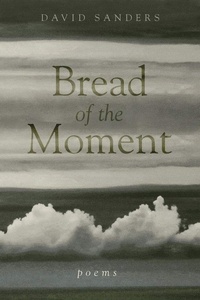
Bread of the Moment
Description
Bread of the Moment, the follow-up to David Sanders' Compass and Clock (Swallow Press, 2016), devotes keen attention to the porous nature of the past and how the unbidden evidence of ordinary life pervades the world, provoking a spectrum of moments from which to draw meaning and find solace. These poems, characterized by a mix of free and formal verse, depict quiet days at home or in nature, as well as close calls and brushes with death: chronic illness, a house fire, a car crushed by a boulder.
In this way, these poems amplify the fragility of the commonplace, a mystery from which we are, amid the noise of our everyday lives, sometimes estranged. Through this exploration, Sanders constructs a precarious balance between alienation and acceptance, striking a note at once recognizable and new.
Reviews / Votes
"The poems in David Sanders's beautifully balanced new collection, Bread of the Moment, reach as deeply as any I know, achieving the emotional clarity of poets like Robert Hayden, Robert Hass, and W. S. Merwin. This is wise, expertly crafted work, facing mortality with humor sufficient to the need and with reverent attention to memory, nature, and the poet's art. I am profoundly moved and instructed by this lucid book." "David Sanders's second collection of poems, Bread of the Moment, contains an astonishing breadth of emotional and physical landscapes in poems beautifully realized and forcefully felt. It is a book haunted by memory-understood as a 'selective, mythic thing, a lie'-and alive with strikingly memorable images, like the French king's hunting trophies, 'sprouting enormous racks, / like dozens of arms, hands, / reaching out to me from the stone blocks, / frozen, locked in place.' Bread of the Moment is an evocative book, a dynamic expression, and expansion, of Sanders's art." "'Every time/ is the last time. That's what the world keeps teaching.' Bread of the Moment's truths are hard won, but its delights are palpable. It is night swimming in cold lake water full of stars." "David Sanders peers into the psychology of a charged or puzzling moment, in most of these poems. Living through such moments can be painful and yet the pondering of them brings a kind of nourishment. In 'So, I Tell Myself' he contemplates an odd confluence of small misfortunes, and the poem enables him to escape from a paranoid interpretation of that confluence. 'Matinee' notices how a mood of inflated pride (as when you see yourself as Cary Grant or Gregory Peck) inevitably must come down to street level-though a poised account of this humbling descent allows for the more sustainable stardom of poetic insight."More details
Other editions
Additional editions
Person
Content
One
Politics (A Walk through the Woods)
The Blue Danube
Waiting to Happen
Wedding Day (Bird Trapped in a Flue)
Matinée
Chatelaine
The Break-In
The Slide
Exercise (Cul-de-sac)
Abandoned Nests Exposed by Winter
Meal of Dreams
The House on Fire across the Street
Self-Portrait as a Fly on the Wall of Modern History
Morning Frost along the River
The Luxury of Light Horses
Another Poem Beginning with the Weather: An Elegy
Art Lessons from the Past
Particulates
Self-Portrait with Antlers
Banking and Turning
Full Moon, Dow Lake, July
Two
Election-Day Raccoon
The Two of Us
After Learning of the Death of a Roommate I Hadn’t Seen in Forty Years
Holiday Party with Roses
Talking to Old People
Emanation
So, I Tell Myself
Autumn and the End of Autumn
In His Defense
Wood Frogs
Letter to the Editor
Utility
My Books
What We Don’t Know
Common Wisdom
A Kind of Proof
Dear Vulture
Early March, with Horses
Reasons Not to Leave
To an Old Friend Whose Politics Have Changed
[Enter ghost]
Morning Sleet