

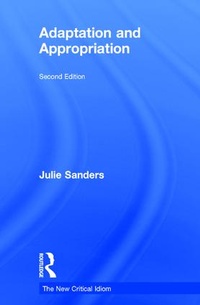
Adaptation and Appropriation
2nd Edition
Published on 30. November 2015
Book
Hardback
240 pages
978-1-138-82898-8 (ISBN)
Description
From the apparently simple adaptation of a text into film, theatre or a new literary work, to the more complex appropriation of style or meaning, it is arguable that all texts are somehow connected to a network of existing texts and art forms. In this new edition Adaptation and Appropriation explores:
multiple definitions and practices of adaptation and appropriation
the cultural and aesthetic politics behind the impulse to adapt
the global and local dimensions of adaptation
the impact of new digital technologies on ideas of making, originality and customization
diverse ways in which contemporary literature, theatre, television and film adapt, revise and reimagine other works of art
the impact on adaptation and appropriation of theoretical movements, including structuralism, post-structuralism, postcolonialism, postmodernism, feminism and gender studies
the appropriation across time and across cultures of specific canonical texts, by Shakespeare, Dickens, and others, but also of literary archetypes such as myth or fairy tale.
Ranging across genres and harnessing concepts from fields as diverse as musicology and the natural sciences, this volume brings clarity to the complex debates around adaptation and appropriation, offering a much-needed resource for those studying literature, film, media or culture.
multiple definitions and practices of adaptation and appropriation
the cultural and aesthetic politics behind the impulse to adapt
the global and local dimensions of adaptation
the impact of new digital technologies on ideas of making, originality and customization
diverse ways in which contemporary literature, theatre, television and film adapt, revise and reimagine other works of art
the impact on adaptation and appropriation of theoretical movements, including structuralism, post-structuralism, postcolonialism, postmodernism, feminism and gender studies
the appropriation across time and across cultures of specific canonical texts, by Shakespeare, Dickens, and others, but also of literary archetypes such as myth or fairy tale.
Ranging across genres and harnessing concepts from fields as diverse as musicology and the natural sciences, this volume brings clarity to the complex debates around adaptation and appropriation, offering a much-needed resource for those studying literature, film, media or culture.
More details
Series
Edition
2nd edition
Language
English
Place of publication
London
United Kingdom
Publishing group
Taylor & Francis Ltd
Target group
College/higher education
Undergraduate Core
Dimensions
Height: 198 mm
Width: 129 mm
Weight
560 gr
ISBN-13
978-1-138-82898-8 (9781138828988)
Copyright in bibliographic data and cover images is held by Nielsen Book Services Limited or by the publishers or by their respective licensors: all rights reserved.
Schweitzer Classification
Other editions
Additional editions
Julie Sanders
Adaptation and Appropriation
Book
11/2015
2nd Edition
Routledge
€39.60
Shipment within 10-20 days
Julie Sanders
Adaptation and Appropriation
E-Book
11/2015
2nd Edition
Routledge
€35.49
Available for download
Julie Sanders
Adaptation and Appropriation
E-Book
11/2015
2nd Edition
Routledge
€35.49
Available for download
Previous edition
Julie Sanders
Adaptation and Appropriation
Book
10/2005
Routledge
€106.66
Article exhausted; check for reprint
Person
Julie Sanders is Professor of English and Pro-Vice-Chancellor for Humanities and Social Sciences at Newcastle University, UK.
Content
Series Editor's preface Acknowledgements Introduction: Going On (and on) Part 1: Defining Terms 1. What is adaptation? 2. What is appropriation? Part 2: Literary Archetypes 3. 'Here's a strange alteration': Shakespearean appropriations 4. 'It's a very old story': myth and metamorphosis 5. 'Other versions' of fairy tale and folklore Part 3: Alternative Perspectives 6. Constructing alternative points of view 7. 'We "Other Victorians": or, rethinking the nineteenth century 8. Stretching history; or, appropriating the facts 9. Customized narratives: copying and the work of art in the age of reproducibility Afterword: Different versions Glossary Bibliography Index