

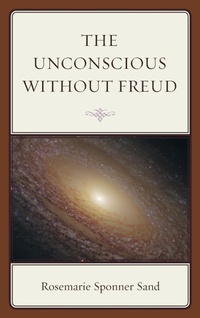
The Unconscious without Freud
Published on 18. December 2013
Book
Hardback
188 pages
978-1-4422-3173-3 (ISBN)
Description
During the first ten years of his career in psychological medicine, Sigmund Freud espoused a theory of unconsciousness which predated his own. As Rosemarie Sand describes in The Unconscious without Freud, he would evolve this theory over the course of his career and eventually apply it to his own psychological practice. Once Freud's hypothesis of unconscious mental functioning was published, the same professionals who had valued the traditional concept turned against what they considered to be a catastrophic, logically indefensible revision. The scientific investigation of unconscious influences was retarded for decades as a war zone opened between implacable opponents and intransigent defenders of the Freudian concept of unconscious mind. In the din of this battle, the traditional theory, free of the features which Freud's foes could not accept, was forgotten. Sand argues that a return to this original theory, which psychotherapists and experimenters might both espouse, could contribute to a cessation of hostilities and lead to the peaceful development of a theory of the unconscious-one that is free from the stigma that is currently attached to Freudian theory.
Reviews / Votes
Rosemarie Sand has resurrected the splendid theory of unconscious mental functioning proposed by G.W. Leibniz at the beginning of the eighteenth century, together with the contributions of Christian Wolff and other disciples during the following decades. The teaching of this Leibniz-Wolffian psychology was highly regarded and widely accepted during the nineteenth century. Freud himself relied on its conceptualization of unconscious mind during the decade before he created his own first theory. Its immediate, potential importance today is attributable to its being unencumbered by the controversial 'Freudian' features to which critics have objected, the grounds for the interminable 'Freud wars.' Devoid of these obstacles, the Leibnizian vision could easily serve as the common denominator for diverse Freudian schools; it could also render service as a common ground where psychoanalytic theoreticians and the experimenters of cognitive psychology could meet. -- Adolf Gruenbaum PhD, Andrew Mellon Professor of Philosophy, University of Pittsburgh This is a brilliant book. Sigmund Freud's seminal discussions of the unconscious mind are well known to the general educated public. Less well known are the contributions to the subject made by Freud's predecessors. What Rosemarie Sand has done is to show in detail using previously untranslated German sources that in the eighteenth and nineteenth centuries, there were far more than hints, brief comments, and allusions to unconscious mentality. Beginning with Leibniz's impressive contributions to psychology, there were well worked out theories and entire schools of thought devoted to the study of the unconscious culminating in the major works of the nineteenth century scholars Heinz Hartmann and Jonathan Herbart. In present day discussions of consciousness, most of the contributions of these pre-Freudian theorists of the unconscious tend to be ignored except by a few specialists. Psychologists, philosophers, and indeed anyone interested in the human mind can profit greatly from reading Sand's The Unconscious without Freud. -- Edward Erwin, PhD, University of MiamiMore details
Series
Language
English
Place of publication
United States
Publishing group
Bloomsbury Publishing Plc
Target group
Professional and scholarly
Dimensions
Height: 235 mm
Width: 157 mm
Thickness: 15 mm
Weight
431 gr
ISBN-13
978-1-4422-3173-3 (9781442231733)
Copyright in bibliographic data and cover images is held by Nielsen Book Services Limited or by the publishers or by their respective licensors: all rights reserved.
Schweitzer Classification
Other editions
Additional editions
Rosemarie Sponner Sand
The Unconscious without Freud
E-Book
12/2013
1st Edition
Rowman & Littlefield Publishers
€107.99
Available for download
Rosemarie Sponner Sand
The Unconscious without Freud
E-Book
12/2013
1st Edition
Rowman & Littlefield Publishers
€107.99
Available for download
Person
Rosemarie Sand has been a psychoanalyst for twenty-five years. She is a member of the Institute for Psychoanalytic Training and Research and the International Psychoanalytical Association. Her works include Early Nineteenth Century Anticipation of Freudian Theory, Confirmation in the Dora Case, Pre-Freudian Discovery of Dream Meaning: the Achievements of Charcot, Janet, and Krafft-Ebing, On a Contribution to a Future Scientific Study of Dream Interpretation, and Freud and the Western Dream Tradition. She specializes in antecedents to Freudian theory.
Content
Preface
Chapter 1. Leibniz and the Unconscious
Chapter 2. Psychodynamics
Chapter 3. The Light and the Dark in the Mind
Chapter 4. The Power of Dark Ideas
Chapter 5. The Leibnizian Brain
Chapter 6. Free Association
Chapter 7. The Cartesian Unconscious
Chapter 8. The Demonic Unconscious
Chapter 9. The Romantic Imagination
Chapter 10. Schopenhauer: The Ego and the Id
Chapter 11. Hartmann: the Blockbuster
Chapter 12. The Ghost in the Freudian Mansion
Chapter 13. The Psychic Mechanism
Chapter 14. The Herbartian Legacy
References
About the Author
Chapter 1. Leibniz and the Unconscious
Chapter 2. Psychodynamics
Chapter 3. The Light and the Dark in the Mind
Chapter 4. The Power of Dark Ideas
Chapter 5. The Leibnizian Brain
Chapter 6. Free Association
Chapter 7. The Cartesian Unconscious
Chapter 8. The Demonic Unconscious
Chapter 9. The Romantic Imagination
Chapter 10. Schopenhauer: The Ego and the Id
Chapter 11. Hartmann: the Blockbuster
Chapter 12. The Ghost in the Freudian Mansion
Chapter 13. The Psychic Mechanism
Chapter 14. The Herbartian Legacy
References
About the Author