

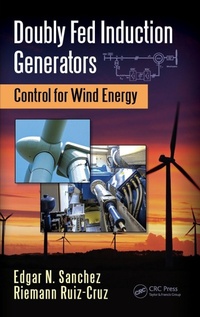
Doubly Fed Induction Generators
Control for Wind Energy
1st Edition
Published on 10. October 2016
Book
Hardback
148 pages
978-1-4987-4584-0 (ISBN)
Description
Doubly Fed Induction Generators: Control for Wind Energy provides a detailed source of information on the modeling and design of controllers for the doubly fed induction generator (DFIG) used in wind energy applications. Focusing on the use of nonlinear control techniques, this book:
Discusses the main features and advantages of the DFIG
Describes key theoretical fundamentals and the DFIG mathematical model
Develops controllers using inverse optimal control, sliding modes, and neural networks
Devises an improvement to add robustness in the presence of parametric variations
Details the results of real-time implementations
All controllers presented in the book are tested in a laboratory prototype. Comparisons between the controllers are made by analyzing statistical measures applied to the control objectives.
Discusses the main features and advantages of the DFIG
Describes key theoretical fundamentals and the DFIG mathematical model
Develops controllers using inverse optimal control, sliding modes, and neural networks
Devises an improvement to add robustness in the presence of parametric variations
Details the results of real-time implementations
All controllers presented in the book are tested in a laboratory prototype. Comparisons between the controllers are made by analyzing statistical measures applied to the control objectives.
Reviews / Votes
"... presents a comprehensive description of the modeling and control of doubly fed induction generators (DFIGs), which are cutting-edge technologies used in the wind industry. This book has taken a fresh approach to introducing various control techniques associated with the DFIG wind generator technology. This approach enables researchers, [even those] with little background knowledge, to obtain a very good understanding of the topic."-Dr. Lasantha Meegahapola, RMIT University, Melbourne, Victoria, Australia
"... focuses on the nonlinear control of DFIG systems. The sliding mode, neural network, and inverse optimal control are included in this book to investigate the operation performance of DFIGs."
-Heng Nian, Zhejiang University, Hangzhou, China
More details
Series
Language
English
Place of publication
Bosa Roca
United States
Publishing group
Taylor & Francis Inc
Target group
College/higher education
Illustrations
87 s/w Abbildungen, 11 s/w Tabellen
11 Tables, black and white; 87 Illustrations, black and white
Dimensions
Height: 240 mm
Width: 161 mm
Thickness: 14 mm
Weight
432 gr
ISBN-13
978-1-4987-4584-0 (9781498745840)
Copyright in bibliographic data and cover images is held by Nielsen Book Services Limited or by the publishers or by their respective licensors: all rights reserved.
Schweitzer Classification
Other editions
Additional editions
E-Book
08/2016
CRC Press
€271.99
Available for download
E-Book
08/2016
CRC Press
€271.99
Available for download
Persons
Edgar N. Sanchez was born in Sardinata, Colombia, in 1949. He earned the BSEE, majoring in power systems, from Universidad Industrial de Santander (UIS), Bucaramanga, Colombia, in 1971; the MSEE, majoring in automatic control, from the Advanced Studies and Research Center of the National Polytechnic Institute (CINVESTAV-IPN), Mexico City, Mexico, in 1974; and the docteur ingenieur degree in automatic control from Institut Nationale Polytechnique de Grenoble, France, in 1980. Since January 1997, he has been with CINVESTAV-IPN, Guadalajara, Mexico. He was granted a USA National Research Council Award as a research associate at NASA Langley Research Center, Hampton, Virginia, USA (January 1985 to March 1987). He is also a member of the Mexican National Research System (promoted to highest rank, III, in 2005), the Mexican Academy of Science, and the Mexican Academy of Engineering. He has published more than 200 technical papers in international journals and conferences, and has served as associate editor and reviewer for different international journals and conferences. He has also been a member of many international program committees, for both IEEE and IFAC conferences. His research interest centers on neural networks and fuzzy logic as applied to automatic control systems.
Riemann Ruiz-Cruz was born in Oaxaca, Mexico, in 1983. He earned the BSEE from Instituto Tecnologico de Oaxaca, Mexico, in 2006; and the MSEE and D.Sc. in electrical engineering from the Advanced Studies and Research Center of the National Polytechnic Institute (CINVESTAV-IPN), Guadalajara, Mexico, in 2009 and 2013, respectively. Since August 2013, he has been with Instituto Tecnologico y de Estudios Superiores de Occidente (ITESO), Guadalajara, Mexico. He is also a member of the Mexican National Research System (rank C). His research interests center on neural control, block control, inverse optimal control, and discrete-time sliding modes, and their applications to electrical machines and power systems.
Riemann Ruiz-Cruz was born in Oaxaca, Mexico, in 1983. He earned the BSEE from Instituto Tecnologico de Oaxaca, Mexico, in 2006; and the MSEE and D.Sc. in electrical engineering from the Advanced Studies and Research Center of the National Polytechnic Institute (CINVESTAV-IPN), Guadalajara, Mexico, in 2009 and 2013, respectively. Since August 2013, he has been with Instituto Tecnologico y de Estudios Superiores de Occidente (ITESO), Guadalajara, Mexico. He is also a member of the Mexican National Research System (rank C). His research interests center on neural control, block control, inverse optimal control, and discrete-time sliding modes, and their applications to electrical machines and power systems.
Content
Introduction. Mathematical Preliminaries. Modeling of Wind Turbines. DFIG Control for Renewable Energy Systems. Neural Network Control of Wind Turbine Induction Generators. Implementation of Wind Energy Testbed. Appendices. References.