

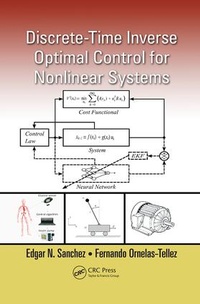
Discrete-Time Inverse Optimal Control for Nonlinear Systems
1st Edition
Published on 29. March 2017
Book
Paperback/Softback
268 pages
978-1-138-07381-4 (ISBN)
Description
Discrete-Time Inverse Optimal Control for Nonlinear Systems proposes a novel inverse optimal control scheme for stabilization and trajectory tracking of discrete-time nonlinear systems. This avoids the need to solve the associated Hamilton-Jacobi-Bellman equation and minimizes a cost functional, resulting in a more efficient controller.
Design More Efficient Controllers for Stabilization and Trajectory Tracking of Discrete-Time Nonlinear Systems
The book presents two approaches for controller synthesis: the first based on passivity theory and the second on a control Lyapunov function (CLF). The synthesized discrete-time optimal controller can be directly implemented in real-time systems. The book also proposes the use of recurrent neural networks to model discrete-time nonlinear systems. Combined with the inverse optimal control approach, such models constitute a powerful tool to deal with uncertainties such as unmodeled dynamics and disturbances.
Learn from Simulations and an In-Depth Case Study
The authors include a variety of simulations to illustrate the effectiveness of the synthesized controllers for stabilization and trajectory tracking of discrete-time nonlinear systems. An in-depth case study applies the control schemes to glycemic control in patients with type 1 diabetes mellitus, to calculate the adequate insulin delivery rate required to prevent hyperglycemia and hypoglycemia levels.
The discrete-time optimal and robust control techniques proposed can be used in a range of industrial applications, from aerospace and energy to biomedical and electromechanical systems. Highlighting optimal and efficient control algorithms, this is a valuable resource for researchers, engineers, and students working in nonlinear system control.
Design More Efficient Controllers for Stabilization and Trajectory Tracking of Discrete-Time Nonlinear Systems
The book presents two approaches for controller synthesis: the first based on passivity theory and the second on a control Lyapunov function (CLF). The synthesized discrete-time optimal controller can be directly implemented in real-time systems. The book also proposes the use of recurrent neural networks to model discrete-time nonlinear systems. Combined with the inverse optimal control approach, such models constitute a powerful tool to deal with uncertainties such as unmodeled dynamics and disturbances.
Learn from Simulations and an In-Depth Case Study
The authors include a variety of simulations to illustrate the effectiveness of the synthesized controllers for stabilization and trajectory tracking of discrete-time nonlinear systems. An in-depth case study applies the control schemes to glycemic control in patients with type 1 diabetes mellitus, to calculate the adequate insulin delivery rate required to prevent hyperglycemia and hypoglycemia levels.
The discrete-time optimal and robust control techniques proposed can be used in a range of industrial applications, from aerospace and energy to biomedical and electromechanical systems. Highlighting optimal and efficient control algorithms, this is a valuable resource for researchers, engineers, and students working in nonlinear system control.
More details
Series
Language
English
Place of publication
London
United Kingdom
Publishing group
Taylor & Francis Ltd
Target group
College/higher education
Researchers, senior undergraduate and graduate students, and engineers working in control, robotics, industrial electronics, biomedical systems, neural networks, and power electronics.
Illustrations
70 s/w Abbildungen, 10 farbige Abbildungen, 6 s/w Tabellen
6 Tables, black and white; 10 Illustrations, color; 70 Illustrations, black and white
Dimensions
Height: 234 mm
Width: 156 mm
Weight
500 gr
ISBN-13
978-1-138-07381-4 (9781138073814)
Copyright in bibliographic data and cover images is held by Nielsen Book Services Limited or by the publishers or by their respective licensors: all rights reserved.
Schweitzer Classification
Other editions
Additional editions
Edgar N. Sanchez | Fernando Ornelas-Tellez
Discrete-Time Inverse Optimal Control for Nonlinear Systems
E-Book
12/2017
1st Edition
CRC Press
€114.99
Available for download
Edgar N. Sanchez | Fernando Ornelas-Tellez
Discrete-Time Inverse Optimal Control for Nonlinear Systems
E-Book
12/2017
CRC Press
€114.99
Available for download
Edgar N. Sanchez | Fernando Ornelas-Tellez
Discrete-Time Inverse Optimal Control for Nonlinear Systems
Book
04/2013
1st Edition
CRC Press
€326.83
Article not available at the moment
Persons
Edgar N. Sanchez is a researcher at CINVESTAV-IPN, Guadalajara Campus, Mexico. He was granted a U.S. National Research Council Award as a research associate at NASA Langley Research Center (January 1985-March 1987). He is also a member of the Mexican National Research System (promoted to the highest rank, III, in 2005), the Mexican Academy of Science, and the Mexican Academy of Engineering. He has published more than 100 technical papers in international journals and conferences, and has served as reviewer for various international journals and conferences. His research interest centers on neural networks and fuzzy logic as applied to automatic control systems.
Fernando Ornelas-Tellez is currently a professor of electrical engineering at Michoacan University of Saint Nicholas of Hidalgo, Mexico. His research interests center on neural control, direct and inverse optimal control, passivity and their applications to biomedical systems, electrical machines, power electronics, and robotics.
Fernando Ornelas-Tellez is currently a professor of electrical engineering at Michoacan University of Saint Nicholas of Hidalgo, Mexico. His research interests center on neural control, direct and inverse optimal control, passivity and their applications to biomedical systems, electrical machines, power electronics, and robotics.
Content
Introduction. Mathematical Preliminaries. Inverse Optimal Control: A Passivity Approach. Inverse Optimal Control: A Control Lyapunov Function Approach, Part I. Inverse Optimal Control: A Control Lyapunov Function Approach, Part II. Neural Inverse Optimal Control. Glycemic Control of Type 1 Diabetes Mellitus Patients. Conclusions. References.