

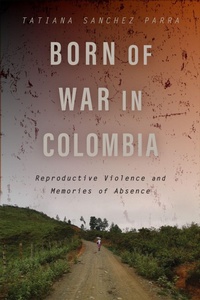
Born of War in Colombia
Reproductive Violence and Memories of Absence
Published on 12. April 2024
Book
Paperback/Softback
204 pages
978-1-9788-3246-6 (ISBN)
Description
Born of War in Colombia addresses why people born of conflict-related sexual violence remain unseen within transitional justice agendas. In Colombia, there are generations of children born of conflict-related sexual violence across the country. Whispers of their presence have traveled outside their communities. They also exist within the country's domestic reparations program, which entitles them to reparations. Drawing on an immersive feminist ethnography with a community that endured a paramilitary confinement, the book reveals how a past-oriented and harm-centered model of transitional justice has converged with a restricted notion of gendered victimhood and the patriarchal politics of reproduction to render the bodies and experiences of people born of conflict-related sexual violence unintelligible to those seeking to understand and address the consequences of war in Colombia.
Reviews / Votes
"In this detailed, carefully crafted ethnography, Sanchez Parra offers insights into the possibilities of transformative justice for children born of conflict-related sexual violence, as well as for their mothers who were forced to assume reproductive labor in the aftermath of rape. It lays out an understanding of past violence and its reproductive legacies, while also enumerating steps toward transformative justice measures for these children and their mothers. Sanchez Parra demonstrates the ways in which gendered expectations of care contribute to hegemonic maternal scripts that too frequently blame women for the sexual and reproductive violence they have survived." - Kimberly Theidon, MPH, PhD (Henry J. Leir professor in international humanitarian studies at Tufts University) "Tatiana Sanchez Parra untangles the layers of power that render persons born of war in Colombia as simultaneously hyper-visible and invisible at a moment of history that witnesses an unprecedented level of recognition of their victim status. Engaging in an ethnography of whispers, silences, and the unspoken, the author transcends the limitations and concealments of transitional justice in Colombia, directing the reader towards a more transformative approach, and advances research, policy, and theories of what it means to be exiled to the interstices of victim and perpetrator." - Erin Baines (associate professor, School of Public Policy and Global Affairs, the University of British Columbia)More details
Series
Language
English
Place of publication
New Brunswick NJ
United States
Target group
College/higher education
Professional and scholarly
Product notice
Paperback (trade)
Unsewn / adhesive bound
Illustrations
7 B-W images
Dimensions
Height: 227 mm
Width: 154 mm
Thickness: 12 mm
Weight
295 gr
ISBN-13
978-1-9788-3246-6 (9781978832466)
Copyright in bibliographic data and cover images is held by Nielsen Book Services Limited or by the publishers or by their respective licensors: all rights reserved.
Schweitzer Classification
Other editions
Additional editions
E-Book
04/2024
1st Edition
Rutgers University Press
€104.99
Available for download
Person
Tatiana Sanchez Parra is a Marie Sklodowksa-Curie Actions Fellow in the School of Social and Political Science at the University of Edinburgh.
Content
List of Illustrations
Introduction: Gendered Victimhood, Reproductive Violence, and Layers of Unintelligibility
1 Between Political Struggles: Gendered Victimhood and Unwanted Lives
2 The Bureaucracies of Victimhood in the Making: A Record of the Unintelligible and the Uncertain
3 Contested Identities: Reproductive Violence, Reproductive Labor, and War
4 Memories of Absence: Collective Reparations and Impossible Witnesses
Conclusion: Towards Futures of Reproductive Justice
Acknowledgements
Notes
Bibliography
Index
Introduction: Gendered Victimhood, Reproductive Violence, and Layers of Unintelligibility
1 Between Political Struggles: Gendered Victimhood and Unwanted Lives
2 The Bureaucracies of Victimhood in the Making: A Record of the Unintelligible and the Uncertain
3 Contested Identities: Reproductive Violence, Reproductive Labor, and War
4 Memories of Absence: Collective Reparations and Impossible Witnesses
Conclusion: Towards Futures of Reproductive Justice
Acknowledgements
Notes
Bibliography
Index