

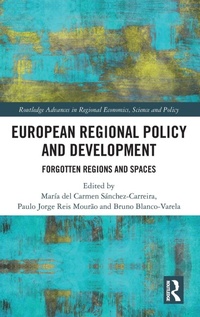
European Regional Policy and Development
Forgotten Regions and Spaces
1st Edition
Published on 18. July 2023
Book
Hardback
204 pages
978-1-032-18796-9 (ISBN)
Description
The shortcomings of traditional regional policies led to a major policy. Thus, regions have become more active in the design and implementation of policies, following a bottom-up approach and involving the participation of the local community in strategic planning, as opposed to the traditional top-down method. This book addresses regional development theories and policies, with a special focus on forgotten places, and raises emerging questions about recent theoretical advances, as well as trends and challenges in the field.
It examines two main and related issues: the crucial role of regional actors for development and the role of Forgotten Spaces. It emphasizes the spatial/territorial approaches from different theoretical perspectives, underlining place-based approaches and compares the experiences of both successful and failed cases, attempting to identify lessons and policy recommendations, as well as adding empirical evidence to this field. The different cases presented, which focus on Forgotten Spaces, allow the reader to assess the role of different actors for regional development as well as some sectoral approaches. While there is a clear focus on European countries with different geographical, institutional and sociocultural characteristics, the book also examines good and bad examples of regional development and policies related to forgotten places from different regions worldwide, including developed and developing countries.
The book benefits from contributions from over 20 authors from different nationalities, and a rich diversity of case studies, approaches and methods of discussion. The authors discuss practical examples and more complex theoretical approaches, involving techniques of spatial analysis, spatial econometrics, social networks, content analysis as well as regional planning techniques. The book will appeal to an interdisciplinary audience and will provide academicians, politicians, and policy designers with original and detailed analyses.
It examines two main and related issues: the crucial role of regional actors for development and the role of Forgotten Spaces. It emphasizes the spatial/territorial approaches from different theoretical perspectives, underlining place-based approaches and compares the experiences of both successful and failed cases, attempting to identify lessons and policy recommendations, as well as adding empirical evidence to this field. The different cases presented, which focus on Forgotten Spaces, allow the reader to assess the role of different actors for regional development as well as some sectoral approaches. While there is a clear focus on European countries with different geographical, institutional and sociocultural characteristics, the book also examines good and bad examples of regional development and policies related to forgotten places from different regions worldwide, including developed and developing countries.
The book benefits from contributions from over 20 authors from different nationalities, and a rich diversity of case studies, approaches and methods of discussion. The authors discuss practical examples and more complex theoretical approaches, involving techniques of spatial analysis, spatial econometrics, social networks, content analysis as well as regional planning techniques. The book will appeal to an interdisciplinary audience and will provide academicians, politicians, and policy designers with original and detailed analyses.
More details
Series
Language
English
Place of publication
London
United Kingdom
Publishing group
Taylor & Francis Ltd
Target group
College/higher education
Academic and Postgraduate
Illustrations
11 s/w Tabellen, 3 s/w Photographien bzw. Rasterbilder, 37 s/w Zeichnungen, 40 s/w Abbildungen
11 Tables, black and white; 37 Line drawings, black and white; 3 Halftones, black and white; 40 Illustrations, black and white
Dimensions
Height: 240 mm
Width: 161 mm
Thickness: 17 mm
Weight
502 gr
ISBN-13
978-1-032-18796-9 (9781032187969)
Copyright in bibliographic data and cover images is held by Nielsen Book Services Limited or by the publishers or by their respective licensors: all rights reserved.
Schweitzer Classification
Other editions
Additional editions
Maria del Carmen Sanchez-Carreira | Paulo Jorge Reis Mourao | Bruno Blanco-Varela
European Regional Policy and Development
Forgotten Regions and Spaces
Book
12/2024
1st Edition
Routledge
€63.10
Shipment within 10-20 days
Maria del Carmen Sanchez-Carreira | Paulo Jorge Reis Mourao | Bruno Blanco-Varela
European Regional Policy and Development
Forgotten Regions and Spaces
E-Book
07/2023
1st Edition
Routledge
€55.49
Available for download
Maria del Carmen Sanchez-Carreira | Paulo Jorge Reis Mourao | Bruno Blanco-Varela
European Regional Policy and Development
Forgotten Regions and Spaces
E-Book
07/2023
1st Edition
Routledge
€55.49
Available for download
Persons
Maria del Carmen Sanchez-Carreira is Associate Professor of Applied Economics at the University of Santiago de Compostela, Galicia, Spain.
Paulo Jorge Reis Mourao is Associate Professor in the Department of Economics, at the University of Minho, Braga, Portugal.
Bruno Blanco-Varela is Lecturer of Applied Economics at the University of Santiago de Compostela, Galicia, Spain.
Paulo Jorge Reis Mourao is Associate Professor in the Department of Economics, at the University of Minho, Braga, Portugal.
Bruno Blanco-Varela is Lecturer of Applied Economics at the University of Santiago de Compostela, Galicia, Spain.
Content
Introduction. Forgotten Spaces in the European Regional Policy and Development Part I: Regional Development and Policies in Europe: main theoretical advances and last trends and challenges 1. Comparative assessment of rural realities in the European Union: The main drivers of the rural population 2. Agglomeration of knowledge intensive activities and brain drain: global cities and forgotten regions across Europe. A case study with Spanish data Part II: Comparative analysis of regional experiences on forgotten spaces in Europe 3. How to make forgotten spaces visible? Image making as a coping strategy of two European small towns 4. Italian Inner areas' strategic plans: a textual network analysis of the Appennino Emiliano and Madonie case studies 5. Engaging with forgotten places: Applying a multifaceted understanding of place in an analysis of two Danish cases 6. Revitalizing forgotten spaces through local leadership and social entrepreneurial ecosystems: the case of Muszyna Commune 7. The specificity determinants of monetary and fiscal policy in the V4 countries. Comparative economics perspective 8. Public procurement as a transformative innovation policy instrument: urban rehabilitation in Malmoe Conclusions. Regional Policies, Development and Forgotten Spaces in Europe