

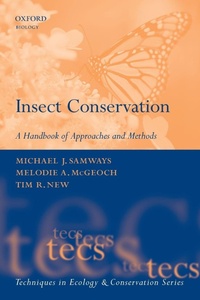
Insect Conservation
A Handbook of Approaches and Methods
Published on 26. November 2009
Book
Paperback/Softback
464 pages
978-0-19-929822-8 (ISBN)
Description
With up to a quarter of all insect species heading towards extinction over the next few decades, there is now a pressing need to summarize the techniques available for measuring insect diversity in order to develop effective conservation strategies.
Insect Conservation outlines the main methods and techniques available to entomologists, providing a comprehensive synthesis for use by graduate students, researchers and practising conservationists worldwide. Both modern and more 'traditional' methodologies are described, backed up by practical background information and a global range of examples. Many newer techniques are included which have not yet been described in the existing book literature.
This book will be particularly relevant to postgraduate and advanced undergraduate students taking courses in insect ecology, conservation biology and environmental management, as well as established researchers in these fields. It will also be a valuable reference for nature conservation practitioners and professional entomologists worldwide.
Insect Conservation outlines the main methods and techniques available to entomologists, providing a comprehensive synthesis for use by graduate students, researchers and practising conservationists worldwide. Both modern and more 'traditional' methodologies are described, backed up by practical background information and a global range of examples. Many newer techniques are included which have not yet been described in the existing book literature.
This book will be particularly relevant to postgraduate and advanced undergraduate students taking courses in insect ecology, conservation biology and environmental management, as well as established researchers in these fields. It will also be a valuable reference for nature conservation practitioners and professional entomologists worldwide.
Reviews / Votes
It should be on the bookshelf of every practising conservationist or environmental manager and will be a great source-book for undergraduates, postgraduates and established researchers.It will certainly be on the essential reading list of the MSc in Invertebrate Ecology and Conservation that we run at Staffordshire! * John W. Glover, Journal of Insect Conservation * This volume is a summary of how to approach insect conservation and its associated research from a rigorous scientific and statistical perspective.The authors have provided an excellent summary of experimental design, sampling techniques,specimen storage and data analysis.Although their intended audience is the early - career researcher, there is no doubt that seasoned scientists, managers and curators could benefit from this synthesis of important information. * Diane M. Debinski, Quarterly Review of Biology * Insect Conservation's greatest strength is its careful descriptions of field methods that no longer are commonly taught. * Ecology *More details
Series
Language
English
Place of publication
Oxford
United Kingdom
Target group
College/higher education
Professional and scholarly
Illustrations
60 line and 85 halftone illustrations
Dimensions
Height: 234 mm
Width: 156 mm
Thickness: 25 mm
Weight
690 gr
ISBN-13
978-0-19-929822-8 (9780199298228)
Copyright in bibliographic data and cover images is held by Nielsen Book Services Limited or by the publishers or by their respective licensors: all rights reserved.
Schweitzer Classification
Other editions
Additional editions
Michael J. Samways | Melodie A. McGeoch | Tim R. New
Insect Conservation
A Handbook of Approaches and Methods
Book
11/2009
Oxford University Press
€148.56
Shipment within 15-20 days
Persons
Michael Samways is Professor and Chair of the Department of Conservation Ecology and Entomology, Stellenbosch University. He has published widely in the field of insect conservation, and in recent years has been recipient of the Stellenbosch University Award for Research Excellence, the Senior Captain Scott Medal of the South African Academy of Sciences and Arts, the John Herschel Medal of the Royal Society of South Africa, and the Gold Medal of the Academy of Science of South Africa for this work. He continues to work with his team of dedicated research students and several international bodies towards putting insect conservation into practice both locally and globally.
Melodie A. McGeoch trained as an entomologist and received her PhD in insect community ecology and the use of insects as bioindicators. She has published across the fields of insect conservation, spatial ecology, biodiversity monitoring and assessment, and the impacts of biological invasion and climate change on biodiversity. After 12 years in an academic environment (at the Universities of Pretoria and Stellenbosch, South Africa), she recently joined South African National Parks to establish and head the Cape Research Node, responsible for providing science support and research direction to Fynbos, Succulent Karoo and Marine Protected Areas under the Node.
Tim New is an entomologist with wide interests in insect conservation, systematics and ecology and has published more than 400 reviewed papers/book chapters, and about 30 books. He is Professor of Zoology at La Trobe University, Melbourne. He serves/has served on a number of conservation advisory committees and editorial boards, and his work on insect conservation has been recognised by the Marsh Christian Trust Award for insect conservation (Royal Entomological Society) and the Henry Aates Award (Association for Tropical Lepidoptera) amongst others.
Melodie A. McGeoch trained as an entomologist and received her PhD in insect community ecology and the use of insects as bioindicators. She has published across the fields of insect conservation, spatial ecology, biodiversity monitoring and assessment, and the impacts of biological invasion and climate change on biodiversity. After 12 years in an academic environment (at the Universities of Pretoria and Stellenbosch, South Africa), she recently joined South African National Parks to establish and head the Cape Research Node, responsible for providing science support and research direction to Fynbos, Succulent Karoo and Marine Protected Areas under the Node.
Tim New is an entomologist with wide interests in insect conservation, systematics and ecology and has published more than 400 reviewed papers/book chapters, and about 30 books. He is Professor of Zoology at La Trobe University, Melbourne. He serves/has served on a number of conservation advisory committees and editorial boards, and his work on insect conservation has been recognised by the Marsh Christian Trust Award for insect conservation (Royal Entomological Society) and the Henry Aates Award (Association for Tropical Lepidoptera) amongst others.
Content
1. Introducing Insect Conservation ; 2. Taxonomy and Curation of Insects ; 3. Designing Sampling Protocols for Insect Conservation ; 4. Collecting and Recording Insects ; 5. Measuring Environmental Variables ; 6. Estimating Population Size and Condition ; 7. The Population and the Landscape ; 8. Ex Situ Conservation: Captive Rearing and Reintroduction Programmes ; 9. Biodiversity and Assemblage Studies ; 10. Studying Insects in the Changing Environment ; Useful software in insect ecology and conservation ; Glossary ; References ; Index