

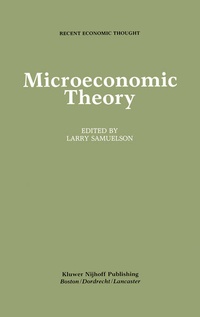
Microeconomic Theory
Published on 31. March 1986
Book
Hardback
XVIII, 278 pages
978-0-89838-170-2 (ISBN)
Description
It is often said that everyone understands precisely what is meant by the notion of probability-except those who have spent their lives studying the matter. Upon close scrutiny, the intuitively obvious idea of probability becomes quite elusive. Is it a subjective or objective concept? Are random variables simply improperly measured deterministic variables, or inherently random? What is meant by the phrase "other things held constant" that often appears in descriptions of probability? These questions involve fundamental philosophical and scientific issues, and promise to elude definitive answers for some time. The same type of difficulty arises when attempting to produce a volume on microeconomic theory. The obvious first question-what is microeconomic theory?--
More details
Series
Edition
1986 ed.
Language
English
Place of publication
Dordrecht
Netherlands
Target group
College/higher education
Professional and scholarly
Research
Illustrations
XVIII, 278 p.
Dimensions
Height: 241 mm
Width: 160 mm
Thickness: 21 mm
Weight
617 gr
ISBN-13
978-0-89838-170-2 (9780898381702)
DOI
10.1007/978-94-009-4219-6
Schweitzer Classification
Other editions
Additional editions
Content
1 Introduction: An Affirmative View of Microeconomic Theory.- 2 Alternatives to Expected Utility Theory for Risky Decisions.- 3 Consumer Learning and Optimal Pricing Strategies for Products of Unknown Quality.- 4 Rationality and Social Choice.- 5 Resolution of Paradoxes in Social Choice.- 6 The Demand Revealing Mechanism.- 7 The Design of Efficient Resource Allocation Mechanisms.- 8 The Theory of Bargaining.- 9 The Elements of Fixprice Microeconomics.- 10 Possibility Theorems, Incentives, and Progress in Economic Theory.- 11 Institutions as a Solution Concept in a Game Theory Context.- 12 The State of Microeconomics: An Historical Perspective.