

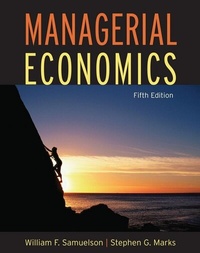
Managerial Economics
5th Edition
Published on 1. December 2005
Book
Hardback
912 pages
978-0-471-66362-1 (ISBN)
Description
The right tools to guide real decisions
When you're climbing a mountain, you have to carefully consider every step if you want to reach your goal. You need to know how your tools will actually perform on the mountain. It also helps to have a trusted guide who knows the way.
The same holds true in today's highly competitive, global business environments. The decisions managers make are more complex and critical than ever before. You need to understand how to use economic analysis techniques to make real business decisions.
When it comes to making real-life decisions based on sound economic analysis, there is no better guide than Samuelson and & Marks's Managerial Economics, 5th Edition. Featuring many detailed, real-world examples, as well as strong coverage of decision making under uncertainty, game theory, and international topics, this practical text equips you with the right tools you need to make smart decisions.
New in the Fifth Edition
* Updated and revised chapters on making decisions under uncertainty (Chapters 8 and 9).
* New discussions of behavioral economics, including such issues as bounded rationality, sunk-cost fallacies, decision-making heuristics and biases, and the winner's curse.
* Updated and expanded coverage of corporate incentives and governance.
* Incorporates new developments in the areas of technological change, network economies, and internet economics.
* Updated applications and revised end-of-chapter problems.
When you're climbing a mountain, you have to carefully consider every step if you want to reach your goal. You need to know how your tools will actually perform on the mountain. It also helps to have a trusted guide who knows the way.
The same holds true in today's highly competitive, global business environments. The decisions managers make are more complex and critical than ever before. You need to understand how to use economic analysis techniques to make real business decisions.
When it comes to making real-life decisions based on sound economic analysis, there is no better guide than Samuelson and & Marks's Managerial Economics, 5th Edition. Featuring many detailed, real-world examples, as well as strong coverage of decision making under uncertainty, game theory, and international topics, this practical text equips you with the right tools you need to make smart decisions.
New in the Fifth Edition
* Updated and revised chapters on making decisions under uncertainty (Chapters 8 and 9).
* New discussions of behavioral economics, including such issues as bounded rationality, sunk-cost fallacies, decision-making heuristics and biases, and the winner's curse.
* Updated and expanded coverage of corporate incentives and governance.
* Incorporates new developments in the areas of technological change, network economies, and internet economics.
* Updated applications and revised end-of-chapter problems.
More details
Edition
5., Auflage
Language
English
Place of publication
New York
United States
Publishing group
John Wiley and Sons Ltd
Target group
Professional and scholarly
Edition type
Revised edition
Illustrations
Illustrations
Dimensions
Height: 23.7 cm
Width: 19.5 cm
Thickness: 34 mm
Weight
1442 gr
ISBN-13
978-0-471-66362-1 (9780471663621)
Schweitzer Classification
Other editions
Previous edition

William F. Samuelson | Stephen G. Marks
Managerial Economics
Book
04/2002
4th Edition
Wiley
€57.90
Article exhausted; check for reprint
Persons
William F. Samuelson is professor of economics and finance at Boston University School of Management. He received his B.A. and Ph.D. from Harvard University. His research interests include game theory, decision theory, bidding, bargaining, and experimental economics. He has published a variety of articles in leading economics and management science journals including The American Economic Review, the Quarterly Journal of Economics, Econometrica, the Journal of Finance, Management Science, and Operations Research. His teaching and research have been sponsored by the National Science Foundation and the National Institute for Dispute resolution, among others. He is currently on the editorial boards of the Journal of Economic Behavior and Organization and Group Decision and Negotiation.
Stephen G. Marks is associate professor of law at Boston University. He received his J.D., M.A., and Ph.D. from the University of California-Berkeley. He has taught in the areas of managerial economics, finance, corporate law, and securities regulation. his research interests include corporate governance, law and economics, finance, and information theory. He has published his research in various law reviews and in such journals as the American Economic Review, The Journal of Legal Studies, and The Journal of Financial and Quantitative Analysis.
Stephen G. Marks is associate professor of law at Boston University. He received his J.D., M.A., and Ph.D. from the University of California-Berkeley. He has taught in the areas of managerial economics, finance, corporate law, and securities regulation. his research interests include corporate governance, law and economics, finance, and information theory. He has published his research in various law reviews and in such journals as the American Economic Review, The Journal of Legal Studies, and The Journal of Financial and Quantitative Analysis.
Content
Ch 1: Introduction to Economic Decision Making
Ch 2: Optimal Decisions Using Marginal Analysis
Ch 3: Demand Analysis and Optimal Pricing
Ch 4: Estimating Demand
Ch 5: Forecasting
Ch 6: Production
Ch 7: Cost Analysis
Ch 8: Decision Making Under Certainty
Ch 9: The Value of Information
Ch 10: Perfect Competition
Ch 11: Monopoly
Ch 12: Oligopoly
Ch 13: Game Theory and Competitive Strategy
Ch 14: Regulation, Public Goods, and Benefit-Cost Analysis
Ch 15: Asymmetric Information and Organizational Design
Ch 16: Bargaining and Negotiation
Ch 17: Auctions and Competitive Bidding
Ch 18: Linear Programming
Ch 19: Capital Budgeting
Ch 2: Optimal Decisions Using Marginal Analysis
Ch 3: Demand Analysis and Optimal Pricing
Ch 4: Estimating Demand
Ch 5: Forecasting
Ch 6: Production
Ch 7: Cost Analysis
Ch 8: Decision Making Under Certainty
Ch 9: The Value of Information
Ch 10: Perfect Competition
Ch 11: Monopoly
Ch 12: Oligopoly
Ch 13: Game Theory and Competitive Strategy
Ch 14: Regulation, Public Goods, and Benefit-Cost Analysis
Ch 15: Asymmetric Information and Organizational Design
Ch 16: Bargaining and Negotiation
Ch 17: Auctions and Competitive Bidding
Ch 18: Linear Programming
Ch 19: Capital Budgeting