

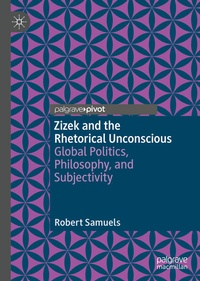
Zizek and the Rhetorical Unconscious
Global Politics, Philosophy, and Subjectivity
Published on 7. August 2020
Book
Hardback
V, 99 pages
978-3-030-50909-5 (ISBN)
Description
This book builds on a critique of Slavoj Zizek's work to outline a new theory of psychoanalytic rhetoric. It turns to Zizek because not only is he one of the most popular intellectuals in the world, but, this book argues, his discourse is shaped by a set of unconscious rhetorical processes that also determine much of contemporary politics, culture, and subjectivity. Just as Aristotle argued that the three main forms of persuasion are logos (reason), pathos (emotion), and ethos (authority), Samuels describes each one of these aspects of communication as related to a fundamental psychoanalytic concept. He also turns to Aristotle's work on theater to introduce a fourth form of rhetoric, catharsis, which is the purging of feelings of fear and pity.
Adding a strong voice to current psychoanalytic debate, this book will be of value to all scholars and students interested in both the history and modern developments of psychoanalytic theory.
Adding a strong voice to current psychoanalytic debate, this book will be of value to all scholars and students interested in both the history and modern developments of psychoanalytic theory.
More details
Edition
1st ed. 2020
Language
English
Place of publication
Cham
Switzerland
Publishing group
Springer International Publishing
Target group
Professional and scholarly
Illustrations
V, 99 p.
Dimensions
Height: 216 mm
Width: 153 mm
Thickness: 11 mm
Weight
263 gr
ISBN-13
978-3-030-50909-5 (9783030509095)
DOI
10.1007/978-3-030-50910-1
Schweitzer Classification
Other editions
Additional editions
E-Book
08/2020
Palgrave Macmillan
€64.19
Available for download
Person
Robert Samuels has doctorates in Psychoanalysis and English. He teaches advanced writing and rhetoric at the University of California, Santa Barbara, USA. He is the author of fifteen books, including
Freud for the Twenty-First Century
.
Content
1. Introduction.- 2. Catharsis: The Politics of Enjoyment.- 3. Pathos, Hysteria, and the Left.- 4. Ethos, Transference, and Liberal Cynicism.- 5. Logos, Global Justice, and the Reality Principle.- 6. Conclusion: Communism or Commonism.