

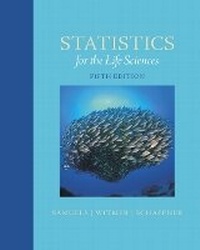
Statistics for the Life Sciences
5th Edition
Published on 9. February 2015
Book
Hardback
648 pages
978-0-321-98958-1 (ISBN)
Description
The Fifth Edition of Statistics for the Life Sciences uses authentic examples and exercises from a wide variety of life science domains to give statistical concepts personal relevance, enabling students to connect concepts with situations they will encounter outside the classroom. The emphasis on understanding ideas rather than memorizing formulas makes the text ideal for students studying a variety of scientific fields: animal science, agronomy, biology, forestry, health, medicine, nutrition, pharmacy, physical education, zoology and more. In the fifth edition, randomization tests have been moved to the fore to motivate the inference procedures introduced in the text. There are no prerequisites for the text except elementary algebra.
More details
Other editions
Previous edition
Myra L. Samuels | Jeffrey A. Witmer | Andrew Schaffner
Statistics for the Life Sciences
Book
01/2011
4th Edition
Pearson
€147.09
Article exhausted; check for reprint
Persons
Myra L. Samuels (late) was an Associate Professor of Biostatistics and Epidemiology in Purdue's Department of Veterinary Pathobiology and Associate Director of Statistical Consulting in the Department of Statistics. She received her PhD in Statistics from the University of California-Berkeley, under Jerzy Neyman, and taught at Purdue for 24 years. Her research was oriented toward issues in biostatistics and included both conceptual issues in mathematical statistics and collaborations on applications. Myra was a member of the American Statistical Association, the Biometric Society, and the Society for Clinical Trials. Dr. Samuels passed away in 1992.
Jeff Witmer is Professor of Mathematics at Oberlin College. He received his PhD in Statistics from the University of Minnesota and taught at the University of Florida before coming to Oberlin. He is a Fellow of the American Statistical Association and an elected member of the International Statistics Institute.
Andrew Schaffner is Professor of Statistics at California Polytechnic State University-San Luis Obispo and faculty statistician for the Environmental Biotechnology Institute. He received his PhD in Statistics from the University of Washington. His research involves statistical applications in environmental monitoring.
Jeff Witmer is Professor of Mathematics at Oberlin College. He received his PhD in Statistics from the University of Minnesota and taught at the University of Florida before coming to Oberlin. He is a Fellow of the American Statistical Association and an elected member of the International Statistics Institute.
Andrew Schaffner is Professor of Statistics at California Polytechnic State University-San Luis Obispo and faculty statistician for the Environmental Biotechnology Institute. He received his PhD in Statistics from the University of Washington. His research involves statistical applications in environmental monitoring.
Content
Table of Contents UNIT I: DATA AND DISTRIBUTIONS
Introduction
1.1 Statistics and the Life Sciences
1.2 Types of Evidence
1.3 Random Sampling
Description of Samples and Populations
2.1 Introduction
2.2 Frequency Distributions
2.3 Descriptive Statistics: Measures of Center
2.4 Boxplots
2.5 Relationships Between Variables
2.6 Measures of Dispersion
2.7 Effect of Transformation of Variables
2.8 Statistical Inference
2.9 Perspective
Probability and the Binomial Distribution
3.1 Probability and the Life Sciences
3.2 Introduction to Probability
3.3 Probability Rules (Optional)
3.4 Density Curves
3.5 Random Variables
3.6 The Binomial Distribution
3.7 Fitting a Binomial Distribution to Data (Optional)
The Normal Distribution
4.1 Introduction
4.2 The Normal Curves
4.3 Areas under a Normal Curve
4.4 Assessing Normality
4.5 Perspective
Sampling Distributions
5.1 Basic Ideas
5.2 The Sample Mean
5.3 Illustration of the Central Limit Theorem
5.4 The Normal Approximation to the Binomial Distribution
5.5 Perspective
Unit I Highlights and Study
UNIT II: INFERENCE FOR MEANS
Confidence Intervals
6.1 Statistical Estimation
6.2 Standard Error of the Mean
6.3 Confidence Interval for ?
6.4 Planning a Study to Estimate ?
6.5 Conditions for Validity of Estimation Methods
6.6 Comparing Two Means
6.7 Confidence Interval for (?1 - ?2)
6.8 Perspective and Summary
Comparison of Two Independent Samples
7.1 Hypothesis Testing: The Randomization Test
7.2 Hypothesis Testing: The t Test
7.3 Further Discussion of the t Test
7.4 Association and Causation
7.5 One-Tailed t Tests
7.6 More on Interpretation of Statistical Significance
7.7 Planning for Adequate Power
7.8 Student's t: Conditions and Summary
7.9 More on Principles of Testing Hypotheses
7.10 The Wilcoxon-Mann-Whitney Test
Comparison of Paired Samples
8.1 Introduction
8.2 The Paired-Sample t Test and Confidence Interval
8.3 The Paired Design
8.4 The Sign Test
8.5 The Wilcoxon Signed-Rank Test
8.6 Perspective
Unit II Highlights and Study
UNIT III: INFERENCE FOR CATEGORICAL DATA
Categorical Data: One-Sample Distributions
9.1 Dichotomous Observations
9.2 Confidence Interval for a Population Proportion
9.3 Other Confidence Levels (Optional)
9.4 Inference for Proportions: The Chi-Square Goodness-of-Fit Test
9.5 Perspective and Summary
Categorical Data: Relationships
10.1 Introduction
10.2 The Chi-Square Test for the 2 x 2 Contingency Table
10.3 Independence and Association in the 2 x 2 Contingency Table
10.4 Fisher's Exact Test
10.5 The r x k Contingency Table
10.6 Applicability of Methods
10.7 Confidence Interval for Difference Between Probabilities
10.8 Paired Data and 2 x 2 Tables
10.9 Relative Risk and the Odds Ratio
10.10 Summary of Chi-Square Test
Unit III Highlights and Study
UNIT IV: MODELING RELATIONSHIPS
Comparing the Means of Many Independent Samples
11.1 Introduction
11.2 The Basic One-Way Analysis of Variance
11.3 The Analysis of Variance Model
11.4 The Global F Test
11.5 Applicability of Methods
11.6 One-Way Randomized Blocks Design
11.7 Two-Way ANOVA
11.8 Linear Combinations of Means
11.9 Multiple Comparisons
11.10 Perspective
Linear Regression and Correlation
12.1 Introduction
12.2 The Correlation Coefficient
12.3 The Fitted Regression Line
12.4 Parametric Interpretation of Regression: The Linear Model
12.5 Statistical Inference Concerning ?1
12.6 Guidelines for Interpreting Regression and Correlation
12.7 Precision in Prediction
12.8 Perspective
12.9 Summary of Formulas
Unit IV Highlights and Study
A Summary of Inference Methods
13.1 Introduction
13.2 Data Analysis Examples
Chapter Appendices Chapter Notes Statistical Tables Answers to Selected Exercises
Introduction
1.1 Statistics and the Life Sciences
1.2 Types of Evidence
1.3 Random Sampling
Description of Samples and Populations
2.1 Introduction
2.2 Frequency Distributions
2.3 Descriptive Statistics: Measures of Center
2.4 Boxplots
2.5 Relationships Between Variables
2.6 Measures of Dispersion
2.7 Effect of Transformation of Variables
2.8 Statistical Inference
2.9 Perspective
Probability and the Binomial Distribution
3.1 Probability and the Life Sciences
3.2 Introduction to Probability
3.3 Probability Rules (Optional)
3.4 Density Curves
3.5 Random Variables
3.6 The Binomial Distribution
3.7 Fitting a Binomial Distribution to Data (Optional)
The Normal Distribution
4.1 Introduction
4.2 The Normal Curves
4.3 Areas under a Normal Curve
4.4 Assessing Normality
4.5 Perspective
Sampling Distributions
5.1 Basic Ideas
5.2 The Sample Mean
5.3 Illustration of the Central Limit Theorem
5.4 The Normal Approximation to the Binomial Distribution
5.5 Perspective
Unit I Highlights and Study
UNIT II: INFERENCE FOR MEANS
Confidence Intervals
6.1 Statistical Estimation
6.2 Standard Error of the Mean
6.3 Confidence Interval for ?
6.4 Planning a Study to Estimate ?
6.5 Conditions for Validity of Estimation Methods
6.6 Comparing Two Means
6.7 Confidence Interval for (?1 - ?2)
6.8 Perspective and Summary
Comparison of Two Independent Samples
7.1 Hypothesis Testing: The Randomization Test
7.2 Hypothesis Testing: The t Test
7.3 Further Discussion of the t Test
7.4 Association and Causation
7.5 One-Tailed t Tests
7.6 More on Interpretation of Statistical Significance
7.7 Planning for Adequate Power
7.8 Student's t: Conditions and Summary
7.9 More on Principles of Testing Hypotheses
7.10 The Wilcoxon-Mann-Whitney Test
Comparison of Paired Samples
8.1 Introduction
8.2 The Paired-Sample t Test and Confidence Interval
8.3 The Paired Design
8.4 The Sign Test
8.5 The Wilcoxon Signed-Rank Test
8.6 Perspective
Unit II Highlights and Study
UNIT III: INFERENCE FOR CATEGORICAL DATA
Categorical Data: One-Sample Distributions
9.1 Dichotomous Observations
9.2 Confidence Interval for a Population Proportion
9.3 Other Confidence Levels (Optional)
9.4 Inference for Proportions: The Chi-Square Goodness-of-Fit Test
9.5 Perspective and Summary
Categorical Data: Relationships
10.1 Introduction
10.2 The Chi-Square Test for the 2 x 2 Contingency Table
10.3 Independence and Association in the 2 x 2 Contingency Table
10.4 Fisher's Exact Test
10.5 The r x k Contingency Table
10.6 Applicability of Methods
10.7 Confidence Interval for Difference Between Probabilities
10.8 Paired Data and 2 x 2 Tables
10.9 Relative Risk and the Odds Ratio
10.10 Summary of Chi-Square Test
Unit III Highlights and Study
UNIT IV: MODELING RELATIONSHIPS
Comparing the Means of Many Independent Samples
11.1 Introduction
11.2 The Basic One-Way Analysis of Variance
11.3 The Analysis of Variance Model
11.4 The Global F Test
11.5 Applicability of Methods
11.6 One-Way Randomized Blocks Design
11.7 Two-Way ANOVA
11.8 Linear Combinations of Means
11.9 Multiple Comparisons
11.10 Perspective
Linear Regression and Correlation
12.1 Introduction
12.2 The Correlation Coefficient
12.3 The Fitted Regression Line
12.4 Parametric Interpretation of Regression: The Linear Model
12.5 Statistical Inference Concerning ?1
12.6 Guidelines for Interpreting Regression and Correlation
12.7 Precision in Prediction
12.8 Perspective
12.9 Summary of Formulas
Unit IV Highlights and Study
A Summary of Inference Methods
13.1 Introduction
13.2 Data Analysis Examples
Chapter Appendices Chapter Notes Statistical Tables Answers to Selected Exercises