

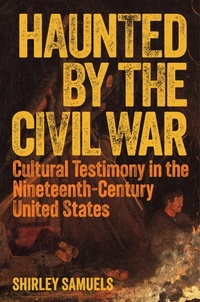
Haunted by the Civil War
Cultural Testimony in the Nineteenth-Century United States
Will be published approx. on 28. October 2025
Book
Hardback
232 pages
978-0-691-24857-8 (ISBN)
Description
How the legacy of the Civil War-as presented by writers, poets, and artists of the time-has shaped American visions of democracy
In Haunted by the Civil War, Shirley Samuels explores the work of Walt Whitman, Emily Dickinson, Herman Melville, Frederick Douglass, Charlotte Perkins Gilman, and others to investigate the long cultural shadow of America's cataclysmic sundering. Juxtaposing these texts with images-ranging from paintings by Winslow Homer to newspaper and magazine illustrations of political controversies-Samuels argues that the Civil War still haunts our attitudes toward democracy. The recent toppling of Confederate monuments, the continuing protests over racial and sexual discrimination, immigration, and Indigenous land rights: each of these forms part of the war's legacy.
Examining the fraught deliberations about an ideal American democracy in the early republic, Samuels turns to the language of sensation in the poetry of Melville, Dickinson, and Whitman alongside Lincoln's relation to the poetic and visual culture of his time. She considers the haunted afterlives of war in the work of Louisa May Alcott and Harriet Beecher Stowe as well as in popular nineteenth-century inspirational fiction. And she investigates the literature of men at sea (and on rivers, enabling both connection and escape), as seen in Melville and Mark Twain, while examining women's wartime work and experience, in writings by Gilman and Frances Harper.
Why does the Civil War still haunt us? To find the answer, Samuels identifies not only the ghosts that cannot rest but also the cultural practices that name them.
In Haunted by the Civil War, Shirley Samuels explores the work of Walt Whitman, Emily Dickinson, Herman Melville, Frederick Douglass, Charlotte Perkins Gilman, and others to investigate the long cultural shadow of America's cataclysmic sundering. Juxtaposing these texts with images-ranging from paintings by Winslow Homer to newspaper and magazine illustrations of political controversies-Samuels argues that the Civil War still haunts our attitudes toward democracy. The recent toppling of Confederate monuments, the continuing protests over racial and sexual discrimination, immigration, and Indigenous land rights: each of these forms part of the war's legacy.
Examining the fraught deliberations about an ideal American democracy in the early republic, Samuels turns to the language of sensation in the poetry of Melville, Dickinson, and Whitman alongside Lincoln's relation to the poetic and visual culture of his time. She considers the haunted afterlives of war in the work of Louisa May Alcott and Harriet Beecher Stowe as well as in popular nineteenth-century inspirational fiction. And she investigates the literature of men at sea (and on rivers, enabling both connection and escape), as seen in Melville and Mark Twain, while examining women's wartime work and experience, in writings by Gilman and Frances Harper.
Why does the Civil War still haunt us? To find the answer, Samuels identifies not only the ghosts that cannot rest but also the cultural practices that name them.
More details
Language
English
Place of publication
New Jersey
United States
Product notice
Trade binding
Illustrations
18 b/w illus.
Dimensions
Height: 164 mm
Width: 244 mm
Thickness: 23 mm
Weight
478 gr
ISBN-13
978-0-691-24857-8 (9780691248578)
Copyright in bibliographic data and cover images is held by Nielsen Book Services Limited or by the publishers or by their respective licensors: all rights reserved.
Schweitzer Classification
Other editions
Additional editions
E-Book
10/2025
1st Edition
Princeton University Press
€30.99
Available for download
Person
Shirley Samuels is the Thomas and Dorothy Litwin Professor of American Studies at Cornell University. She is the author of Facing America: Iconography and the Civil War and Romances of the Republic: Women, the Family, and Violence in the Literature of the Early American Nation.