

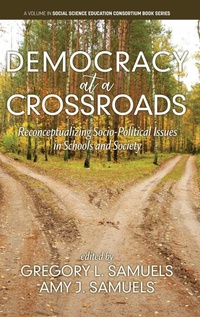
Democracy at a Crossroads
ReconceptualizingSocio-Political Issues in Schools and Society
Published on 4. June 2019
Book
Hardback
262 pages
978-1-64113-717-1 (ISBN)
Description
At a time of questionable civility in American politics, democratic education appears to be at a crossroads. As we consider how to best explore democracy and foster a more civically-engaged populace in the current socio-political context, it is critical to examine what frames our educational systems, policies, and practices and shapes our civic identity. While teachers struggle with decreased instructional time for social studies and the demands of standardized tests, the social sciences are often pushed to the margins. Reflecting on how to negotiate local, state, national, and global tensions related to policy and practice, educators work to do what is best to equip students to foster democratic citizenship and ideals.
Social sciences educators are uniquely positioned to embrace a journey that upholds democratic ideals of equality, freedom, and justice, while simultaneously critiquing inequity and injustice in schools and our society. The contributors to this volume situate a variety of discussions within the context of the crossroads and explore how to negotiate, translate, and reconceptualize our own beliefs and positionings in ways that positively influence and empower students, teachers, teacher educators, and education policy makers. Studies are presented related to civic education, cross-cultural interpretations, emotional citizenship, international economics, and race-consciousness, as well as those that discuss how to challenge dominant narratives and negotiate educational policies and practices.
Social sciences educators are uniquely positioned to embrace a journey that upholds democratic ideals of equality, freedom, and justice, while simultaneously critiquing inequity and injustice in schools and our society. The contributors to this volume situate a variety of discussions within the context of the crossroads and explore how to negotiate, translate, and reconceptualize our own beliefs and positionings in ways that positively influence and empower students, teachers, teacher educators, and education policy makers. Studies are presented related to civic education, cross-cultural interpretations, emotional citizenship, international economics, and race-consciousness, as well as those that discuss how to challenge dominant narratives and negotiate educational policies and practices.
More details
Series
Language
English
Place of publication
Charlotte
United States
Publishing group
Emerald Publishing Inc
Target group
Professional and scholarly
Dimensions
Height: 240 mm
Width: 161 mm
Thickness: 19 mm
Weight
561 gr
ISBN-13
978-1-64113-717-1 (9781641137171)
Copyright in bibliographic data and cover images is held by Nielsen Book Services Limited or by the publishers or by their respective licensors: all rights reserved.
Schweitzer Classification
Other editions
Additional editions
Gregory L. Samuels
Democracy at a Crossroads
Reconceptualizing Socio-Political Issues in Schools and Society
E-Book
01/2019
1st Edition
Information Age Publishing
from
€62.33
Available for download
Persons
Gregory L. Samuels, University of Montevallo
Amy J. Samuels, University of Montevallo
Amy J. Samuels, University of Montevallo
Content
Introduction; Gregory L. Samuels and Amy Samuels.
Acknowledgments.
Chapter 1. School Choice Policies in Democratic Societies: Localizing the Tensions; Laura K. Handler, and Tracy C. Rock.
Chapter 2. Conflict, Teachers, and High-Stakes Testing in Civic Education; Joshua Carey.
Chapter 3. Seeing Civics Through Visual Representations in Kindergarten Classrooms: A Cross-National Study; Ilene R. Berson, Michael J. Berson, Joyce Esi Bronteng, and Aaron Osafo-Acquah.
Chapter 4. Teachers at the Crossroads of Democracy: A Case Study of Elementary Civic Education; Tina L. Heafner and Jessica Norwood.
Chapter 5. (Re)Considering the Holocaust: Sensitive Content as a Vehicle for Emotional Citizenship; Brandon J. Haas.
Chapter 6. Remembering What We Would Rather Forget: Examining Counter-Monuments in the United States and Germany; Sara B. Demoiny and Stewart Waters.
Chapter 7. Assessing Curricular Bias: Student Resistance and the Transformative Classroom; M. Nickie Coomer, Robin G. Jackson, and Tammera S. Moore.
Chapter 8. Heritage Not Hate? Crossroads Between Racial Ideologies and Teaching; Jacob S. Bennett.
Chapter 9. The Earthquake and the Aftershock: An Autoethnography; Crista K. Banks.
Chapter 10. Will Donald Trump Knock Our School Down if He Doesn't Like It? Creating and Teaching Civics Curriculum in Contentious Times; William Toledo.
Chapter 11. A Threat to Democracy in the Era of Trump, A New Phenomenon? Confronting and Knowing Democracy Through Social Studies Instruction in Elementary School Classrooms; Michael D. Bartone.
Chapter 12. Democracy, International Economics, and Current United States Trade Policy: What Citizens Need to Know; James E. Davis.
Chapter 13. Summation and Reflection-At the Crossroads: The Democratic Journey; Charles S. White.
About the Editors.
About the Contributors.
Acknowledgments.
Chapter 1. School Choice Policies in Democratic Societies: Localizing the Tensions; Laura K. Handler, and Tracy C. Rock.
Chapter 2. Conflict, Teachers, and High-Stakes Testing in Civic Education; Joshua Carey.
Chapter 3. Seeing Civics Through Visual Representations in Kindergarten Classrooms: A Cross-National Study; Ilene R. Berson, Michael J. Berson, Joyce Esi Bronteng, and Aaron Osafo-Acquah.
Chapter 4. Teachers at the Crossroads of Democracy: A Case Study of Elementary Civic Education; Tina L. Heafner and Jessica Norwood.
Chapter 5. (Re)Considering the Holocaust: Sensitive Content as a Vehicle for Emotional Citizenship; Brandon J. Haas.
Chapter 6. Remembering What We Would Rather Forget: Examining Counter-Monuments in the United States and Germany; Sara B. Demoiny and Stewart Waters.
Chapter 7. Assessing Curricular Bias: Student Resistance and the Transformative Classroom; M. Nickie Coomer, Robin G. Jackson, and Tammera S. Moore.
Chapter 8. Heritage Not Hate? Crossroads Between Racial Ideologies and Teaching; Jacob S. Bennett.
Chapter 9. The Earthquake and the Aftershock: An Autoethnography; Crista K. Banks.
Chapter 10. Will Donald Trump Knock Our School Down if He Doesn't Like It? Creating and Teaching Civics Curriculum in Contentious Times; William Toledo.
Chapter 11. A Threat to Democracy in the Era of Trump, A New Phenomenon? Confronting and Knowing Democracy Through Social Studies Instruction in Elementary School Classrooms; Michael D. Bartone.
Chapter 12. Democracy, International Economics, and Current United States Trade Policy: What Citizens Need to Know; James E. Davis.
Chapter 13. Summation and Reflection-At the Crossroads: The Democratic Journey; Charles S. White.
About the Editors.
About the Contributors.