

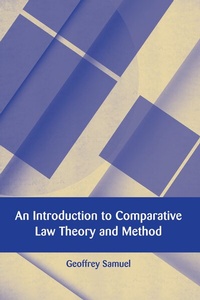
An Introduction to Comparative Law Theory and Method
1st Edition
Published on 29. May 2014
Book
Paperback/Softback
232 pages
978-1-84946-643-1 (ISBN)
Description
This short book on comparative law theory and method is designed primarily for postgraduate research students whose work involves comparison between legal systems. It is, accordingly, a book on research methods, although it will also be of relevance to all students (undergraduate and postgraduate) taking courses in comparative law and to academics entering the field of comparison. The substance of the book has been developed over many years of teaching general theory of comparative law, primarily on the European Academy of Legal Theory programme in Brussels but also on other programmes in French, Belgian and English universities. It is arguable that there has been to date no single introductory work exclusively devoted to comparative law methodology and thus this present book aims to fill this gap.
Reviews / Votes
This is an ambitious project by Geoffrey Samuel and one that hopefully exposes more scholars and students to the variety of methodological and theoretical approaches of comparative law and comparative legal theory...The potential methodological framework through the ten dichotomies in the concluding remarks provides an excellent road map for issues that researchers should keep in mind when embarking on a comparative legal theory project...For those who are in the target audience and are interested in questions about comparative law and legal theory, this text should be a welcome resource. -- Allyson C. Yankle * Law and Politics Book Review * This volume is...a recapitulation of the reflection carried out by one of the most renowned, critical and thoughtful scholars in the field...this book is certainly a must read. -- Emma Patrignani * The Rabel Journal of Comparative and International Private Law * The author provides a short introduction to various models by which law is conceptualised, mostly by works of jurisprudence and sociology of law, from the rule model to the system model, and the fundamental dichotomies dividing them, showing how problematic it is to subscribe to any of them. (...) As comparative law studies move onward, the map that Samuel unfolds on the table will have to be expanded, but without it much would not be known, understood or perhaps even noticed. -- Michele Graziadei * Zeitschrift fur Europaisches Privatrecht *More details
Series
Language
English
Place of publication
Oxford
United Kingdom
Publishing group
Bloomsbury Publishing PLC
Target group
College/higher education
Professional and scholarly
Product notice
Hardback (stationery)
Dimensions
Height: 232 mm
Width: 152 mm
Thickness: 14 mm
Weight
360 gr
ISBN-13
978-1-84946-643-1 (9781849466431)
Copyright in bibliographic data and cover images is held by Nielsen Book Services Limited or by the publishers or by their respective licensors: all rights reserved.
Schweitzer Classification
Other editions
Additional editions
Geoffrey Samuel
An Introduction to Comparative Law Theory and Method
E-Book
12/2014
1st Edition
Hart Publishing
€30.99
Available for download
Geoffrey Samuel
An Introduction to Comparative Law Theory and Method
E-Book
12/2014
1st Edition
Hart Publishing
€30.99
Available for download
Person
Geoffrey Samuel, MA, LLB, PhD (Cantab), Dr (Maastricht) Dr (honoris causa) (Nancy 2), has been Professor of Law at Kent Law School since 1997 and is a Professor affilie in the Ecole de Droit, Sciences-Po, Paris since 2012. He is, or has been, a Visiting professor at the Universities of Dijon, Nancy, Paris I and Paris II, Zaragoza, Sciences-Po, Lille, Bordeaux, Littoral, Fribourg, Auckland, Corsica and Aix-en-Provence.
Content
1. Problems and Promises of Comparative Law
2. Asking the Right Question
3. What is 'Comparison'?
4. Functional Method
5. Alternatives to Functionalism
6. Structural Method
7. Hermeneutical Method
8. What is 'Law' (1)?
9. What is Law (2)?
10. Paradigm Orientations
2. Asking the Right Question
3. What is 'Comparison'?
4. Functional Method
5. Alternatives to Functionalism
6. Structural Method
7. Hermeneutical Method
8. What is 'Law' (1)?
9. What is Law (2)?
10. Paradigm Orientations