

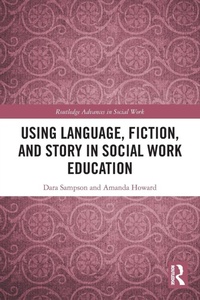
Using Language, Fiction, and Story in Social Work Education
1st Edition
Published on 6. May 2025
Book
Paperback/Softback
164 pages
978-1-032-07775-8 (ISBN)
Description
This book provides an accessible, research-informed text for social work educators, students, and practitioners interested in the use of story to engender the connection of human experiences with ideas, theories, and skills. A broad lens is also taken to the ways in which fiction has been used as a teaching tool in other degrees, ranging from medicine to engineering to philosophy and economics. Although the research explored is social work specific, this text has applicability for any educator looking for creative methods to teach complex theories, skills, and concepts.
Showing how fiction can be used in social work education, it explains why story matters to social work and how fiction can emulate these stories, as well as the capacity of fiction to evoke empathy. Ways in which educators can enlist fiction to create a 'safe space' for the exploration of complex emotional terrain are explored, as are the ways in which a community of practice can be created through fiction.
Woven within the end of every chapter are some practice examples and author conversations which work to locate the research into a practice context. The text concludes with examples of how fiction has been effectively utilised by the authors, in order to provide a starting point for those interested in exploring this pedagogical approach further.
Showing how fiction can be used in social work education, it explains why story matters to social work and how fiction can emulate these stories, as well as the capacity of fiction to evoke empathy. Ways in which educators can enlist fiction to create a 'safe space' for the exploration of complex emotional terrain are explored, as are the ways in which a community of practice can be created through fiction.
Woven within the end of every chapter are some practice examples and author conversations which work to locate the research into a practice context. The text concludes with examples of how fiction has been effectively utilised by the authors, in order to provide a starting point for those interested in exploring this pedagogical approach further.
Reviews / Votes
Stories are powerful. They connect us with emotions, can create meaning and purpose, and help us remember and engage more effectively with information than other forms of learning. In this book, stories and storytelling take us on a journey of discovery in social work education and practice. The authors expertly and thoughtfully weave complex themes around the development of empathy, pedagogy, the mobilisation of thoughtful clinical and reflective skills, and integration of research into an engaging narrative that encourages the reader to rethink the learning experience. A must read for anyone remotely interested in teaching, learning, and connecting with others through fiction. Book clubs will never be the same again!Professor Frances Kay-Lambkin
Director Hunter Medical Research Institute
As a social work educator who has also previously taught with the authors, it has been fascinating to observe this journey. I highly recommend not only this book, but this teaching approach. The text invites us to engage with the complexities of social work, including a critical examination of the ways we traditionally teach and assess social work competence. I intend implementing many of their ideas.
Professor Milena Heinsch
Head of Discipline, Social Work
University of Tasmania
This book is a unique contribution to the scholarship of social work education. It allows us to explore in depth the connection between storytelling, reading both individually and collectively, and the development of empathy as a core social work skill and trait. This book will support social work academics and educators in their ongoing work to develop professionals suited to working with our most vulnerable peoples.
Reviewer 1 from peer-review process
More details
Series
Language
English
Place of publication
London
United Kingdom
Publishing group
Taylor & Francis Ltd
Target group
College/higher education
Postgraduate
Illustrations
1 s/w Abbildung, 1 s/w Zeichnung
1 Line drawings, black and white; 1 Illustrations, black and white
Dimensions
Height: 234 mm
Width: 156 mm
Thickness: 10 mm
Weight
278 gr
ISBN-13
978-1-032-07775-8 (9781032077758)
Copyright in bibliographic data and cover images is held by Nielsen Book Services Limited or by the publishers or by their respective licensors: all rights reserved.
Schweitzer Classification
Other editions
Additional editions
Dara Sampson | Amanda Howard
Using Language, Fiction, and Story in Social Work Education
E-Book
12/2023
1st Edition
Taylor & Francis
€60.49
Available for download
Dara Sampson | Amanda Howard
Using Language, Fiction, and Story in Social Work Education
E-Book
12/2023
1st Edition
Taylor & Francis
€60.49
Available for download
Dara Sampson | Amanda Howard
Using Language, Fiction, and Story in Social Work Education
Book
12/2023
1st Edition
Routledge
€207.20
Shipment within 10-20 days
Persons
Dara Sampson, PhD, is a senior research fellow in the School of Medicine and Public Health, University of Newcastle. She has worked as both a social worker and senior leader in Commonwealth government and taught social work at the University of Newcastle and University of Sydney. Her PhD topic was an exploration of the use of fiction in social work education, bringing together her commitment to social work and her love of words.
Amanda Howard, Professor, is part of the Social Work and Policy Studies team at the University of Sydney and is the director of Undergraduate Programs. Areas of research include community development, disasters and climate change, inclusion, and participatory action research.
Amanda Howard, Professor, is part of the Social Work and Policy Studies team at the University of Sydney and is the director of Undergraduate Programs. Areas of research include community development, disasters and climate change, inclusion, and participatory action research.
Content
1.The background and how this book began. 2.How are stories being used in teaching? 3.I just don't like this book. 4.Language, power, and social work. 5.The safe space of fiction. 6.Empathy, story, and power. 7.Imprinting our own story. 8.A community of fiction. 9.Teaching social work with fiction. 10.What did we learn about reading fiction and social work? 11.Which fiction? 12.The transformative power of fiction. 13.Ten reasons fiction deepens social work education. Appendix.