


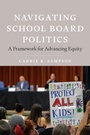
Navigating School Board Politics
A Framework for Advancing Equity
Published on 30. November 2024
Book
Paperback/Softback
240 pages
978-1-68253-937-8 (ISBN)
Description
A visionary overview of the political role of publicly elected school boards and a proactive take on the work they can accomplish toward social justice
In Navigating School Board Politics, Carrie R. Sampson examines the political power of the US education system's publicly elected school boards, the reality of how they apply that power, and the resounding impact of their governance. The work makes the case that school boards, as both the direct link between local communities and school districts, and the political conduits between school districts and state and federal policymakers, can be driving forces to diminish inequities in public education.
Sampson begins with a historical overview of the role of school boards in the United States. She shows that, despite the recent ideological deadlocks publicized as "school board wars," board members can accomplish vital work as advocates for their communities: forming effective coalitions with superintendents, administrators, and community leaders; scrutinizing budgets that represent millions of dollars of public investment; and maintaining a deep understanding of local issues.
The work highlights the School Board Governance for Equity framework, an evidence-based set of principles that current and prospective board members can adopt to advance social justice in their districts. Through case studies, Sampson demonstrates that equity-focused school board governance requires a collective effort: just as elected board members must maintain awareness of structural inequities and provide representation for marginalized community members, community members must speak up at board meetings and vote for both equity-focused candidates and equitable policies and practices.
In Navigating School Board Politics, Carrie R. Sampson examines the political power of the US education system's publicly elected school boards, the reality of how they apply that power, and the resounding impact of their governance. The work makes the case that school boards, as both the direct link between local communities and school districts, and the political conduits between school districts and state and federal policymakers, can be driving forces to diminish inequities in public education.
Sampson begins with a historical overview of the role of school boards in the United States. She shows that, despite the recent ideological deadlocks publicized as "school board wars," board members can accomplish vital work as advocates for their communities: forming effective coalitions with superintendents, administrators, and community leaders; scrutinizing budgets that represent millions of dollars of public investment; and maintaining a deep understanding of local issues.
The work highlights the School Board Governance for Equity framework, an evidence-based set of principles that current and prospective board members can adopt to advance social justice in their districts. Through case studies, Sampson demonstrates that equity-focused school board governance requires a collective effort: just as elected board members must maintain awareness of structural inequities and provide representation for marginalized community members, community members must speak up at board meetings and vote for both equity-focused candidates and equitable policies and practices.
More details
Language
English
Place of publication
Cambridge
United States
Target group
Professional and scholarly
Dimensions
Height: 229 mm
Width: 152 mm
ISBN-13
978-1-68253-937-8 (9781682539378)
Copyright in bibliographic data and cover images is held by Nielsen Book Services Limited or by the publishers or by their respective licensors: all rights reserved.
Schweitzer Classification
Other editions
Additional editions
E-Book
11/2024
Harvard Education Press
€29.49
Available for download