

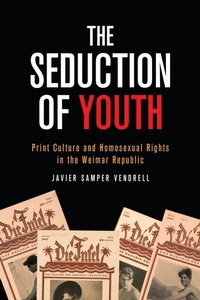
The Seduction of Youth
Print Culture and Homosexual Rights in the Weimar Republic
Published on 6. April 2020
Book
Paperback/Softback
280 pages
978-1-4875-2503-3 (ISBN)
Description
A simple man from the provinces, Friedrich Radszuweit merged popular culture, consumerism, and politics as the leader of the League for Human Rights, Germany's first mass homosexual organization. The Seduction of Youth is the first study to focus on the League and its leader, using his position at the centre of the Weimar-era gay rights movement to tease out the diverging political strategies and contradictory tactics that distinguished the movement.
By examining news articles and opinion pieces, as well as literary texts and photographs in the League's numerous pulp magazines for homosexuals, Javier Samper Vendrell reconstructs forgotten aspects of the history of same-sex desire and subjectivity. While recognizing the possibilities of liberal rights for sexual freedom during the Weimar Republic, the League's "respectability politics" failed in part because Radszuweit's own publications contributed to the idea that homosexual men were considered a threat to youth, doing little to change the views of the many people who believed in homosexual seduction - a homophobic trope that endured well into the twentieth century.
By examining news articles and opinion pieces, as well as literary texts and photographs in the League's numerous pulp magazines for homosexuals, Javier Samper Vendrell reconstructs forgotten aspects of the history of same-sex desire and subjectivity. While recognizing the possibilities of liberal rights for sexual freedom during the Weimar Republic, the League's "respectability politics" failed in part because Radszuweit's own publications contributed to the idea that homosexual men were considered a threat to youth, doing little to change the views of the many people who believed in homosexual seduction - a homophobic trope that endured well into the twentieth century.
Reviews / Votes
"Not only has Samper Vendrell written a book that is potentially generative of new histories of this moment, but his dexterity in handling the difficult themes of youth, consent, and abuse in the context of homosexual emancipation will also undoubtably serve as a model for future studies."- Christopher Ewing, Virginia Commonwealth University (H-German) "In this concise and conceptually elegant study, Javier Samper Vendrell examines the ideas, business enterprises, advocacy, and organizing work of Friedrich Radszuweit, a leading figure in the Weimar homosexual rights movement."
- Edward Dickinson, University of California, Davis (H-Soz-Kult) "This book deserves a wide readership, for beyond its methodological lessons for historians it offers astute insight into the fragile advantages and serious limitations of a politicking grounded in superficial visibility and respectability and that continues to dominate mainstream queer organizations amidst a reactionary storm rumbling across North America." (Journal of History) "The book represents a valuable addition to recent studies of the politics of respectability in the first homosexual emancipation movement." - Andrea Rottmann, Freie Universitaet Berlin (Journal of the History of Sexuality)
More details
Series
Language
English
Place of publication
Toronto
Canada
Target group
College/higher education
Professional and scholarly
Product notice
Paperback (trade)
Illustrations
14 b&w illustrations
Dimensions
Height: 227 mm
Width: 149 mm
Thickness: 17 mm
Weight
412 gr
ISBN-13
978-1-4875-2503-3 (9781487525033)
Copyright in bibliographic data and cover images is held by Nielsen Book Services Limited or by the publishers or by their respective licensors: all rights reserved.
Schweitzer Classification
Person
Javier Samper Vendrell is an assistant professor of German and core faculty in the Program in Gender, Sexuality, and Women's Studies at the University of Pennsylvania.
Content
Dedication
Acknowledgements
Introduction
1. Theories of Adolescent Sexuality and Homosexual Seduction
2. The League for Human Rights, Print Culture, and Homosexual Rights
3. The Allure of Youth in the League for Human Rights' Publications
4. The 1926 Trash and Smut Law, Youth Protection, and Homosexual Publications
5. The Pitfalls of Boy Love
6. Male Prostitution, Age of Consent, and the Decriminalization of Homosexuality
Conclusion: The Seduction of Youth, Respectability, and the End of Weimar's Homosexual Rights Movement
Endnotes
Bibliography
Acknowledgements
Introduction
1. Theories of Adolescent Sexuality and Homosexual Seduction
2. The League for Human Rights, Print Culture, and Homosexual Rights
3. The Allure of Youth in the League for Human Rights' Publications
4. The 1926 Trash and Smut Law, Youth Protection, and Homosexual Publications
5. The Pitfalls of Boy Love
6. Male Prostitution, Age of Consent, and the Decriminalization of Homosexuality
Conclusion: The Seduction of Youth, Respectability, and the End of Weimar's Homosexual Rights Movement
Endnotes
Bibliography