

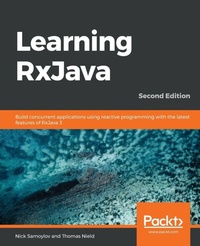
Learning RxJava
Build concurrent applications using reactive programming with the latest features of RxJava 3
2nd Edition
Published on 28. February 2020
Book
Paperback/Softback
412 pages
978-1-78995-015-1 (ISBN)
Description
Updated with the latest Maven coordinates, Java programming features, and API changes, this book is your guide to solving problems in writing asynchronous and event-based programs
Key Features
Explore a variety of tools and techniques used to solve problems in implementing concurrency and parallelization
Learn about core operators in RxJava that enable you to express your code logic productively
Apply RxJava with Kotlin to create responsive Android apps with better user experience
Book DescriptionRxJava is not just a popular library for building asynchronous and event-based applications; it also enables you to create a cleaner and more readable code base. In this book, you'll cover the core fundamentals of reactive programming and learn how to design and implement reactive libraries and applications.
Learning RxJava will help you understand how reactive programming works and guide you in writing your first example in reactive code. You'll get to grips with the workings of Observable and Subscriber, and see how they are used in different contexts using real-world use cases. The book will also take you through multicasting and caching to help prevent redundant work with multiple Observers. You'll then learn how to create your own RxJava operators by reusing reactive logic. As you advance, you'll explore effective tools and libraries to test and debug RxJava code. Finally, you'll delve into RxAndroid extensions and use Kotlin features to streamline your Android apps.
By the end of this book, you'll become proficient in writing reactive code in Java and Kotlin to build concurrent applications, including Android applications.What you will learn
Discover different ways to create Observables, Observers, and Subscribers
Multicast in order to push data to multiple destinations and cache and replay them
Express RxJava idiomatically with the help of Kotlin features such as extension functions and data classes
Become familiar with various operators available in RxJava to perform common transformations and tasks
Explore RxJava's reactive types, including Flowable, Single, Maybe, and Completable
Demystify Observables and how they express data and events as sequences
Who this book is forThis book is for Java developers who want to leverage reactive programming to develop more resilient and concurrent applications. If you're an RxJava user looking to get to grips with the latest features and updates in RxJava 3, this book is for you. Fundamental knowledge of core Java features and object-oriented programming will assist you in understanding the key concepts covered in this book.
Key Features
Explore a variety of tools and techniques used to solve problems in implementing concurrency and parallelization
Learn about core operators in RxJava that enable you to express your code logic productively
Apply RxJava with Kotlin to create responsive Android apps with better user experience
Book DescriptionRxJava is not just a popular library for building asynchronous and event-based applications; it also enables you to create a cleaner and more readable code base. In this book, you'll cover the core fundamentals of reactive programming and learn how to design and implement reactive libraries and applications.
Learning RxJava will help you understand how reactive programming works and guide you in writing your first example in reactive code. You'll get to grips with the workings of Observable and Subscriber, and see how they are used in different contexts using real-world use cases. The book will also take you through multicasting and caching to help prevent redundant work with multiple Observers. You'll then learn how to create your own RxJava operators by reusing reactive logic. As you advance, you'll explore effective tools and libraries to test and debug RxJava code. Finally, you'll delve into RxAndroid extensions and use Kotlin features to streamline your Android apps.
By the end of this book, you'll become proficient in writing reactive code in Java and Kotlin to build concurrent applications, including Android applications.What you will learn
Discover different ways to create Observables, Observers, and Subscribers
Multicast in order to push data to multiple destinations and cache and replay them
Express RxJava idiomatically with the help of Kotlin features such as extension functions and data classes
Become familiar with various operators available in RxJava to perform common transformations and tasks
Explore RxJava's reactive types, including Flowable, Single, Maybe, and Completable
Demystify Observables and how they express data and events as sequences
Who this book is forThis book is for Java developers who want to leverage reactive programming to develop more resilient and concurrent applications. If you're an RxJava user looking to get to grips with the latest features and updates in RxJava 3, this book is for you. Fundamental knowledge of core Java features and object-oriented programming will assist you in understanding the key concepts covered in this book.
More details
Edition
2nd Revised edition
Language
English
Place of publication
Birmingham
United Kingdom
Target group
Professional and scholarly
US School Grade: College Graduate Student
Edition type
Revised edition
Dimensions
Height: 235 mm
Width: 191 mm
Thickness: 23 mm
Weight
766 gr
ISBN-13
978-1-78995-015-1 (9781789950151)
Copyright in bibliographic data and cover images is held by Nielsen Book Services Limited or by the publishers or by their respective licensors: all rights reserved.
Schweitzer Classification
Other editions
Additional editions
Nick Samoylov | Thomas Nield
Learning RxJava
Build concurrent applications using reactive programming with the latest features of RxJava 3
E-Book
09/2024
2nd Edition
Packt Publishing
€23.49
Available for download
Persons
Nick Samoylov graduated from Moscow Institute of Physics and Technology, working as a theoretical physicist and learning to program as a tool for testing his mathematical models. After the demise of the USSR, Nick created and successfully ran a software company, but was forced to close it under the pressure of governmental and criminal rackets. In 1999, with his wife Luda and two daughters, he emigrated to the USA and has been living in Colorado since then, working as a Java programmer. In his free time, Nick likes to write and hike in the Rocky Mountains. Thomas Nield is a business consultant for Southwest Airlines in Schedule Initiatives, and a maintainer for RxJavaFX and RxKotlin. Early in his career, he became fascinated with technology and its role in business analytics. After becoming proficient in Java, Kotlin, Python, SQL, and reactive programming, he became an open source contributor and an author/speaker at O'Reilly Media. He is passionate about sharing what he learns and enabling others with new skill sets. He enjoys making technical content relatable and relevant to those unfamiliar with it or who are intimidated by it. He is interested in data science, reactive programming, and the Kotlin language.
He has also authored the book Getting Started with SQL, by O'Reilly Media.
He has also authored the book Getting Started with SQL, by O'Reilly Media.
Content
Table of Contents
Thinking Reactively
Observable and Observer
Basic Operators
Combining Observables
Multicasting, Replaying, and Caching
Concurrency and Parallelization
Switching, Throttling, Windowing, and Buffering
Flowables and Backpressure
Transformers and Custom Operators
Testing and Debugging
RxJava on Android
Using RxJava for Kotlin
Appendix A: Introducing Lambda Expressions
Appendix B: Functional Types
Appendix C: Mixing Object-Oriented and Reactive Programming
Appendix D: Materializing and Dematerializing
Appendix E: Understanding Schedulers
Thinking Reactively
Observable and Observer
Basic Operators
Combining Observables
Multicasting, Replaying, and Caching
Concurrency and Parallelization
Switching, Throttling, Windowing, and Buffering
Flowables and Backpressure
Transformers and Custom Operators
Testing and Debugging
RxJava on Android
Using RxJava for Kotlin
Appendix A: Introducing Lambda Expressions
Appendix B: Functional Types
Appendix C: Mixing Object-Oriented and Reactive Programming
Appendix D: Materializing and Dematerializing
Appendix E: Understanding Schedulers